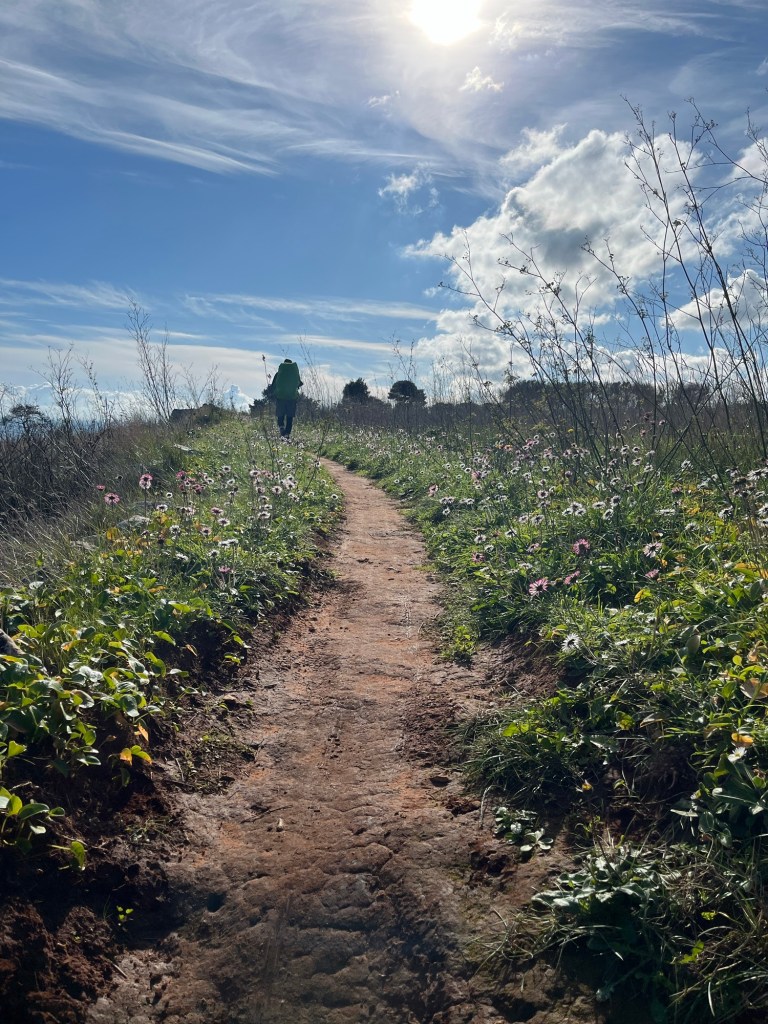
Highlights – the coastal path, surrounded by flowers, and overlooking the sea. More very colourful buildings.
After passing through the town of Marritima, it is largely a quiet day to ourselves, along country roads, rocky paths, and the scenic stretches along the clifftop. We see very few people, though some locals are out enjoying this beautiful stretch of the pathway.
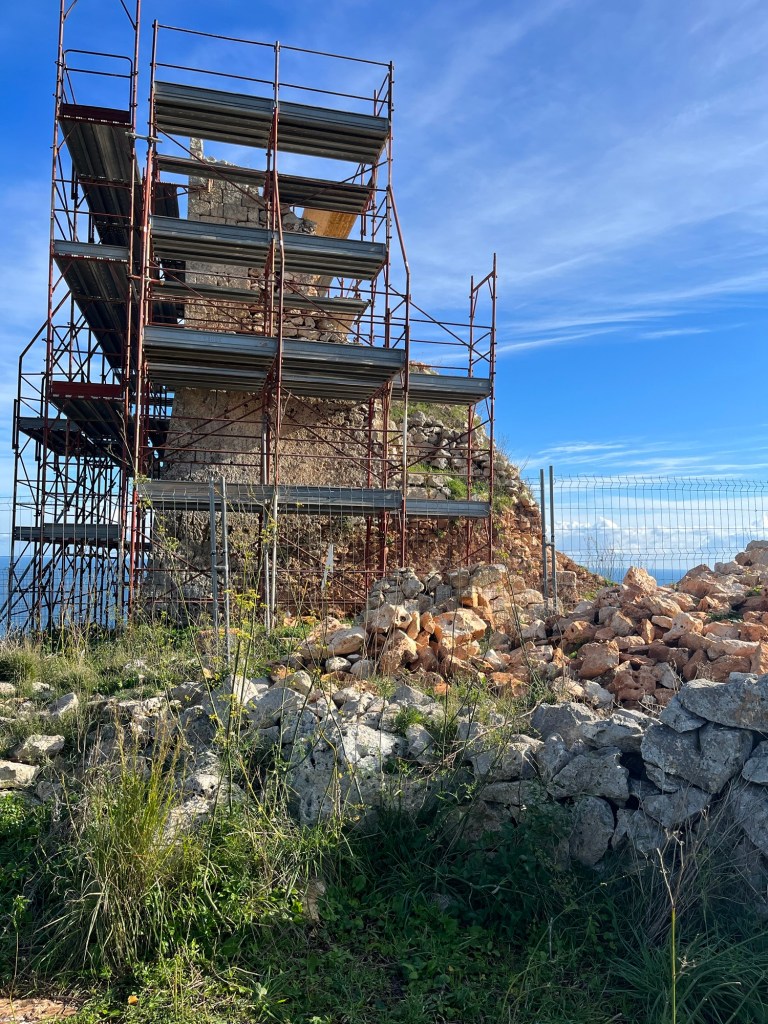
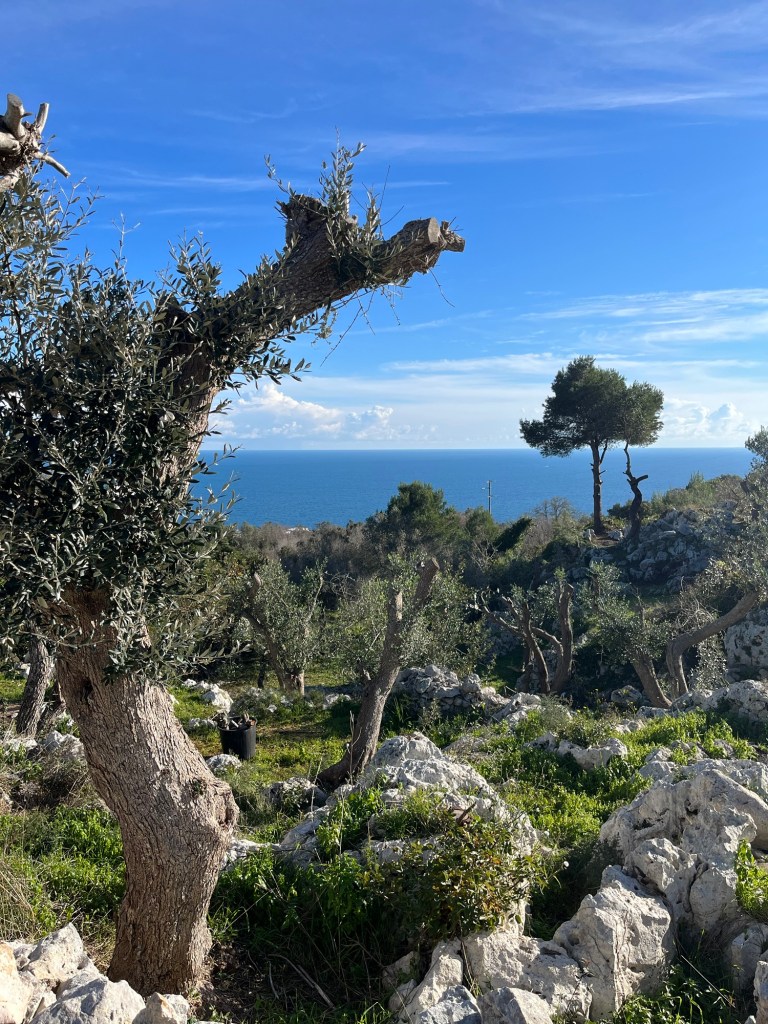
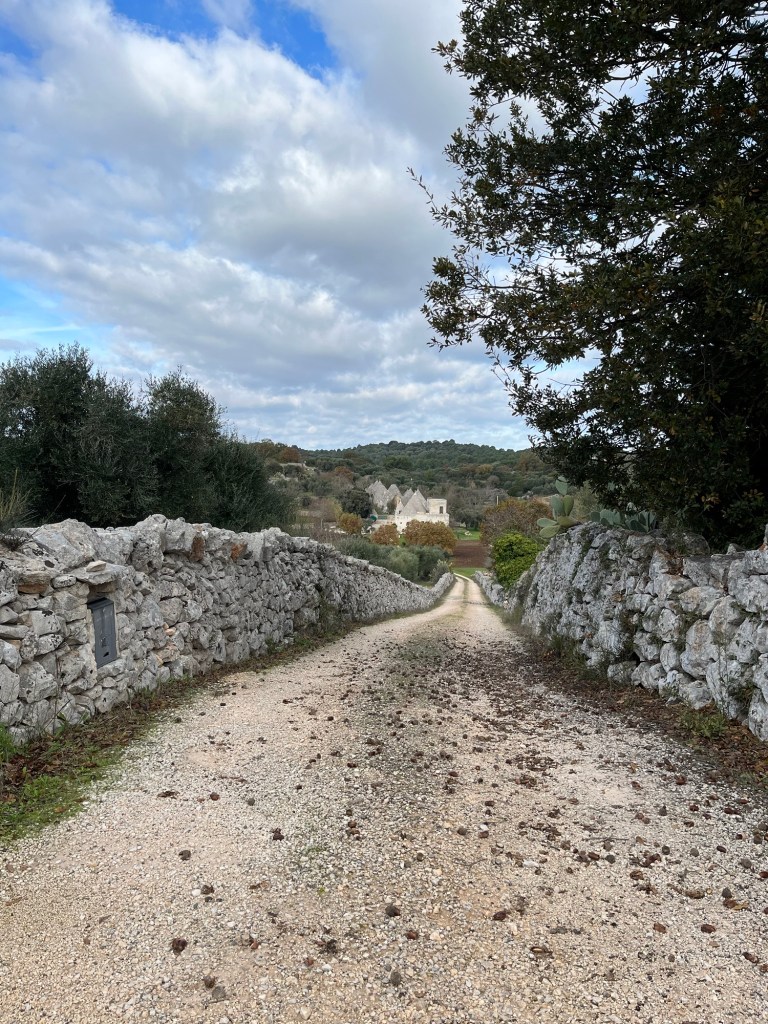
Today, we are in no rush. We stop for a leisurely lunch break by a pajare with an outstanding view along the coastline, go slightly off track amongst the gum trees to see the crumbling tower, and eventually emerge at the turn off away from the sea and towards Tricase.
This stretch heading inland is a bit busier with cars, and you can tell we are not locals – they just keep on walking, trusting, paying no attention to the cars, whereas we stop and step out of the way of each vehicle.
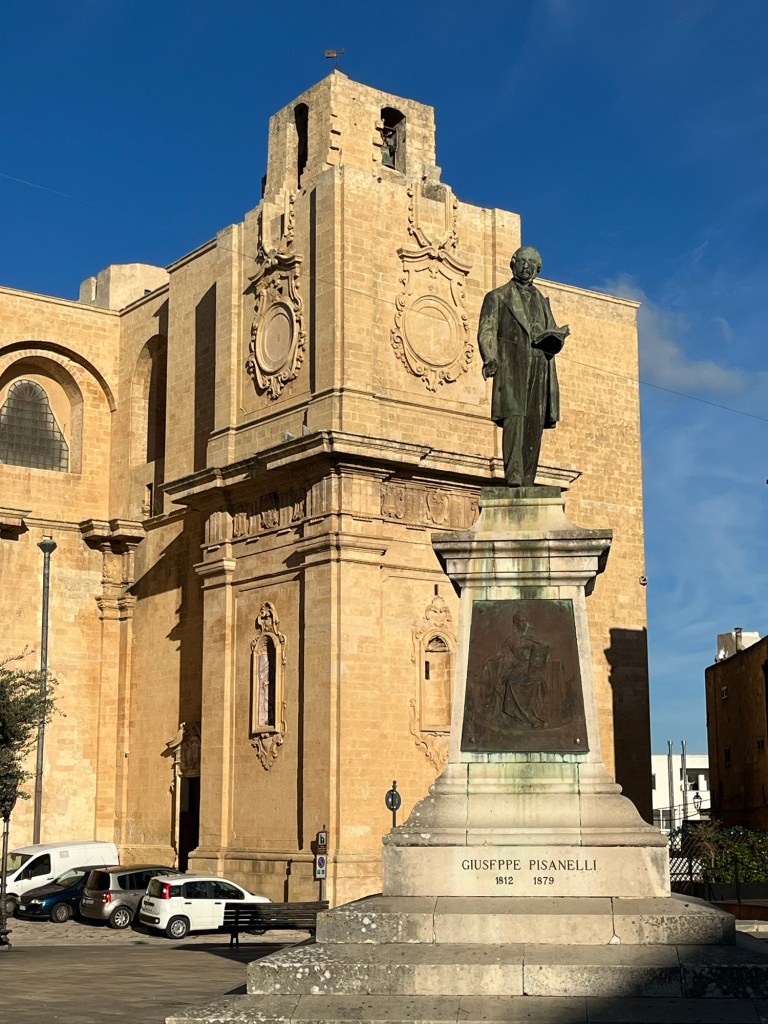
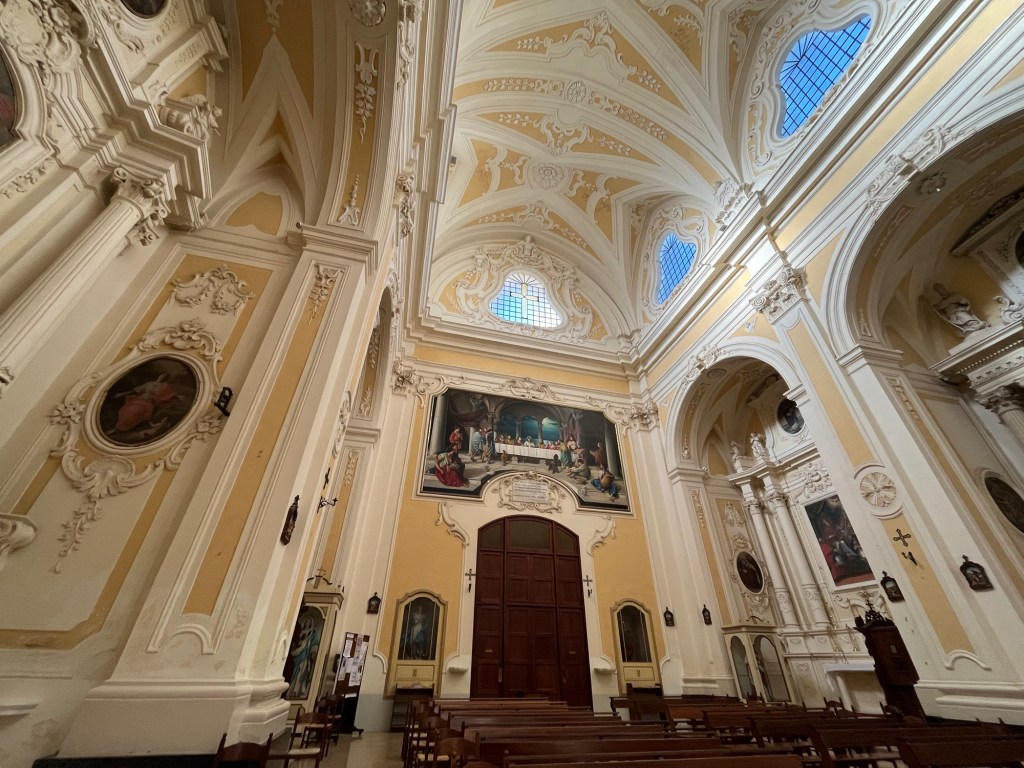
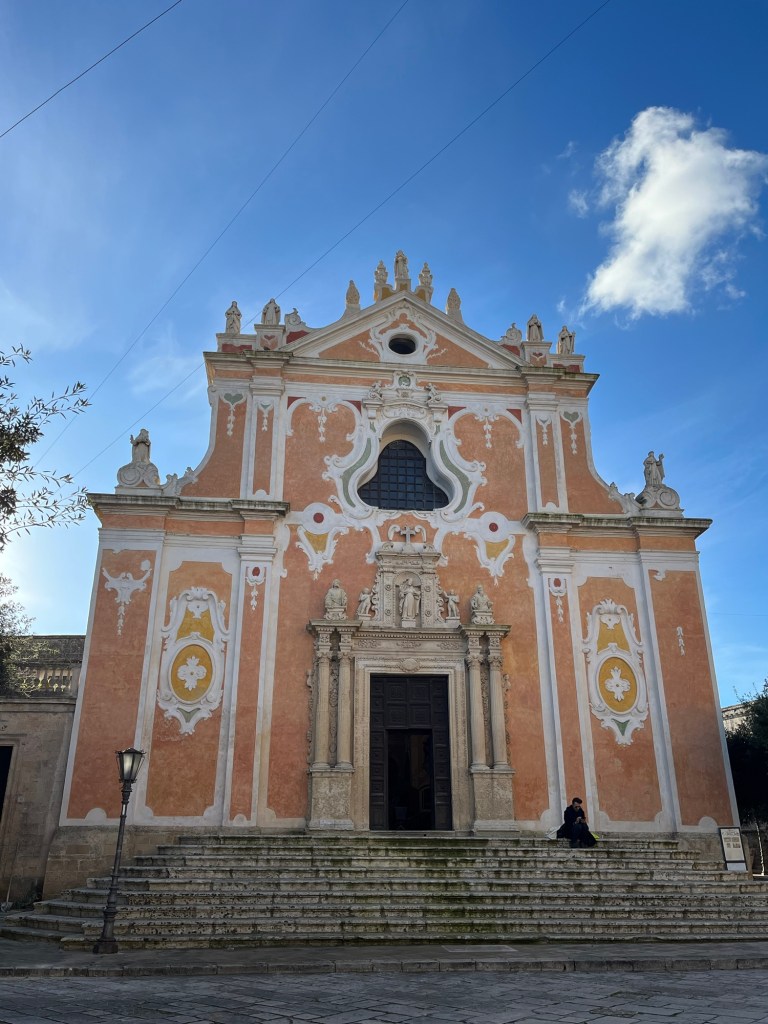
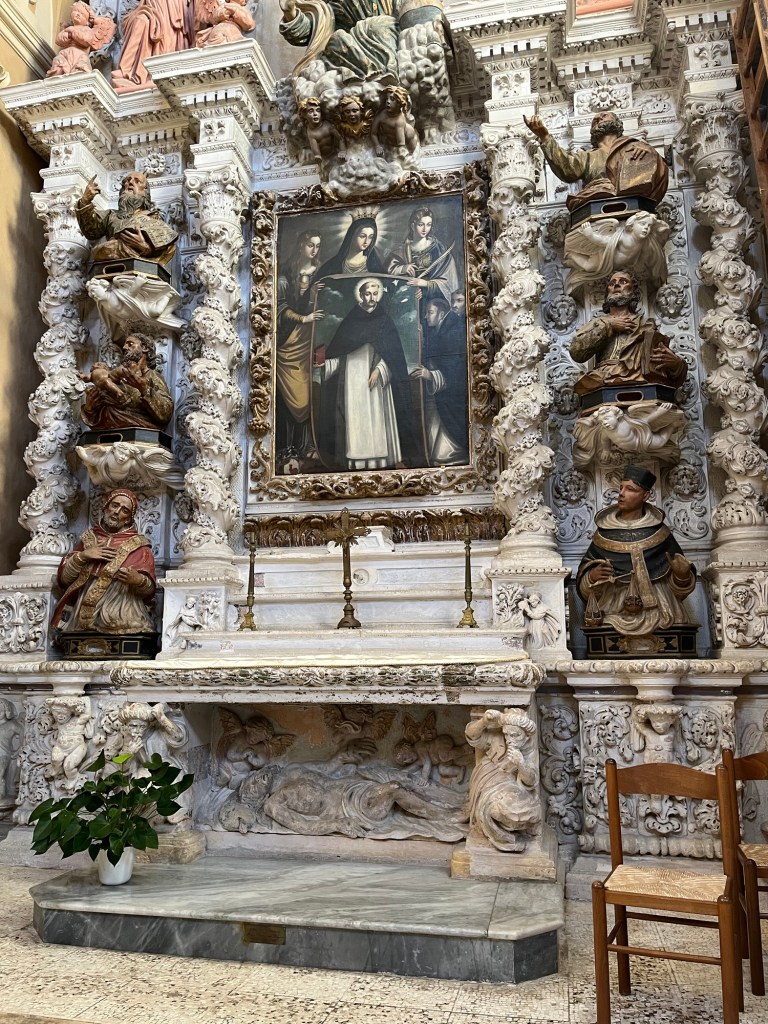
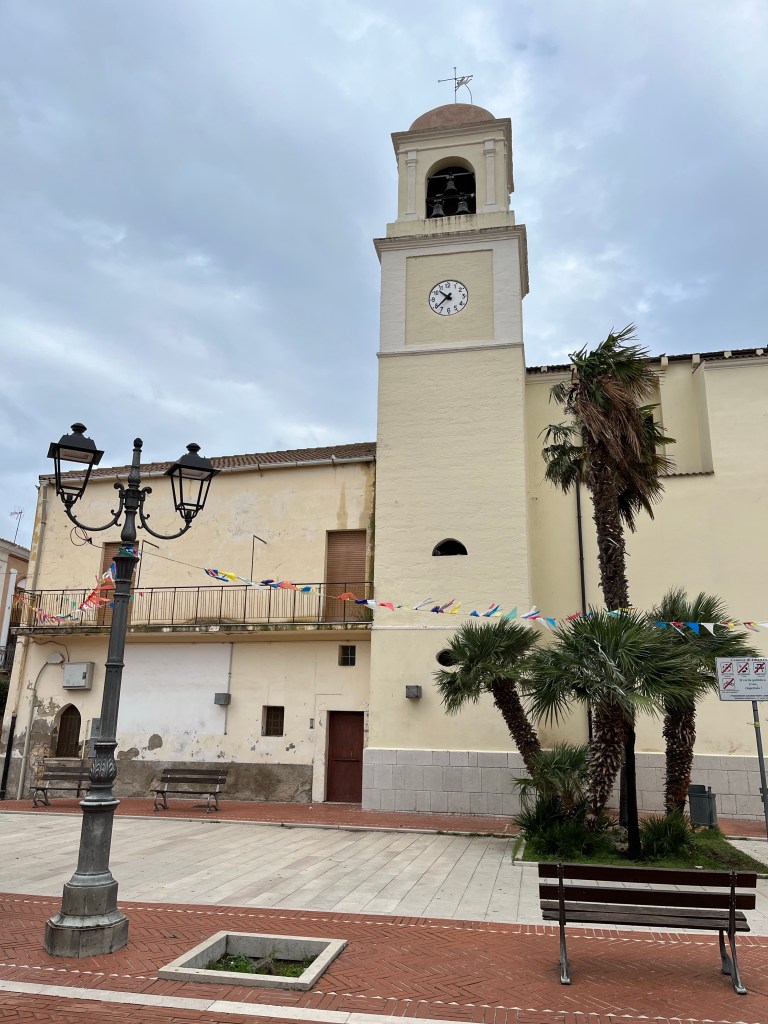
On reaching the outskirts of Tricase, it is a climb up to arrive at the spectacular Piazza Giuseppe Pisanelli, home to la Chiesa Parrocchiale della Nativita and la Chiesa di San Domenico
From there, it is a bit of a slog through the streets to our home for night, opposite the train station.
Stay and eat – Hotel Adriatico, as recommended in the guidebook. A very comfortable room at a good price at this time of year, with their restaurant just across the road, and a really good breakfast to see us on our way the following morning.
20kms, on a range of country lanes, quiet roads, and paths. 6.5 hours.
11deg, clear/cloud cover.
Quite a few small ups and downs, then a descent down to the plain from the valley. Well marked; Followed the green arrows and continued to use the Alltrails app as needed.
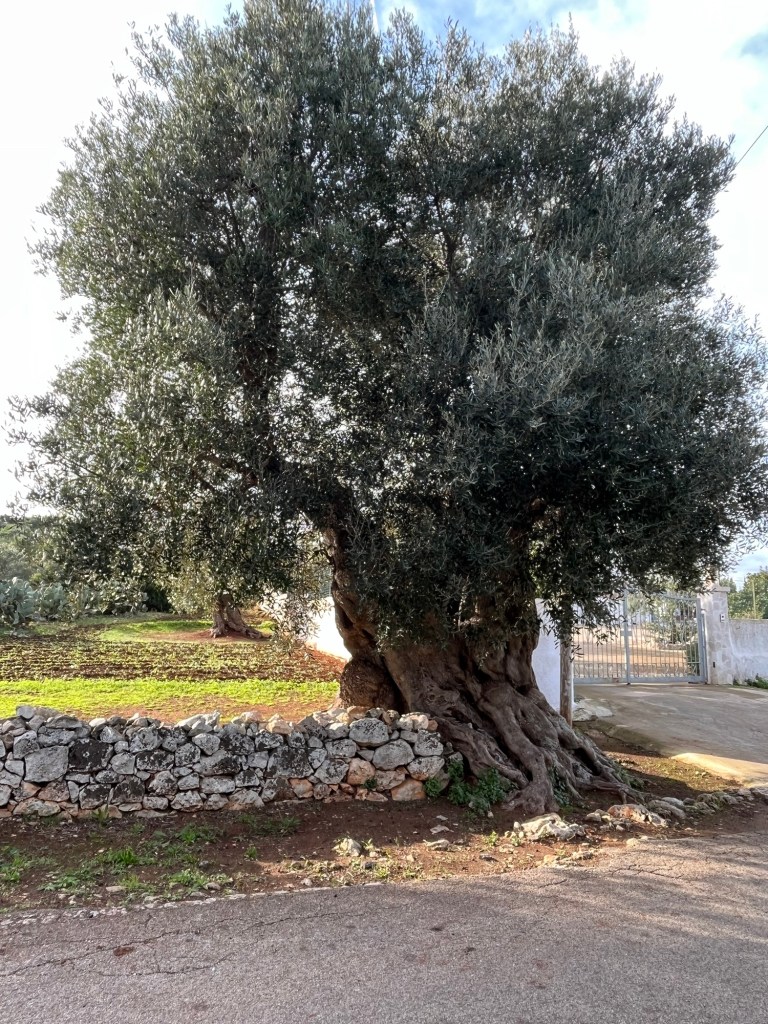
Highlight – the ancient olive trees.
Another gorgeous day on this trail, except for one issue. But first …
Before describing today, we have noticed a marked difference in Puglia when crossing the road compared to our previous experience in Italy. One episode today exemplified that.
Firstly, most of our experience crossing the road in Italy, including if it is a designated crossing, is that the cars do not stop unless you actually step out onto the road, and they have to stop. Many weeks ago, back in Lazio, at Castel Gandolfo, we watched in amazement as a group of nuns waited at a crossing and not one car stopped for them to cross. Nuns!
Our predominant experience in Puglia is that not only do the cars stop for you at a crossing, but they stop and wave you across even if not an actual pedestrian crossing – again and again this has been our experience, in small towns and the bigger cities.
When arriving at the outskirts of Ostuni today, we had to get across the ring road – busy with traffic in both directions and no designated pedestrian crossing. We didn’t have to wait long though – when the traffic cleared in one direction, a car in the other direction stopped, with other cars behind, and waved us across.
Additionally, when out walking and we step aside on a narrow road for cars to easily pass, most drivers wave an acknowledgement; again a new experience in Italy.
Of course, there are still those that race past.
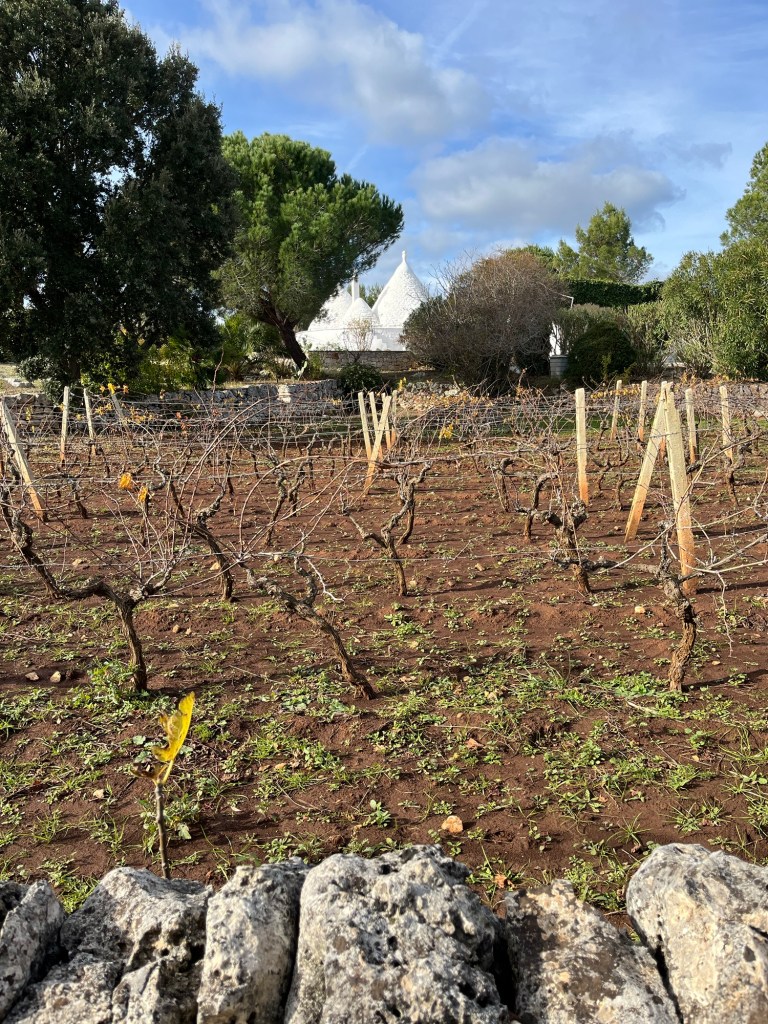
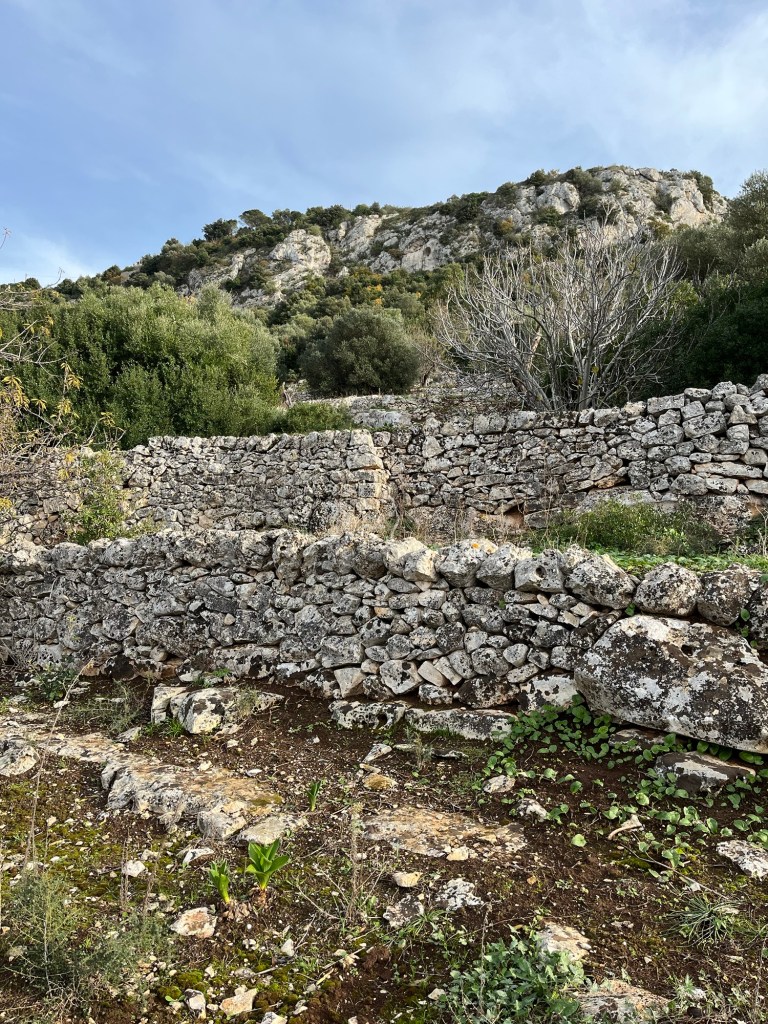
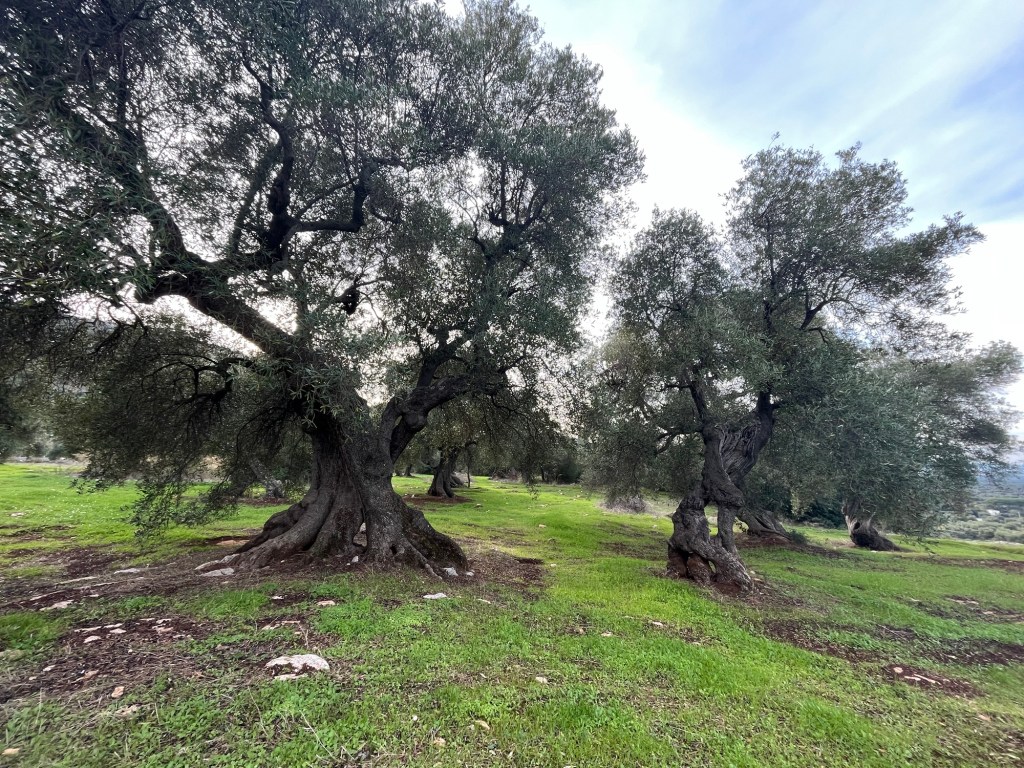
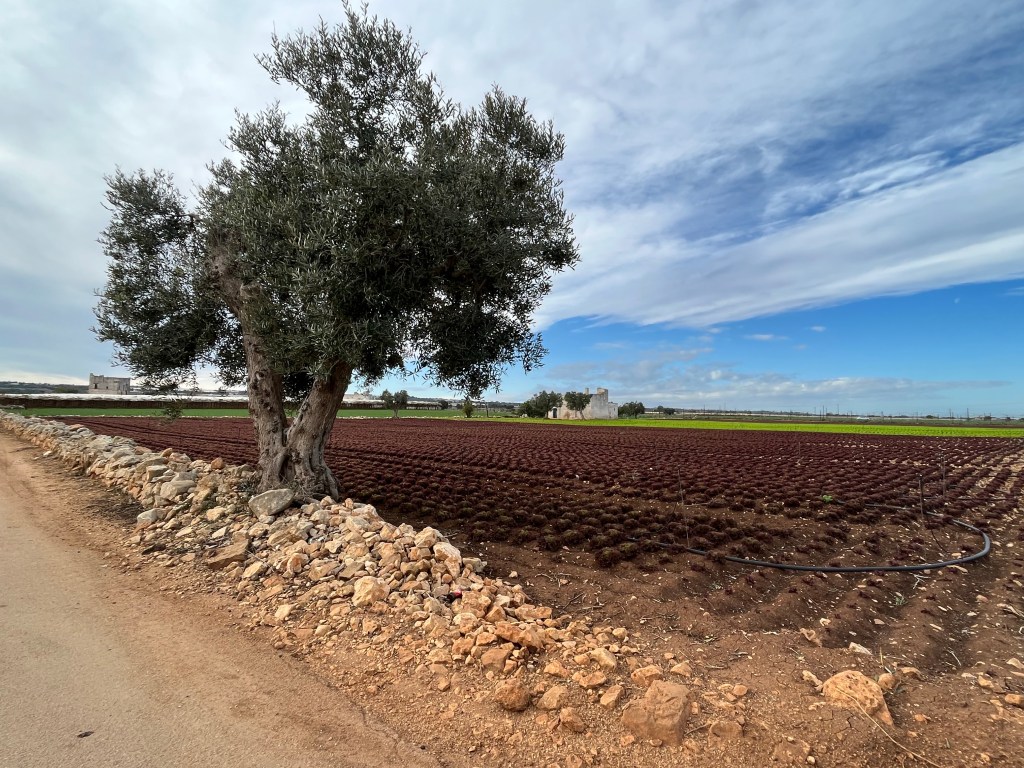
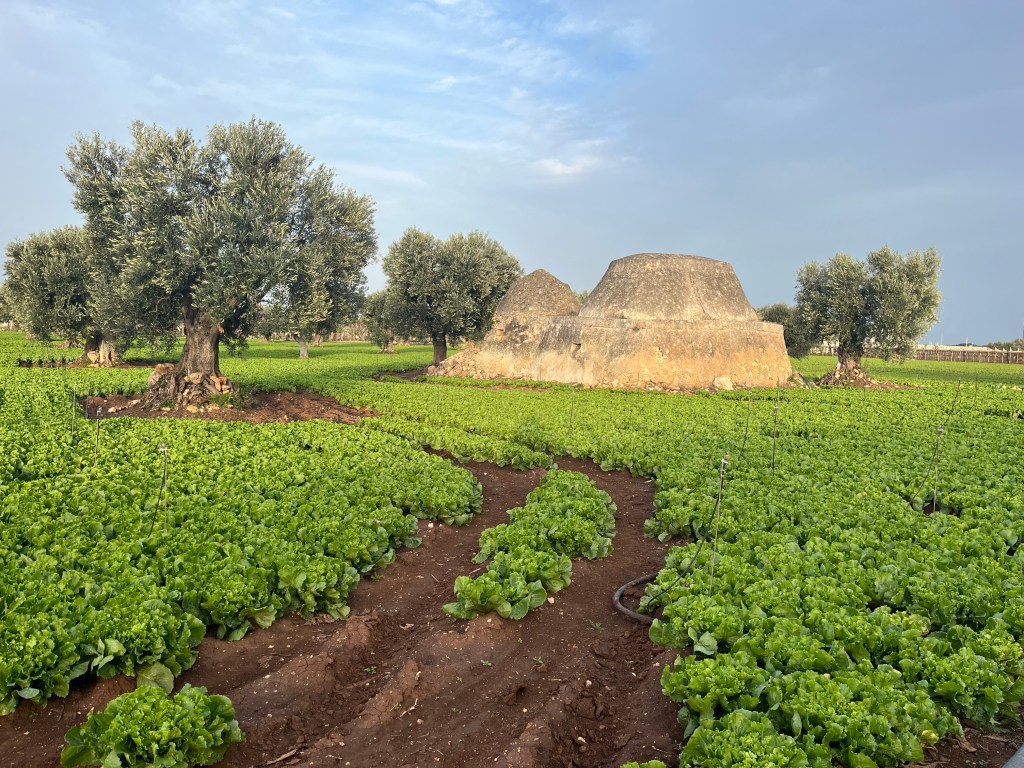
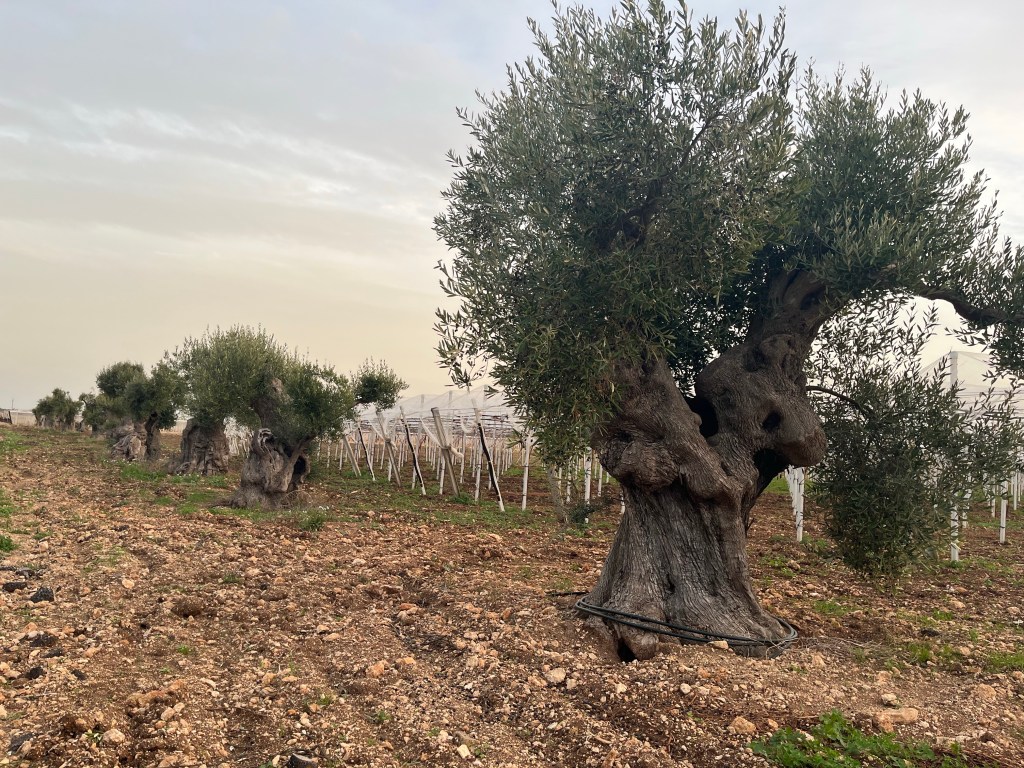
Once out of Cisternino, the trail again follows quiet county lanes. Past fields and their stone walls, old and renovated trulli, but today the hero is the olive tree – some of the oldest in Puglia.
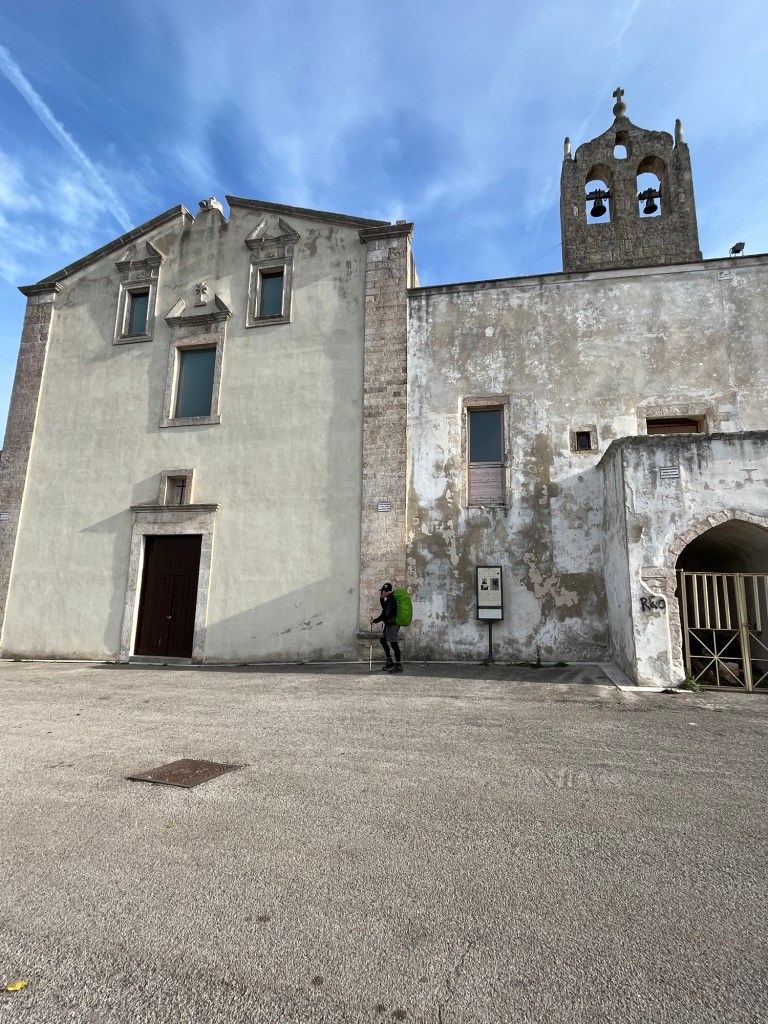
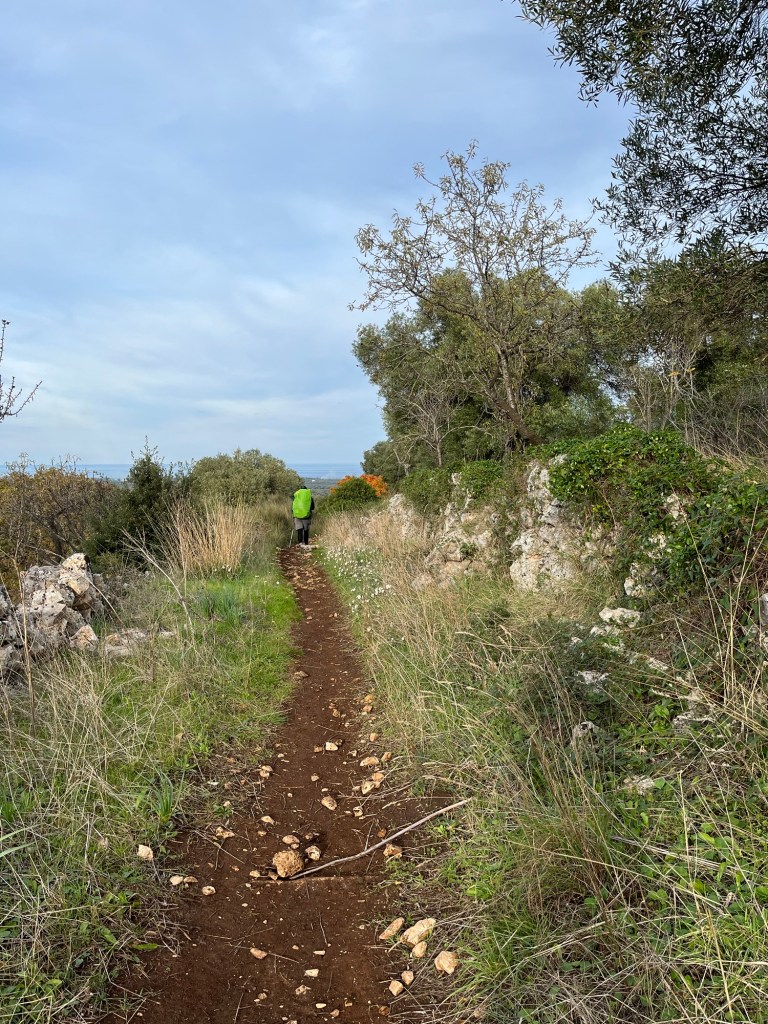
Eventually we arrive at a section on and off a broad road, but we encounter few cars and it has a wide shoulder. Leaving this road, you start the steep downhill towards the plain, along a road until the church, then paths down through the terraces of olive trees.
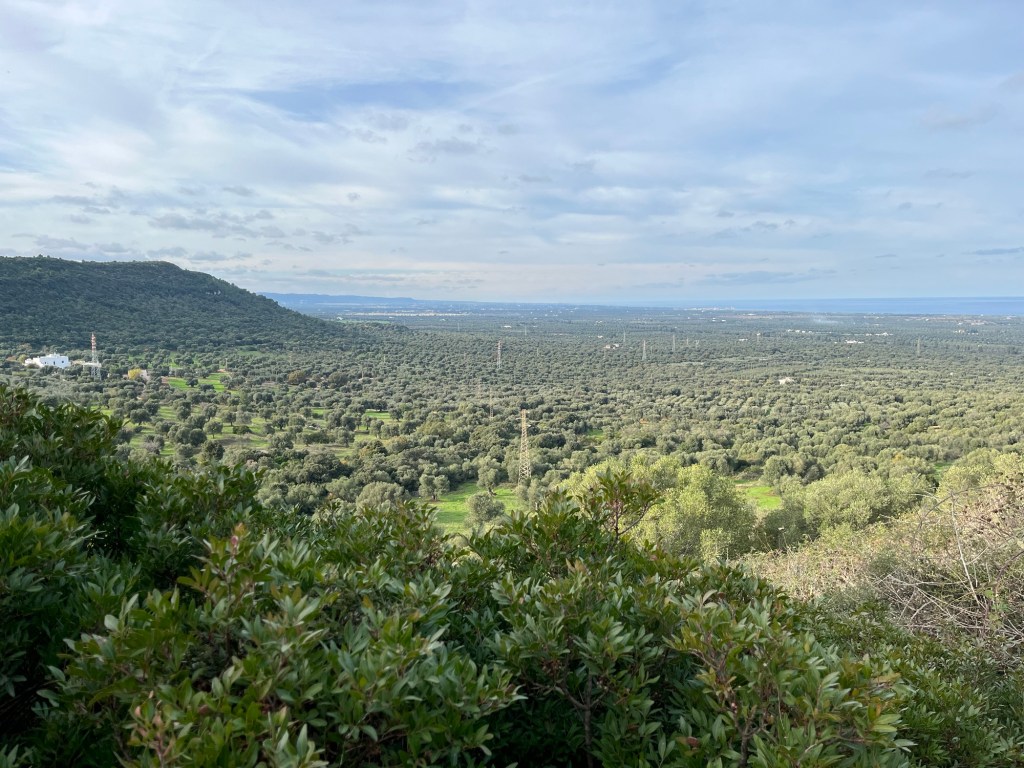
Just after the church we stop for a rest and snacks, taking in the view down to the plain and the coast. We can hear the occasional gun shot from hunters echoing around the hills.
As we are about to set off again, two hunters arrive and follow the path we are about to follow. We soon separate as we take the steep descent into the fields, but we waste no time as the hunters’ shots are now closer. It takes us back to those VF north trails where encountering hunters was a new experience for us.
Once we have descended further we take a bit more time to appreciate the route through the olive trees, the flowers, thyme and sage, and other plants.
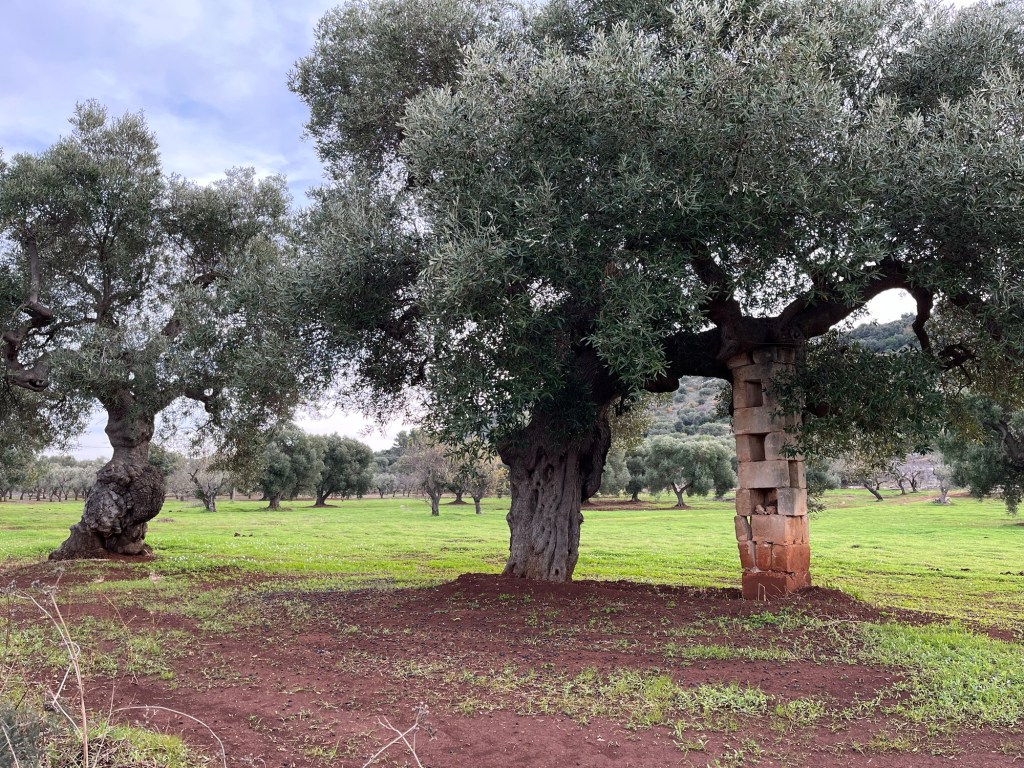
It is then that we arrive at the fields of probably the oldest olive trees we have come across – they distract us for quite a while before getting back on our way, only to again be distracted and slowed.
We don’t get a glimpse of Ostuni, the white city, until we are not far from it’s outskirts.
Across the ring road and then up and up to our accommodation for the night.
We try the tourist information centre for a stamp, but it is closed despite our arrival well before the scheduled closing time – no stamp for Ostuni. In the piazza and old town of Ostuni the decorations are up, though not to the same degree as the previous towns in the valley.
When we arrive up the hill to the cathedral, it too is closed with a DJ set up on the steps and disco hits from the 70s-80s playing – I am not the only who picks up on the opening notes of Born to be alive.
We have really enjoyed our few days walking in the Valle d’Itrea – some of our favourite days that we have managed this trip. This trail, running from Brindisi to Alberobello then onto Matera, has experienced it’s challenges. I note on the website that they are struggling to find cost-appropriate accommodation for pilgrims through the valley and therefore have chosen to focus on the stages from Martina Franca to Matera. I chose this inland route (and had hoped to complete more of it) due to its beauty, to add to the varied experience of Puglia, and at this time of year there is still an abundance of accommodation – although maybe not so much on the long weekend – compared to the closures along the coast outside of the warmer months. Should we have the opportunity to return again, we would strongly consider this route.
Stay – White room,
Eat – Arco dei Sapori
Tomorrow, the weather turns again – 8deg and rain – we will take the train to Brindisi.
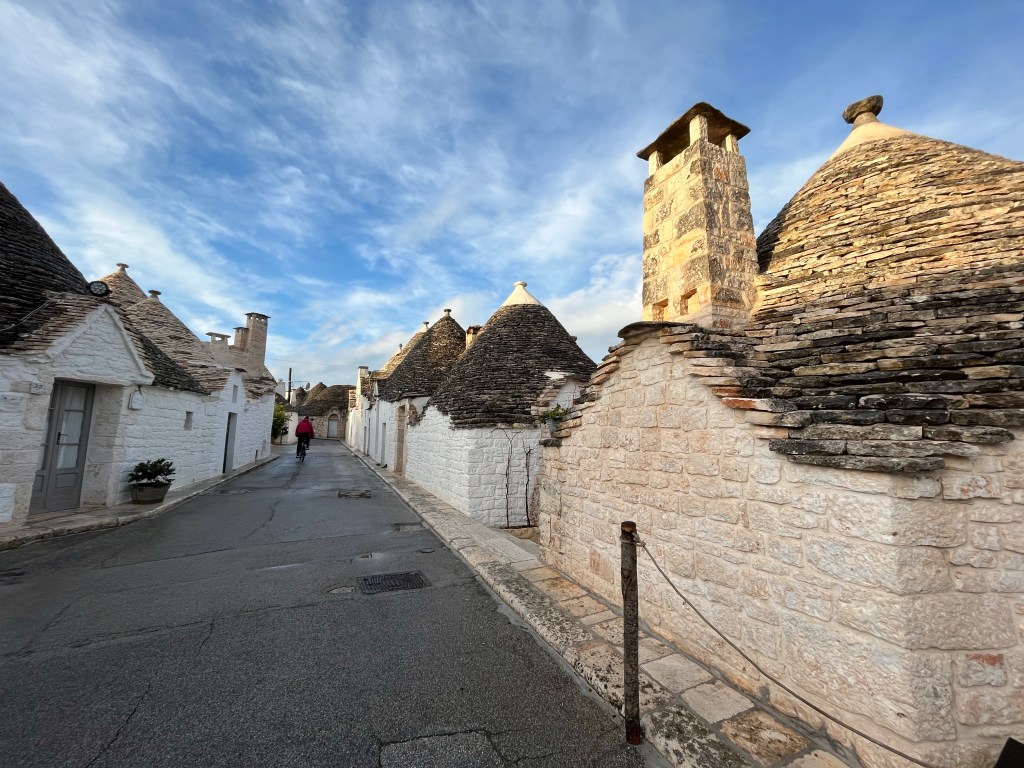
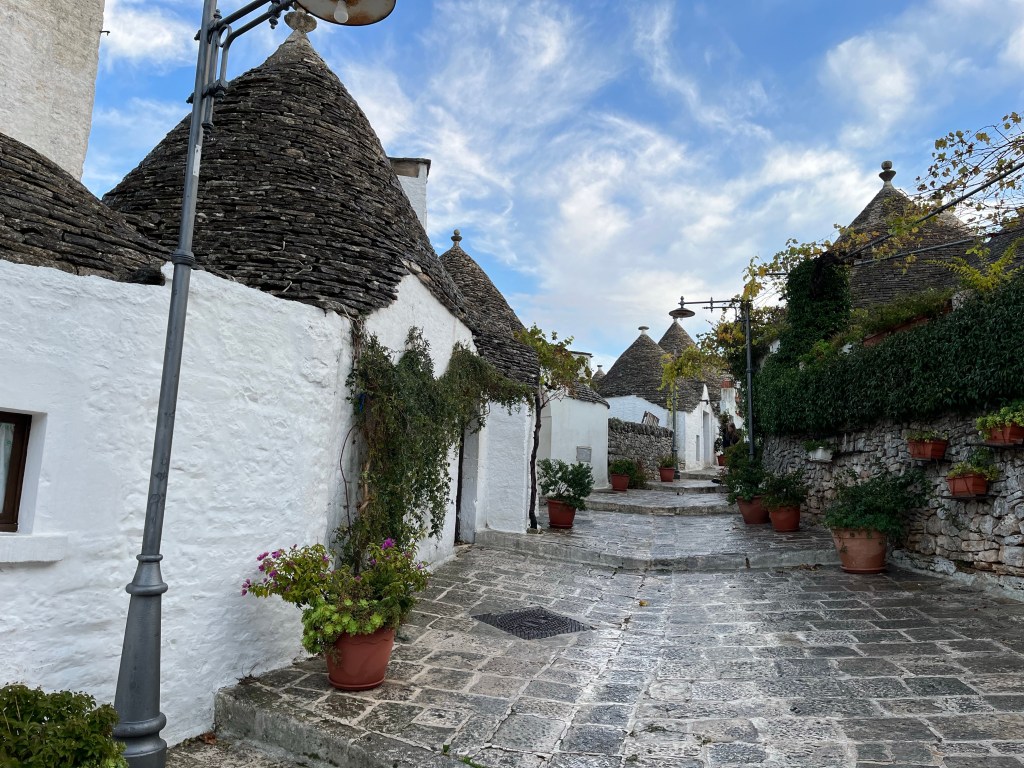
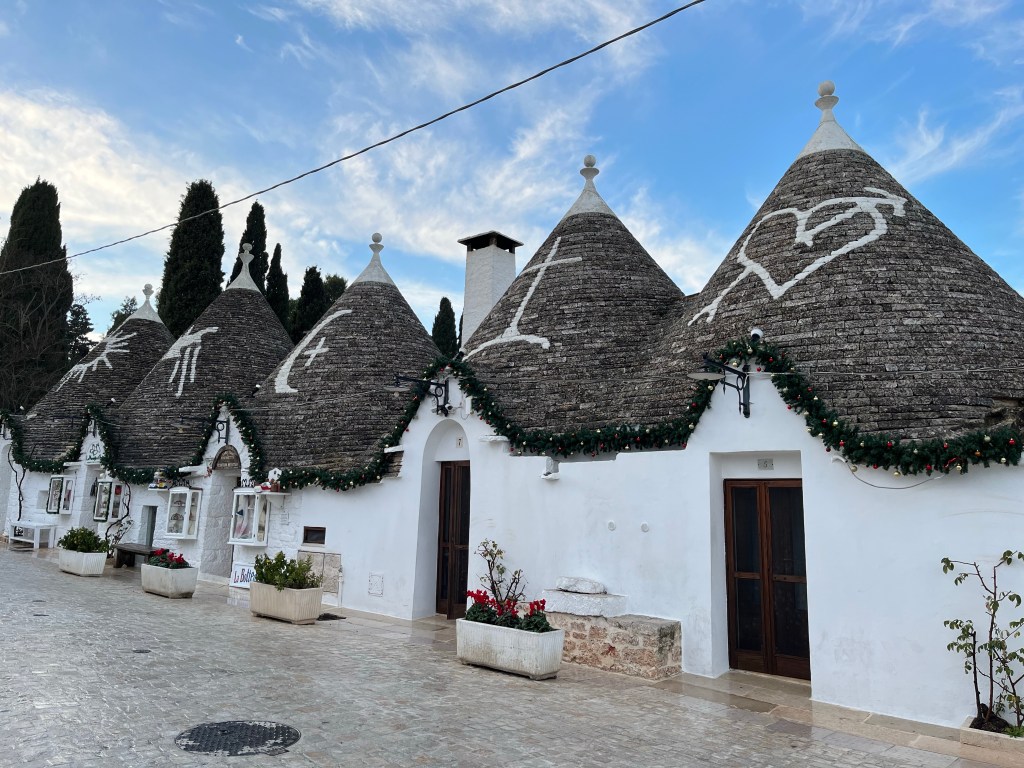
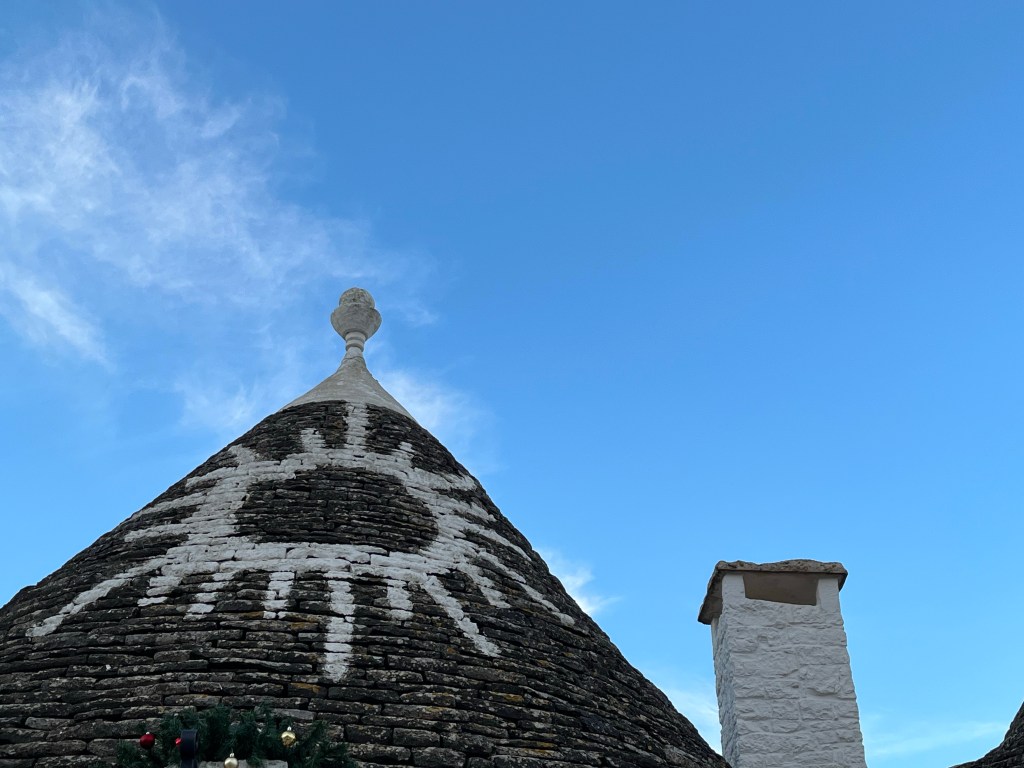
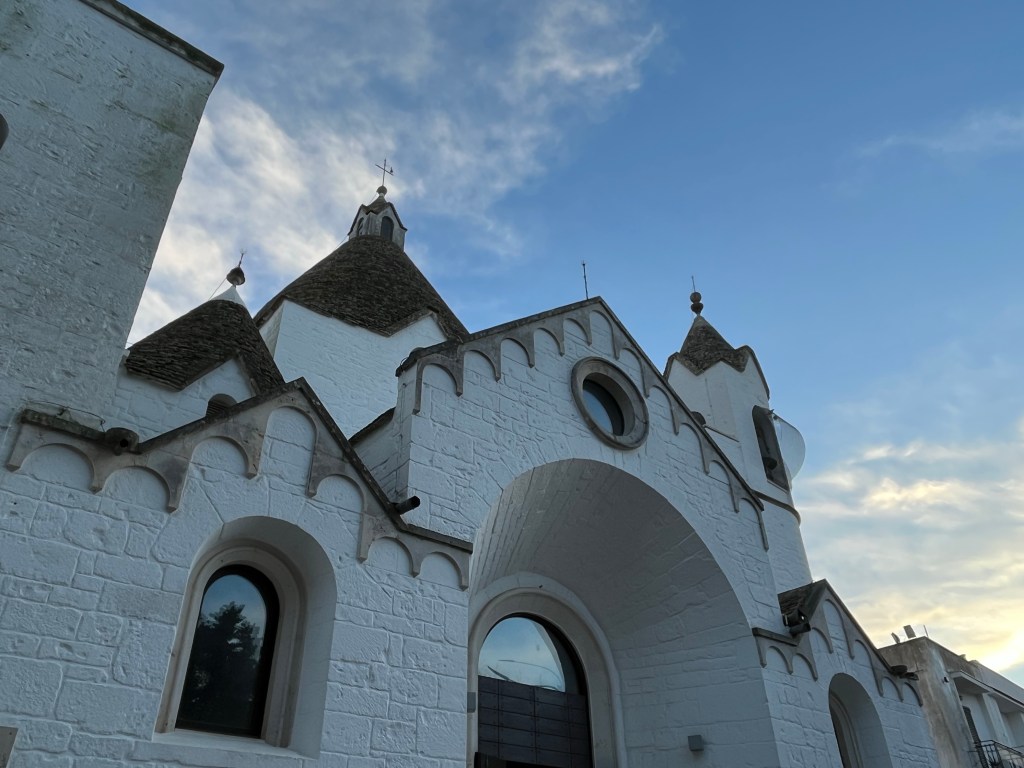
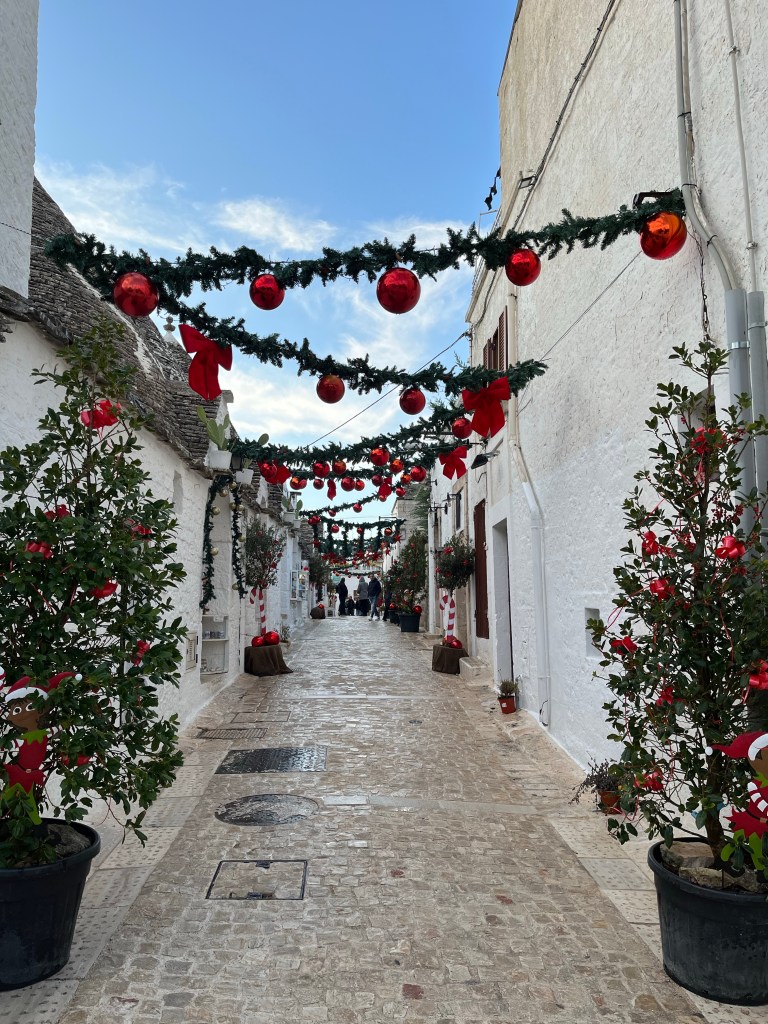
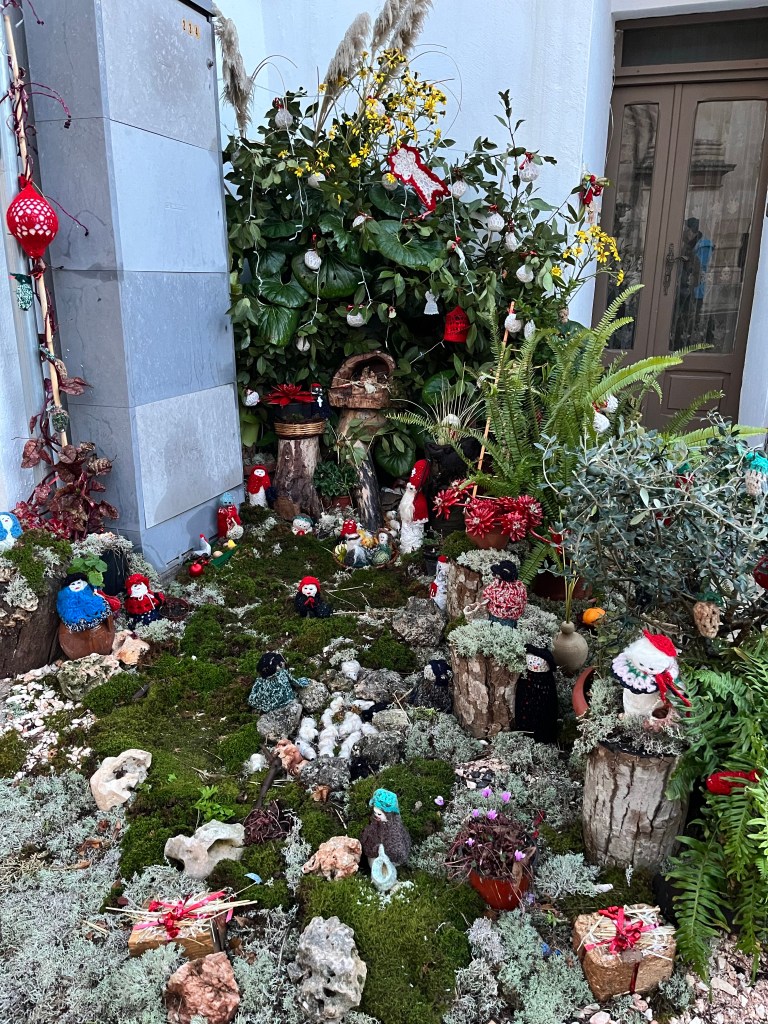
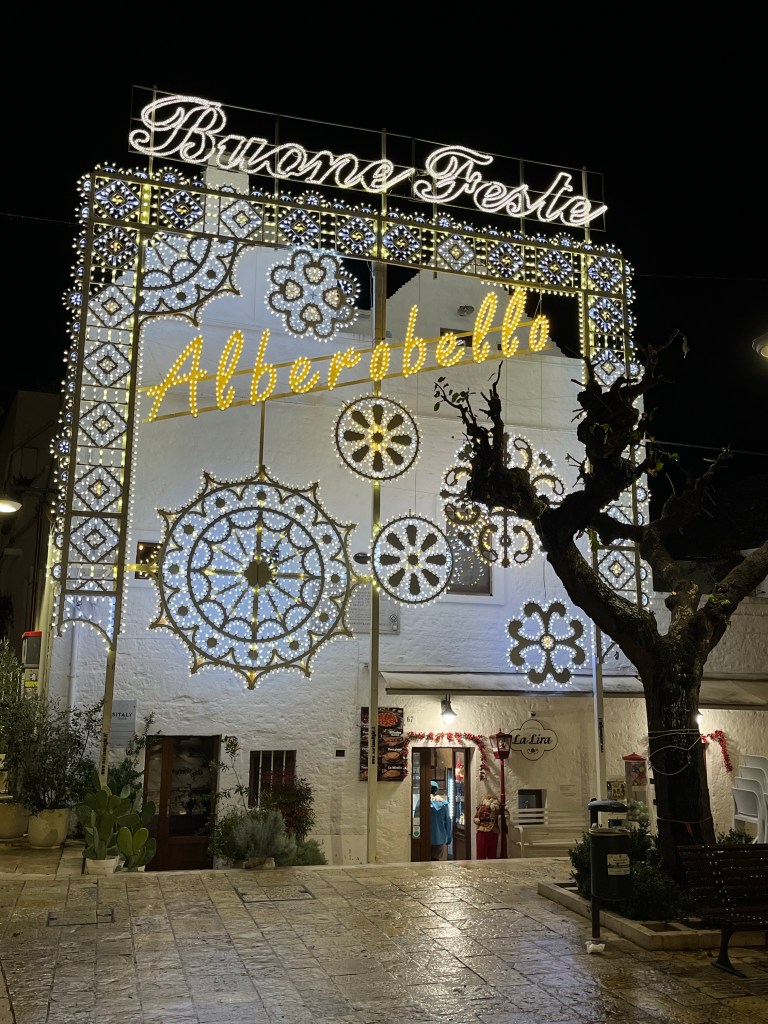
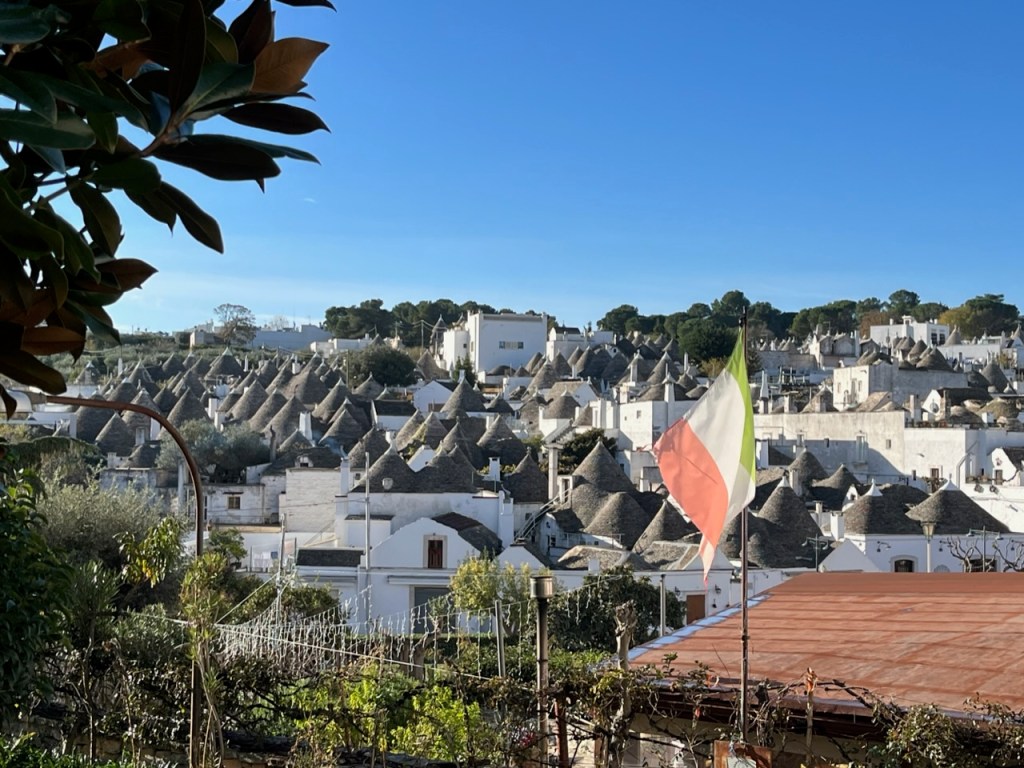
After catching the bus from Monopoli (a really scenic, circuitous route that climbs up from the coast to the Valle d’Itria) we managed a bit of a tourist visit to Alberobello without the large crowds common to this town. In between the afternoon and evening rain, we hit the streets along with the other few visitors, everyone waiting their turn for photos and in turn moving aside. I can certainly see the appeal of this town, and it’s unique housing. Christmas decorations are still being set up, and some of the shops and eateries are open – with a long weekend ahead it will probably fill up more than today.
I try repeatedly to catch the information office open to seek a stamp, but despite passing by multiple times, and the flag being up, the door remains closed. No stamp for Alberobello.
Stay – Trullo delle sorelle (booking.com); A really lovely room and great host.
Alberobello to Locorotondo
12km, largely on quiet roads; 3.25 hours.
11deg, clear/overcast, a few spits of rain.
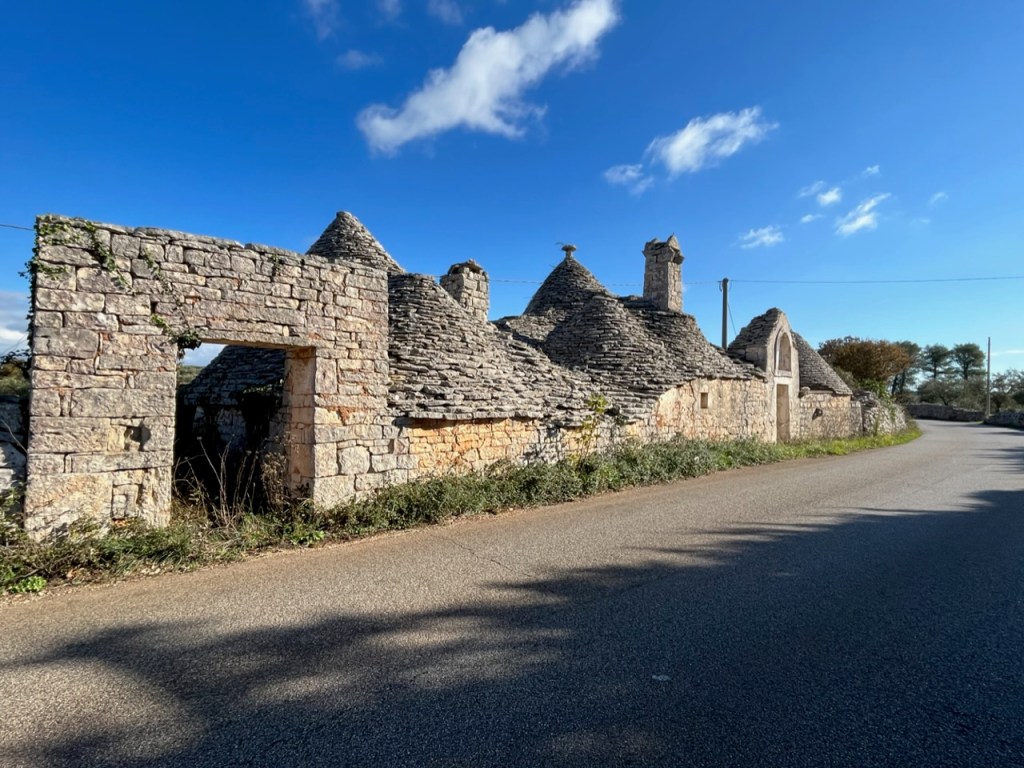
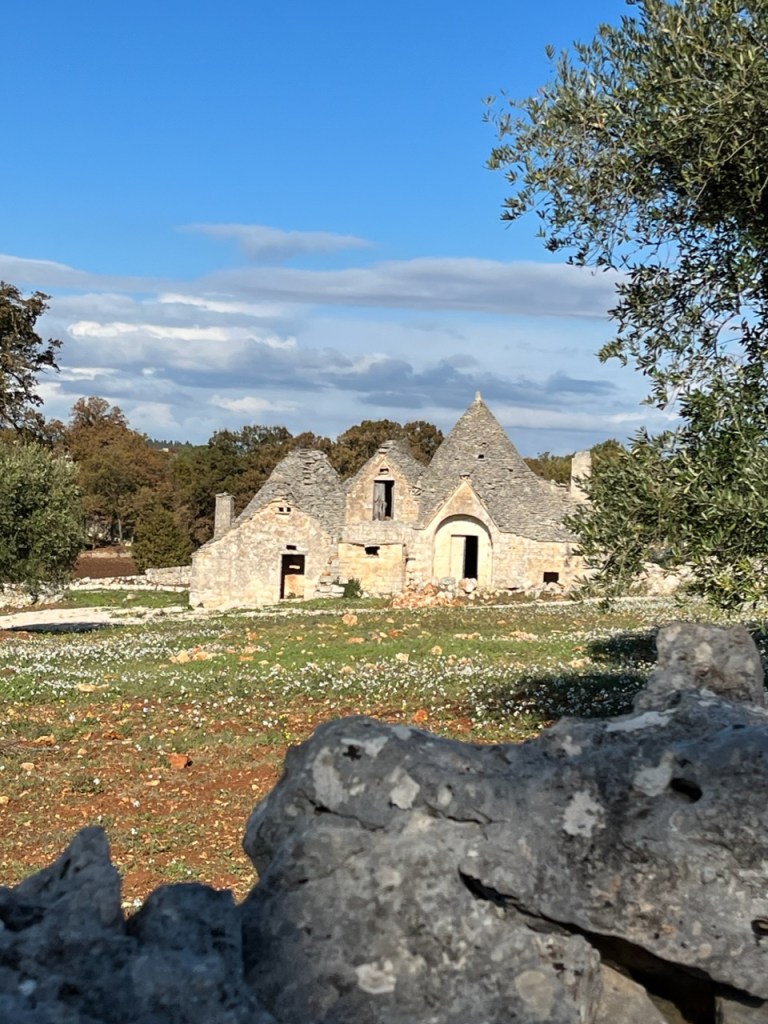
Highlights – Trulli amongst the fields and stone walls.
We tossed up whether to take the official 23 km route between the two towns (to the east), or the shorter route via the woods to the west – we decided on the shorter route. (Using the AllTrails app to follow the route).
Heading out of the town towards the Bosco Selvo, the trail follows quiet roads. We see few cars, but are passed by quite a few cyclists out on this public holiday, and long weekend; this area of Puglia is criss-crossed by cycling routes.
The trulli is commonplace in the countryside – It is the star of the day, whether opulent, well-worn or crumbling in an olive field.
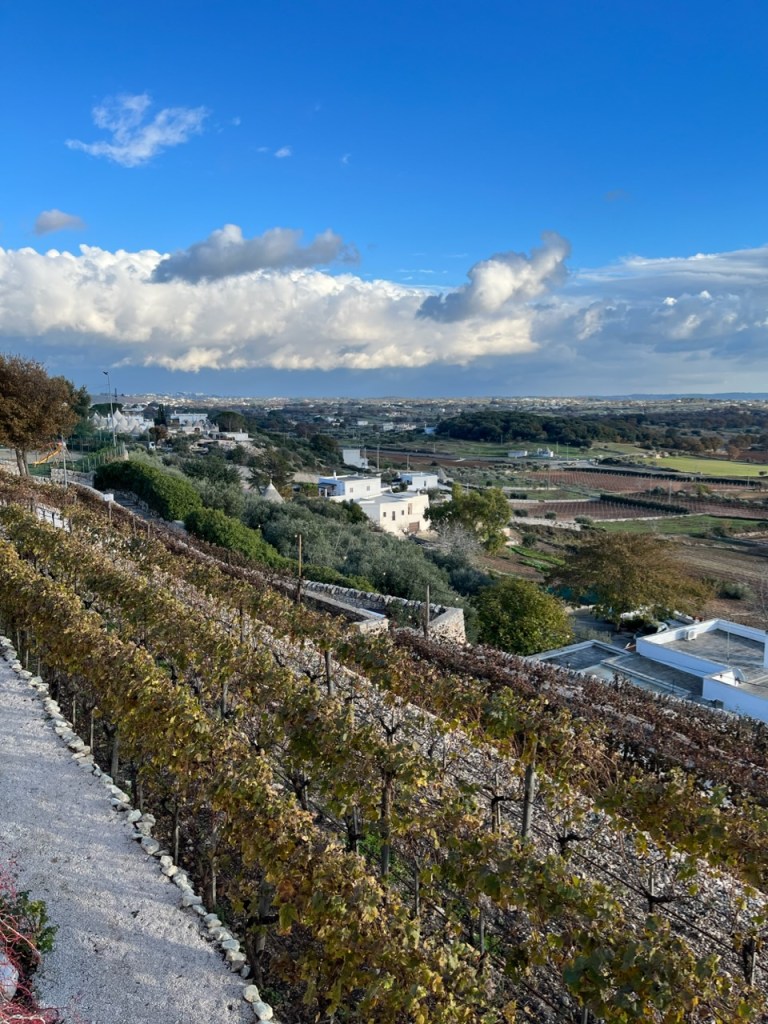
As we approach Locorotondo, there are a few spits of rain, and there is a large double rainbow over towards the coast. The rain thankfully remains further to the east of us as we reach the town. There are some great views over the green valley from its hilltop position.
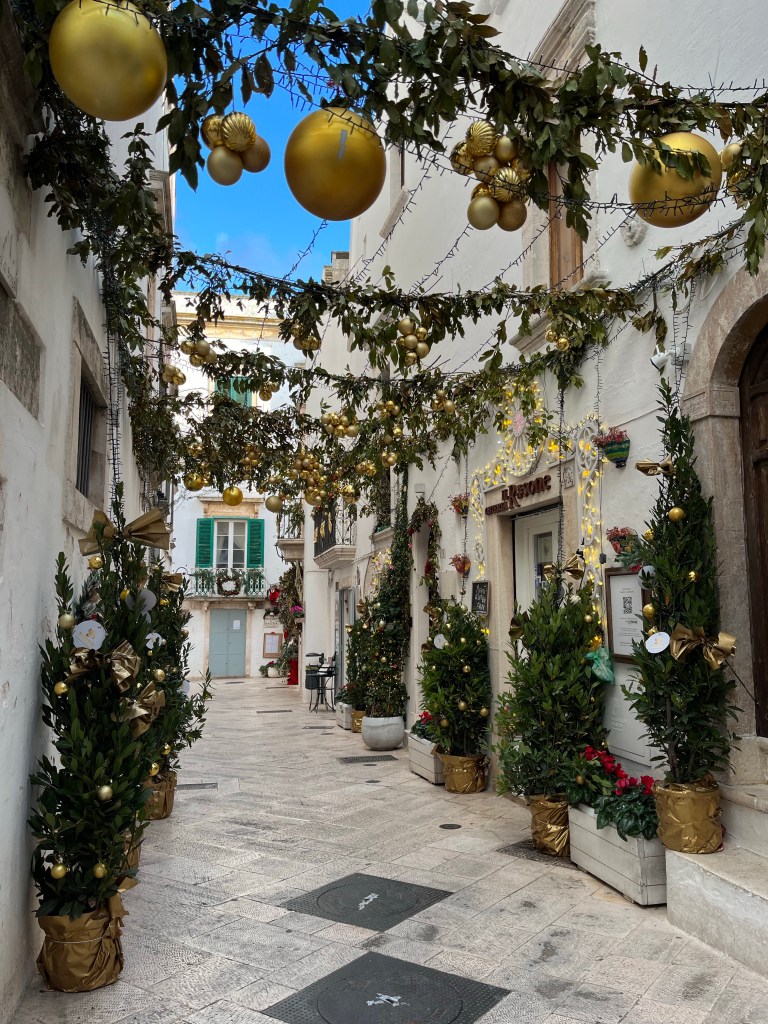
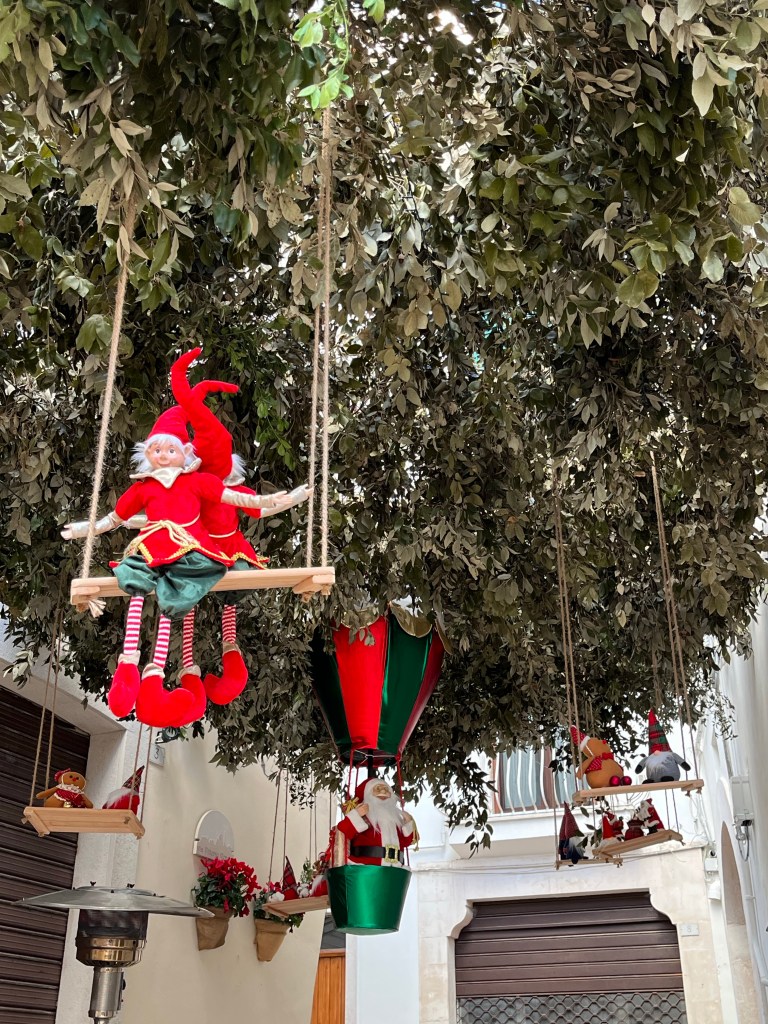
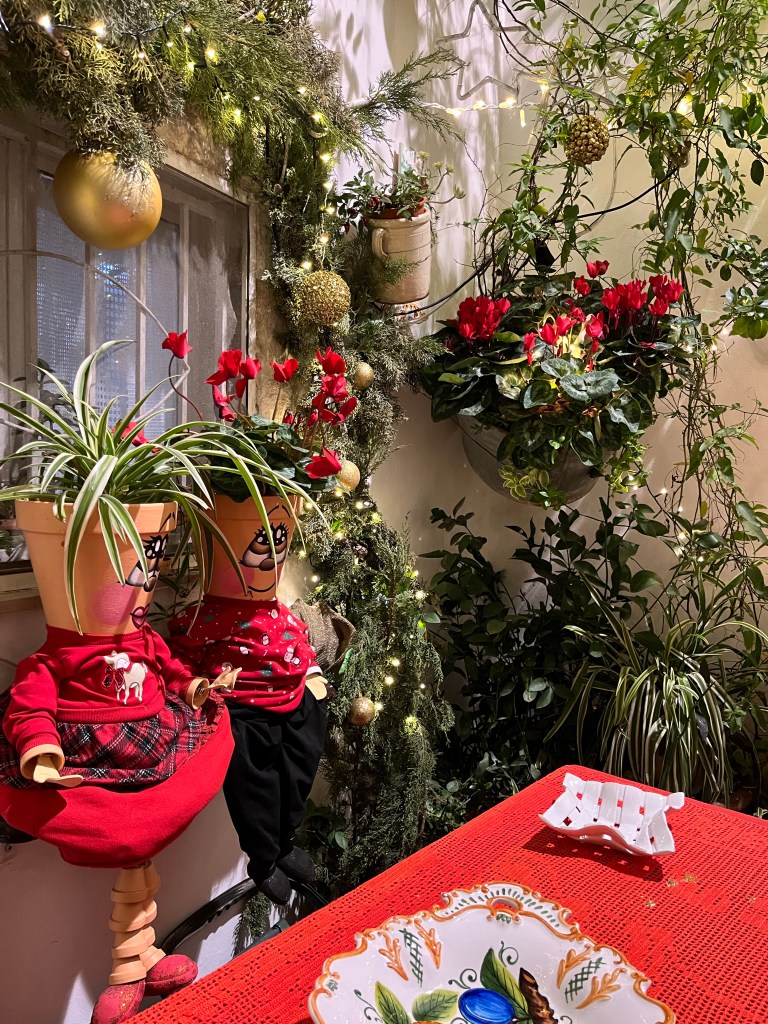
One of the reasons I chose this inland route is the time of year – the towns of the Valle d’Itria love their Christmas decorations, and Locorotondo is well known for their commitment. We can both be a bit bah-humbug about many aspects of Christmas, but we find we are not even annoyed by the piped Christmas carols, and are enchanted by the decorated streets. With the town full of visitors on this long weekend, it is a very crowded evening passeggiata and the restaurants and bars are bursting at the seams (got some lucky quiet moments with the following pics).
The tourist information office is open and we get our stamp.
Tomorrow, we continue on the via Ellenica, onto Cisternino, then Ostuni the following day.
So glad we did not try to do this all in one day as there would have been tears, and so many words spoken in anger, in English and Italian; plus no time to appreciate the many delights of this long, predominantly coastal section.
Part 1 –
19km, 5.25 hours.
13deg, largely clear skies, until some rain in the evening.
Highlights – Coastal views, and the old town of Polignano a mare. A beautiful day.
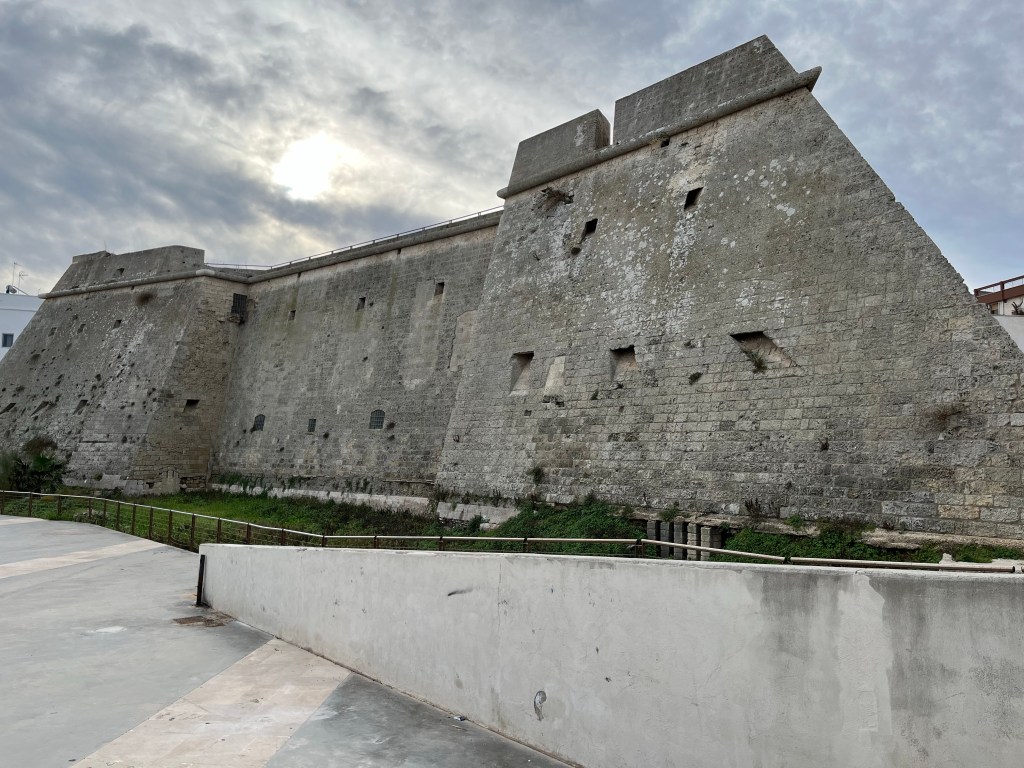
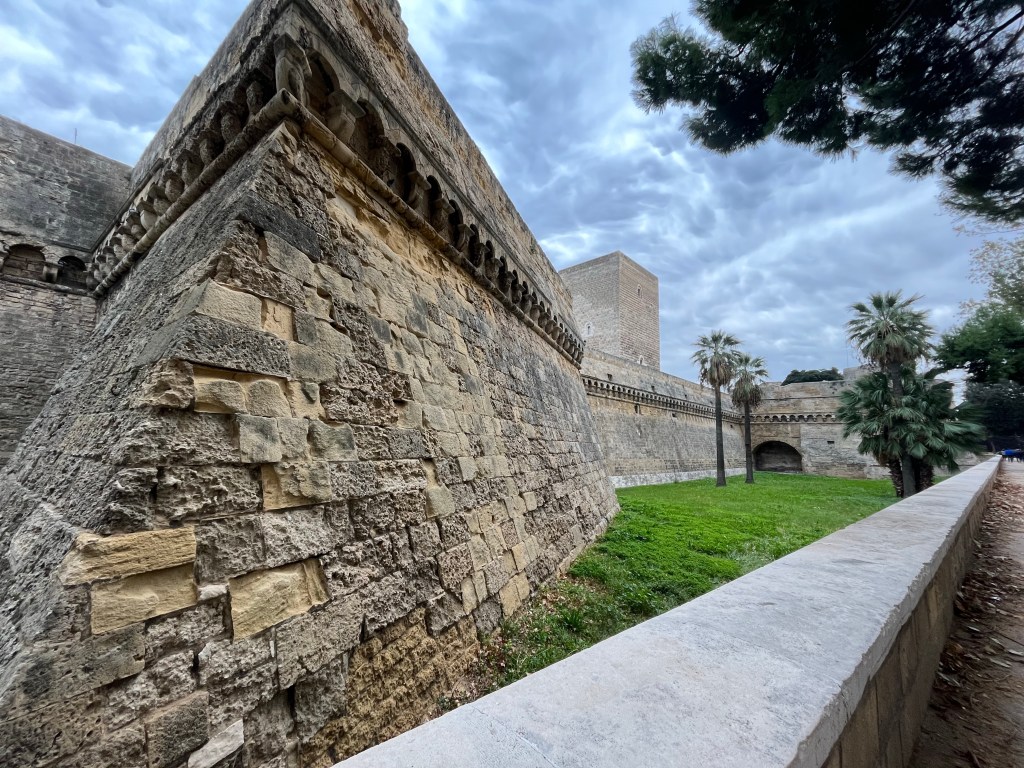
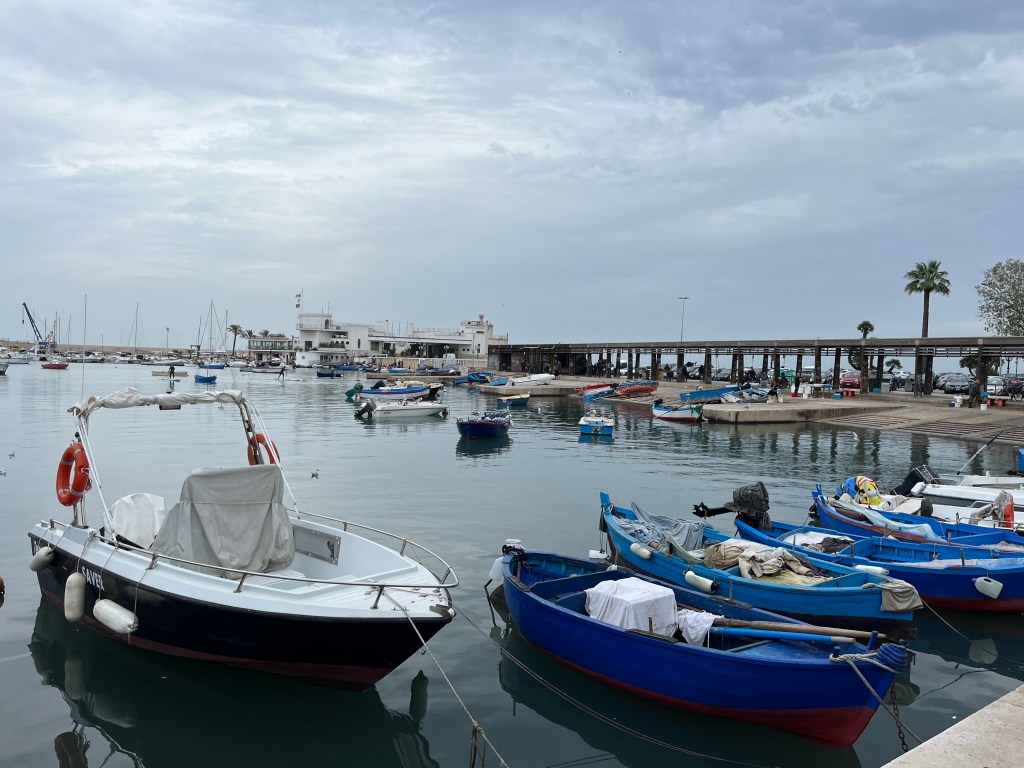
We head out of Mola di Bari past the piazza, the remains of the castle, and the harbour.
The route then cuts inland, passing under the freeway to return us to the colourful fields of vines, olives, and vegetables – lettuce, parsley, cabbages, and artichokes. It is easy walking.
Back over the freeway and returning to the coast where we had hoped to find something open for a light lunch. Nothing is open – two local older men having a sit in the sun and a chat by the sea tell me that there are no bars, no restaurants open until Polignano a Mare. They are only open in this area in the summer.
The path follows a long stretch adjacent to the coast, with largely easy walking on paths, but with plenty of places to explore. In the parklands behind the beach there are many trulli ruins; though we stick to the beach, we do see a group of people emerge from the area of the ruins.
After a short section on a secondary road beside the freeway, we return to the sea
Past some coves and we arrive at the centre of Polignano a Mare, in the warmer months a hive of activity, but this afternoon, far more quiet, though predominantly with people who are dressed far, far better than we are.
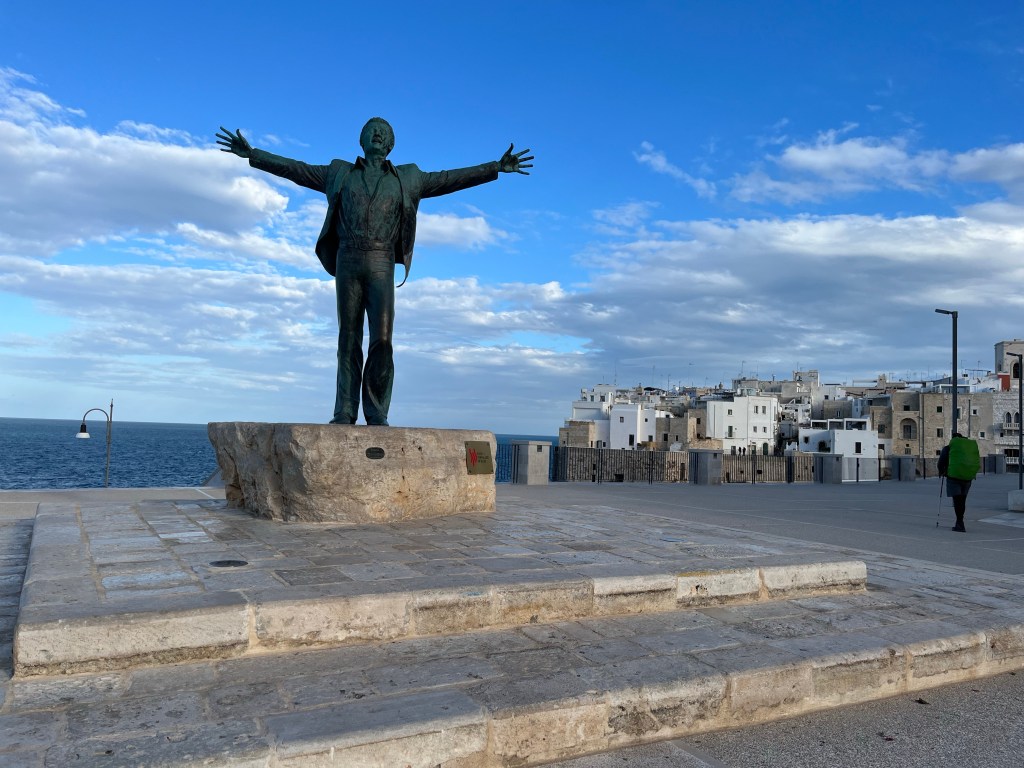
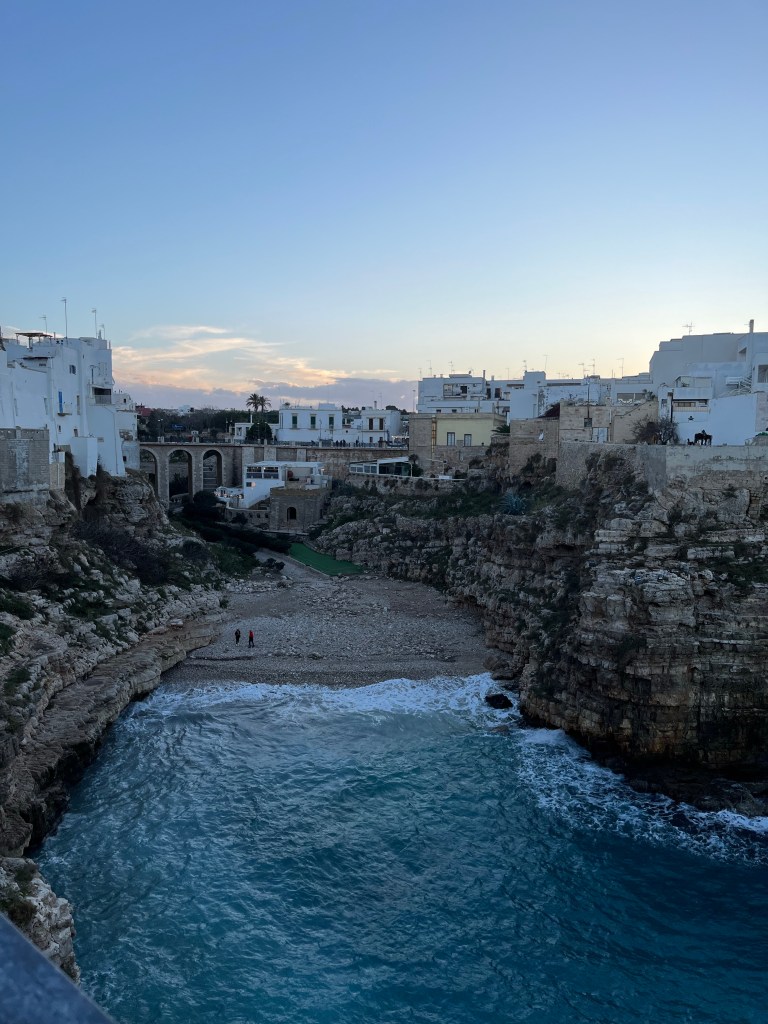
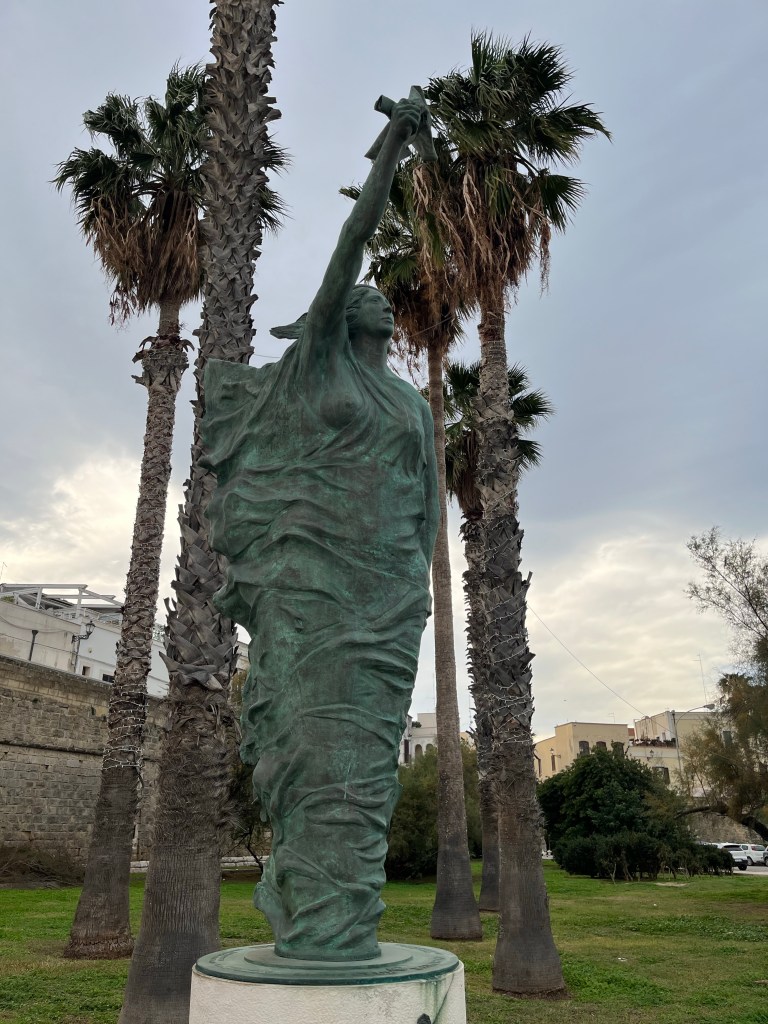
Past the statue for the famous song, over the bridge and into the old town for our accommodation for tonight. We take in the views of the old town and the lookouts as the sun sets.
You know some of the words: Volare, oh oh, Cantare oh oh oh oh
There are some Christmas decorations around, and a small market in the square, but the streets empty when the rain arrives for the evening.
Eat – Osteria dei Mulini, just near the entrance arch to the old town
Stay – La Naca sul Porto, lovely room, rooftop terrace, fantastic breakfast.
Part 2
10 kms, 4.25 hours
11 deg, clear and sunny blue skies.
Highlights – more amazing coastal views, the thousands of birds, and the old castle and port of Monopoli. Another beautiful day, though more challenging than we thought it would be.
Just a short section today we thought; should be easy walking today we thought. However, two hours in, we found ourselves having covered only 4.5kms.
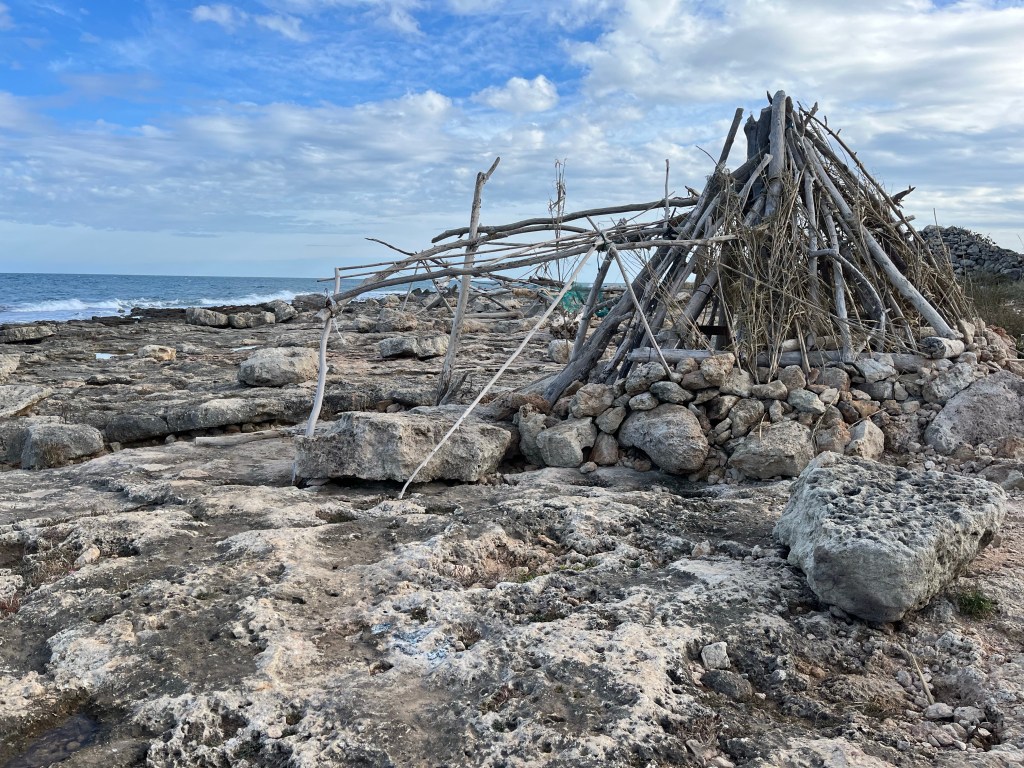
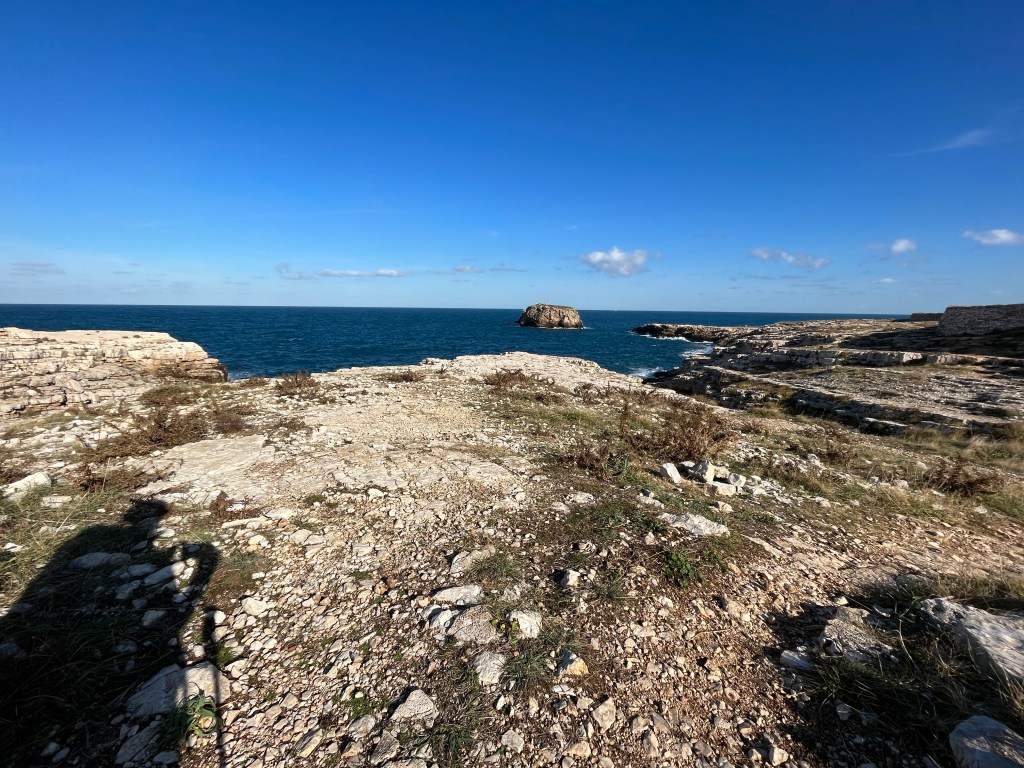
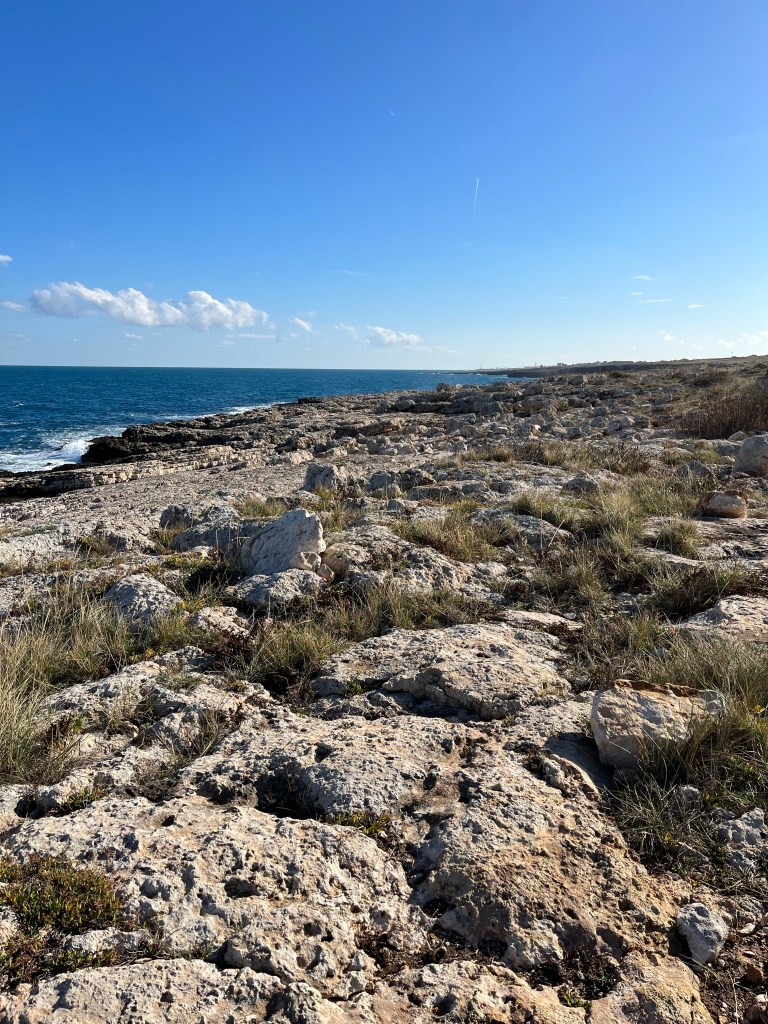
Admittedly, a large part of this route we were very distracted by the rocks, including looking for fossils, the views, and in particular the hundreds of flocking birds. The terrain, though, is not as easy as the preceding day along the coastal sections – the path is at times rough, and rocky, and we need to pick our way along the route. Added to the challenge are the multiple coves that you need to descend into and come out of – some are very easy, with clearly established steps, while others have little visible path with some rock scrambling involved, or steep rock steps. More than once it was hands to pull up, as well as legs to push, to get up the path.
The first cove in particular is a challenge. We leave Polignano a Mare by the scenic promenade, soon arriving at a fence in our way – you cross this with a stile. We follow what we think is the path through the grass and rocks, but find ourselves on the other side having to scramble up loose rocks, amongst the weeds and prickles – and I hate rock scrambling. Maybe we chose the wrong path through the grass; maybe there was an easier route out, but we could not see it.
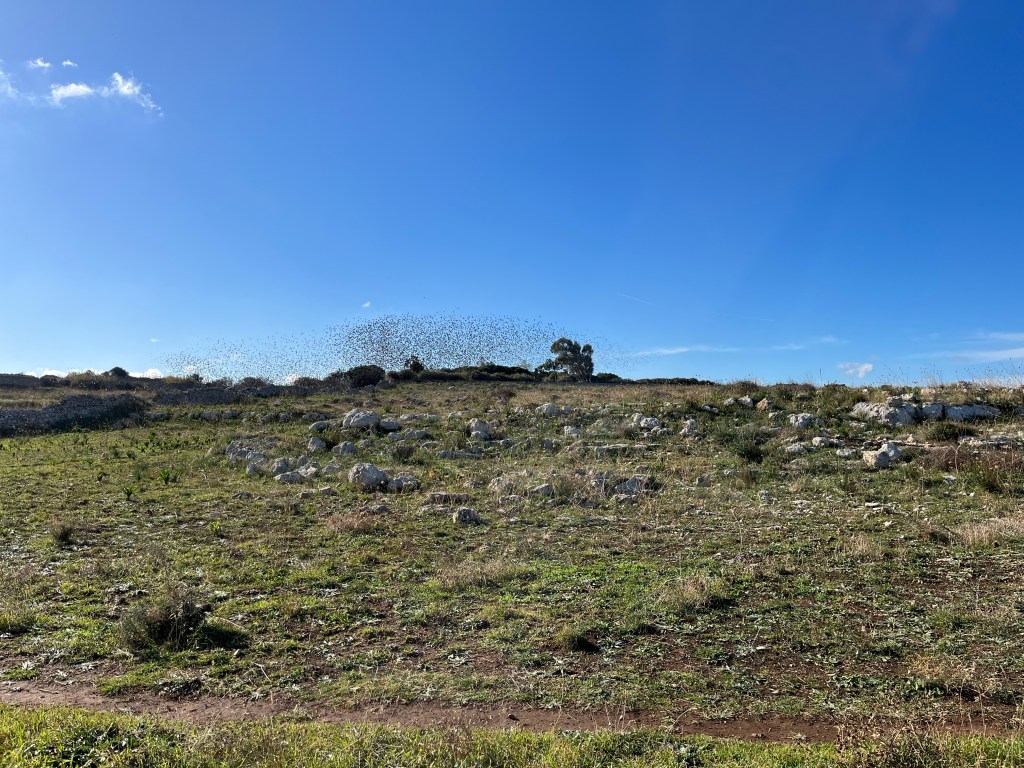
As we emerge from this cove, flying just overhead is a large flock of birds, maybe starlings, silently massing overhead then moving on. At this stage, I am trying to calm myself and don’t really appreciate them (as I said, I hate rock scrambling). In two other locations we can see the hundreds, or maybe, thousands, of birds, making formations, flying en masse this way, then that way.
At times the path is easy walking adjacent to the fields; other times it amongst the rocks, and rock pools.
After getting through all the coves, we arrive at the outskirts of the town, first following the bike path (I am taking a guess – past the sewerage works?) then making our way to the old town centre.
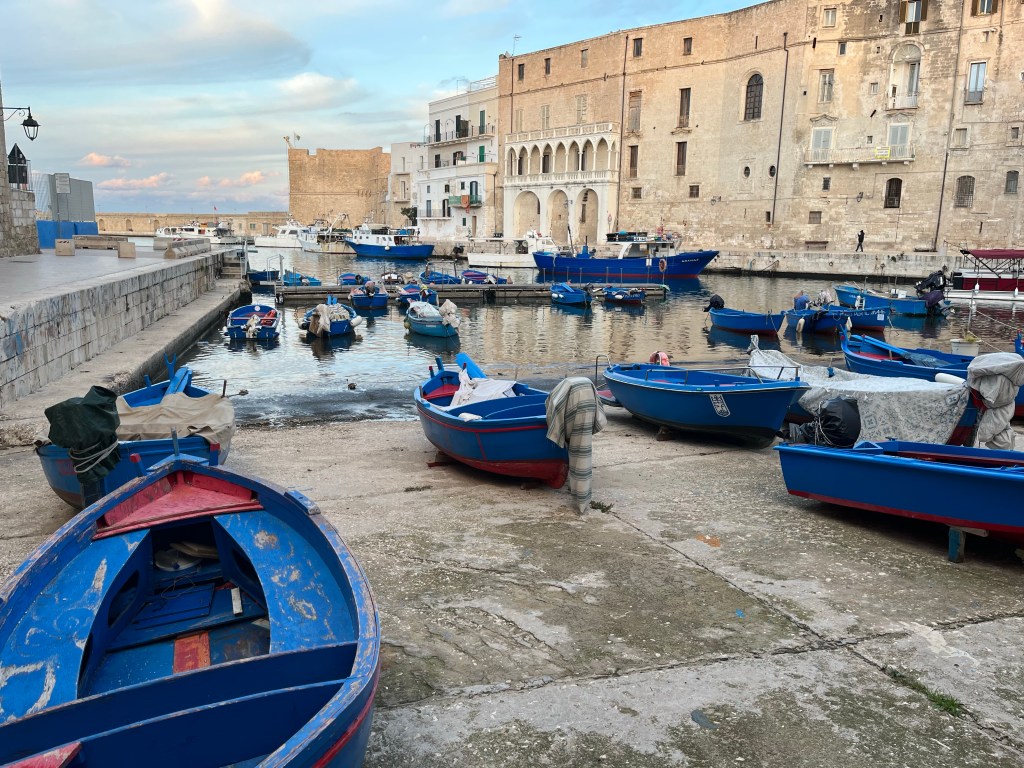
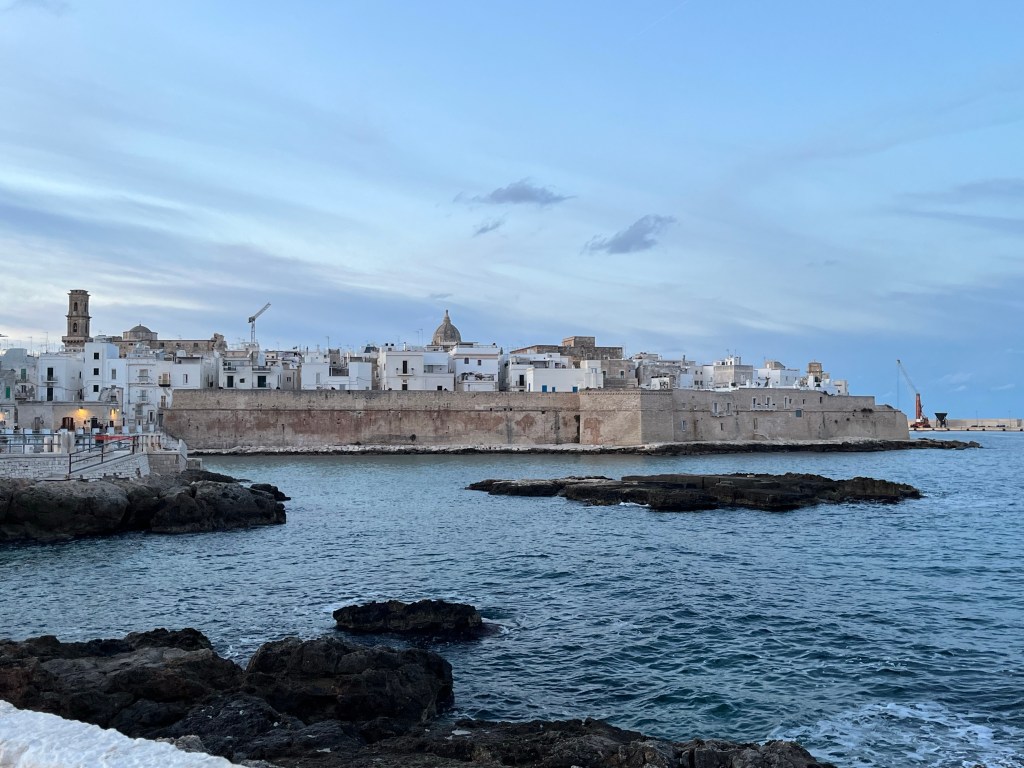
Check-in, eat, and a wander around the old town of Monopoli at sunset.
Tomorrow, we veer off from the Via Francigena route, and onto the Via Ellenica – we will be on the bus to Alberobello at 11:00.
Stay – B&B Borgo san Martino, as recommended in the guidebook.
Feeling nervous about news of ongoing strike action on the trains, we head to the train station early to head straight to Bari, for a sight-seeing day (they definitely outnumber our days of walking)
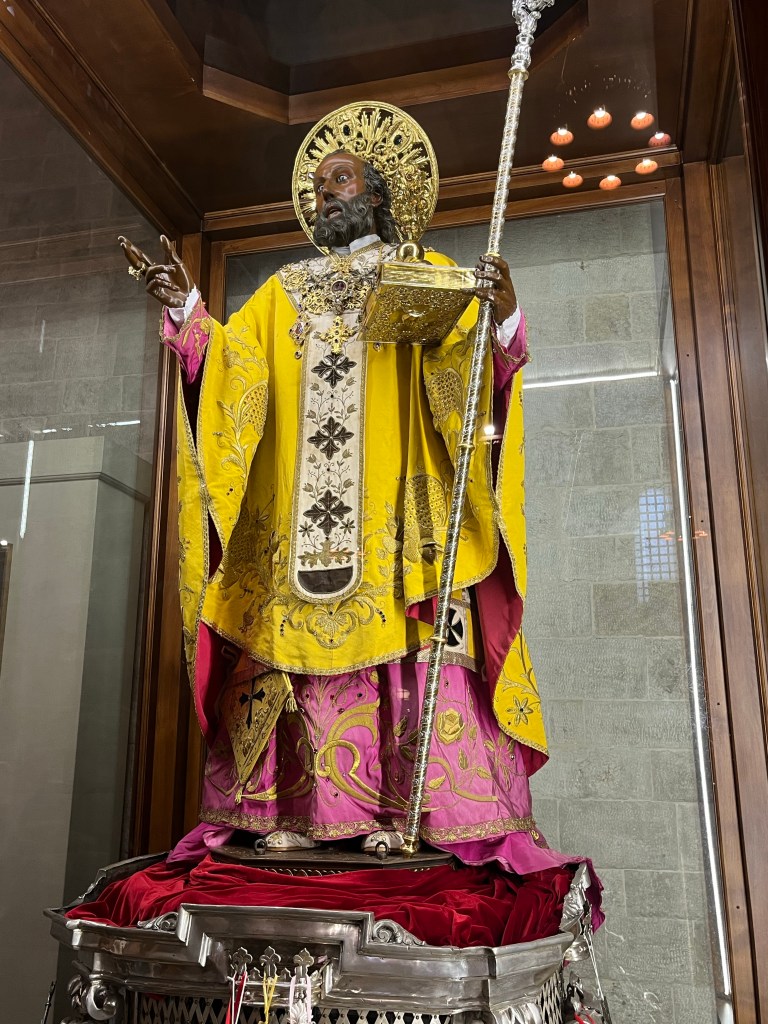
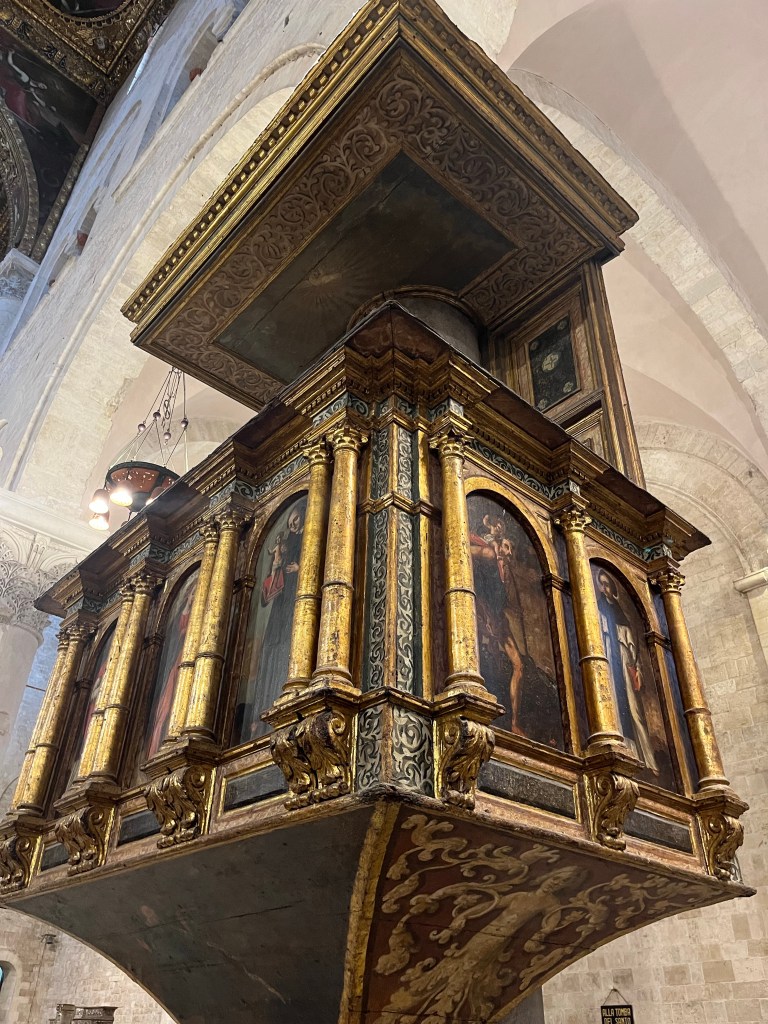
I had read a book on Puglia in the early days, and it includes a chapter telling the story of San Nicola, so it was great to visit the Basilica (with a stamp obtained at the bookshop), and wander the old town.
Bari to Mola di Bari
24 kms; 7.25 hours, inc lunch break.
20deg, as per the forecast, but it did not feel like that, and most locals were wrapped up in their puffer jackets.
Highlights – A fairly good day on the VFS, with seaside views.
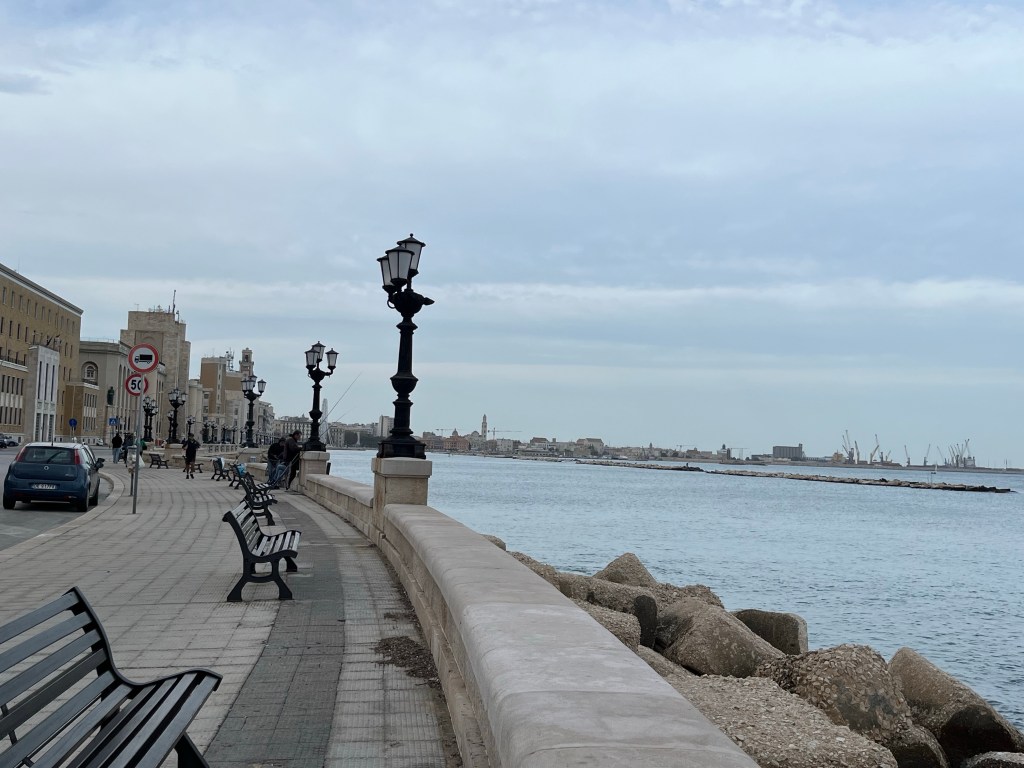
Out through the narrow streets to the coastal promenade. Past the theatre and grand buildings of Bari, the SUP boarders and the wrapping up of the fish market. On this Saturday morning the promenade is busy with joggers, fishermen, people walking together, those walking their dogs, and a Yoga group.
The promenade continues long past the main part of Bari.
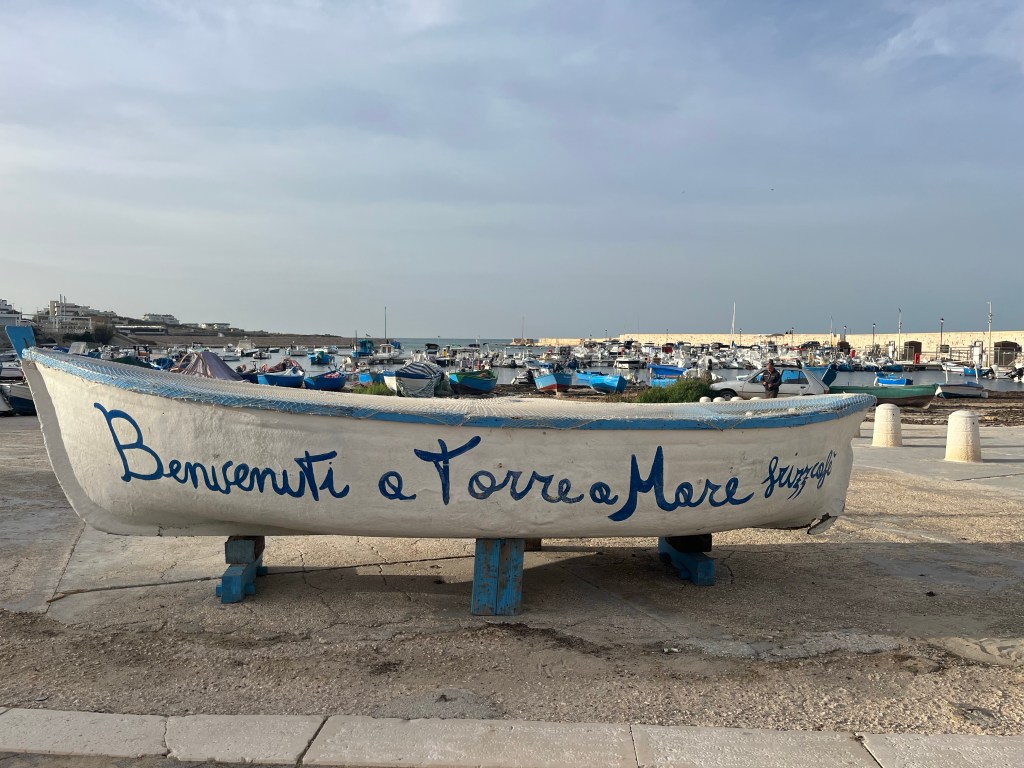
The footpath eventually narrows, but continues alongside the road on our right, and the sea on our left. We have a brief stop for a drink at San Giorgio, then continue past the fish stalls and onwards towards our lunch stop at Torre a Mare.
After our lunch stop, the road cuts inland, initially for a section along the secondary road next to the freeway – it is noisy but only the occasional car passes us by.
Then into the fields of olive trees and vines.
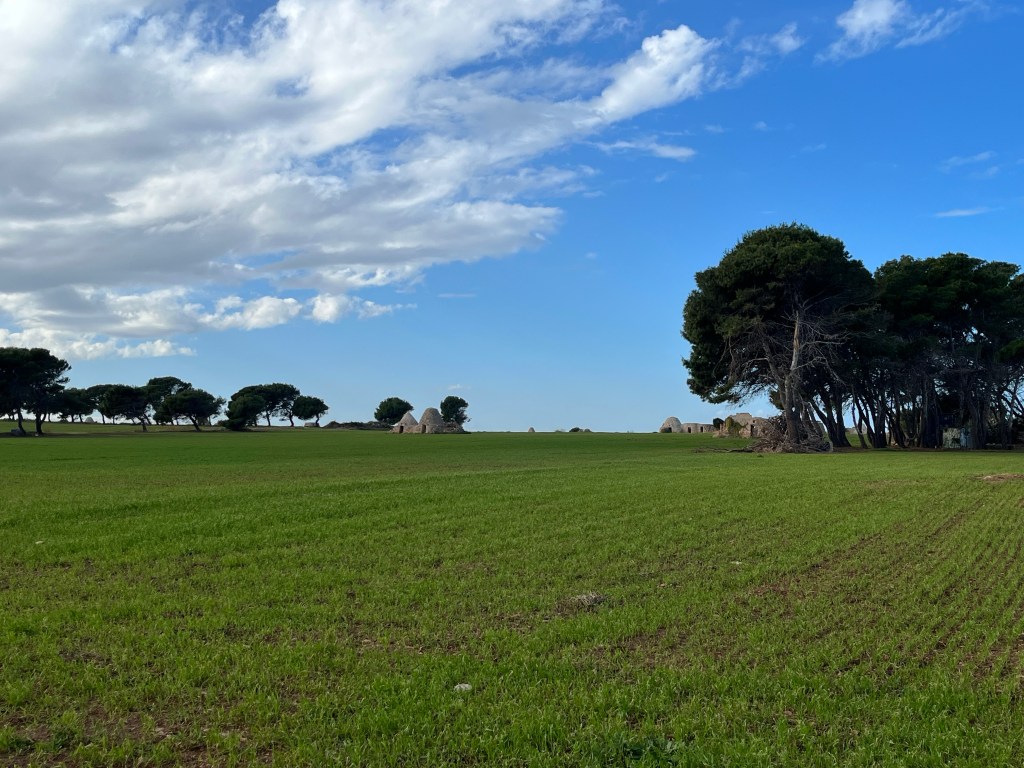
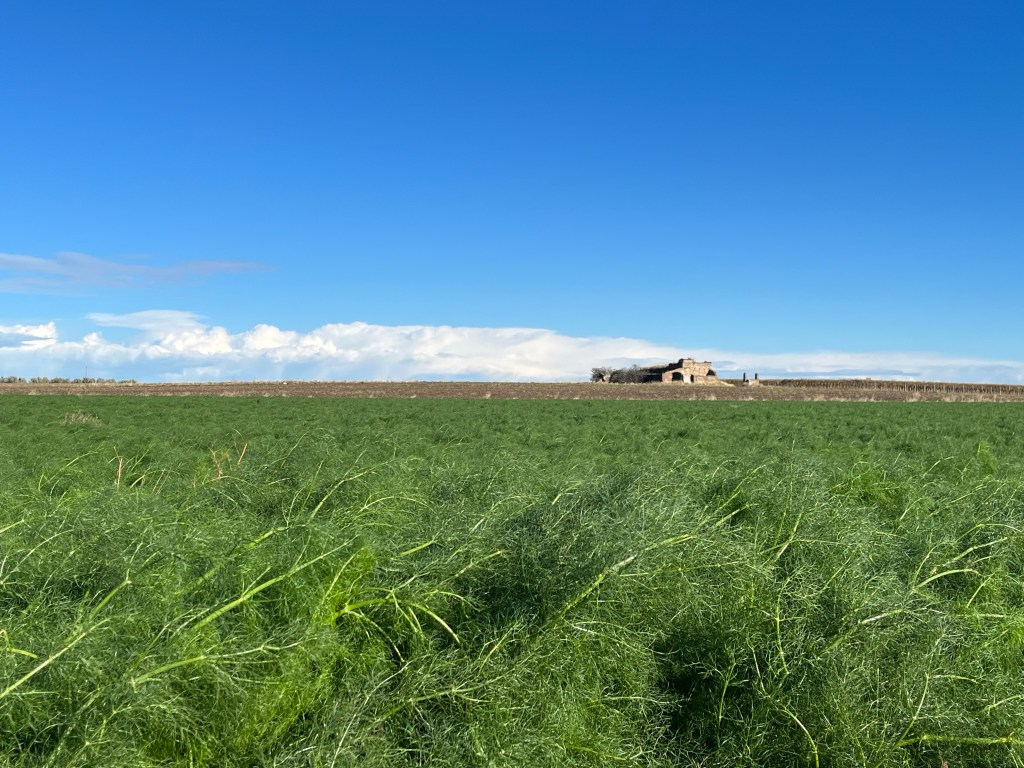
We see the first of the old Trulli, stone buildings in the fields of lettuce and fennel.
Ancient olive trees are a frequent sight today.
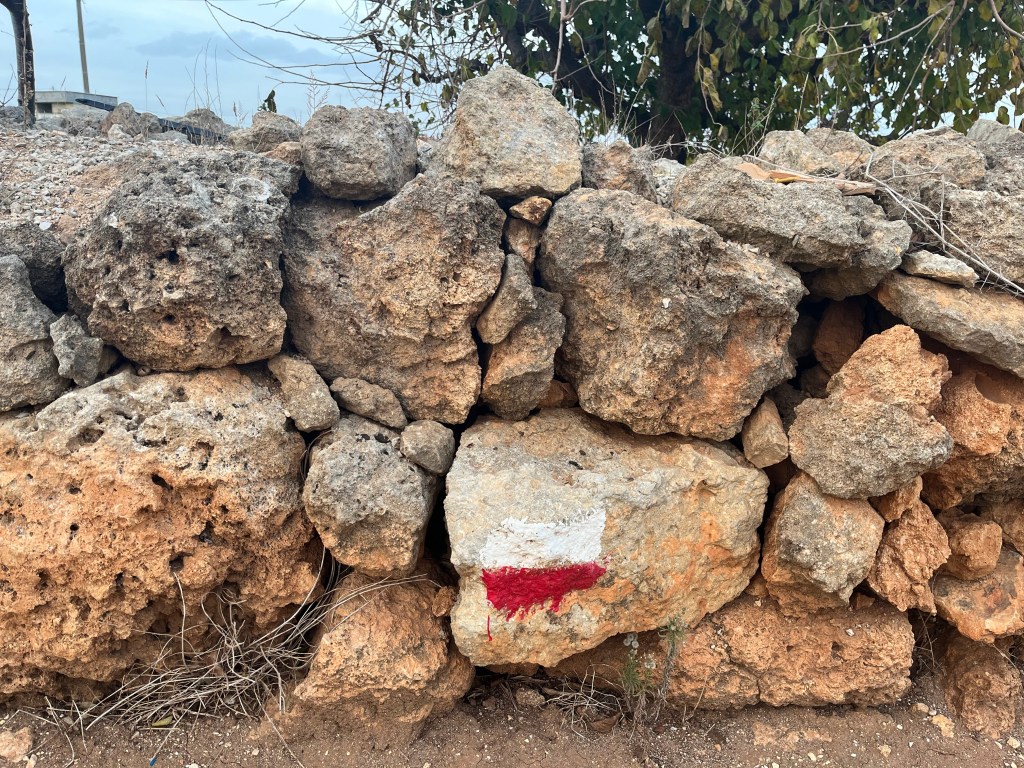
Top tip of the day – Stone walls now surround most of the fields, lining the paths; do not scrape your pack, with it’s pack cover on, against the stones when taking it off for a break – they are sharp and will cut through your pack cover (doh).
We arrive at the outskirts of Mola di Bari with the last of the day’s light and head to our accommodation.
Dinner – Hostaria
Stay – Beans Street Affittacamere. On a quiet pededstrain street in the old town.
With the idea of fitting in some tourist sites with walking, I booked a few nights at an apartment in Barletta. The plan – some pack-free walking along the sections of the via Litoranea along the coast, and train to return (they run really frequently along this route).
I had read about the beauty of some of these old towns along the coast, and figured that the walking would also be scenic. However, I had not been able to find a lot of information specific to this trail towards Bari. Other advantages of an apartment for a few nights – eating our dinner at an earlier time that suits us, and the washing machine
We caught the bus from Cerignola to Barletta – it starts to spit soon after setting out on the bus, and within minutes of arriving at our apartment accommodation, it starts to pour.
We made the trip to the supermarket in the rain, but it stopped later on for an evening wander.
Barletta to Trani 15km,
16deg, sunny, mild breeze
We like Barletta, with its castle, and old town.
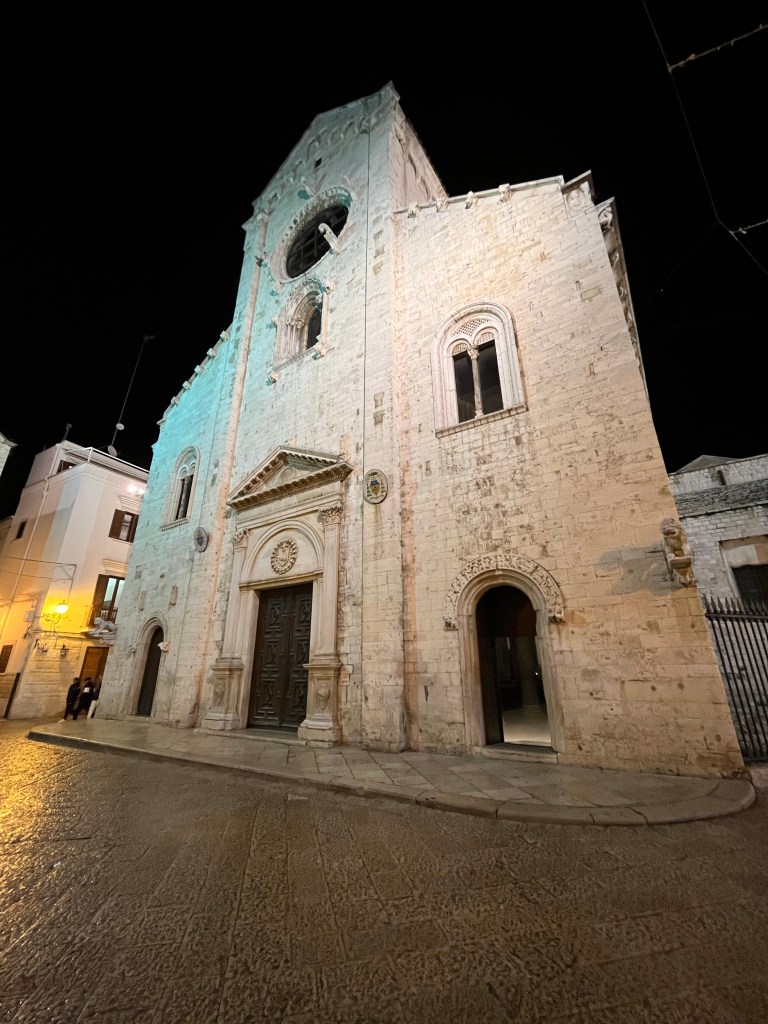
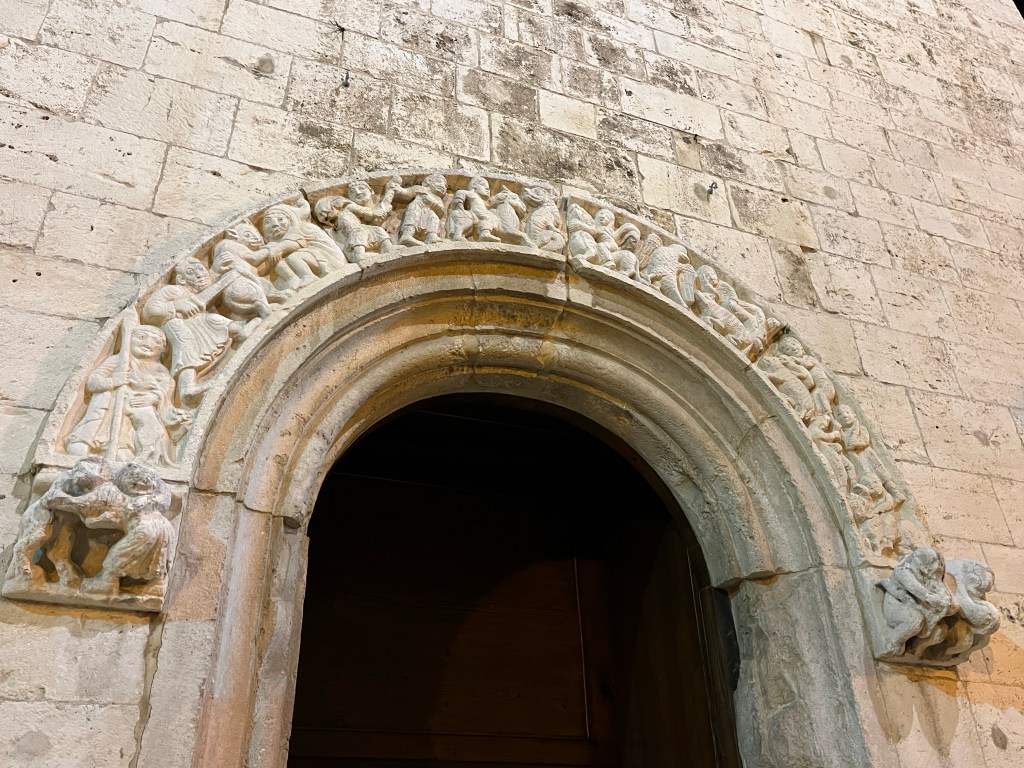
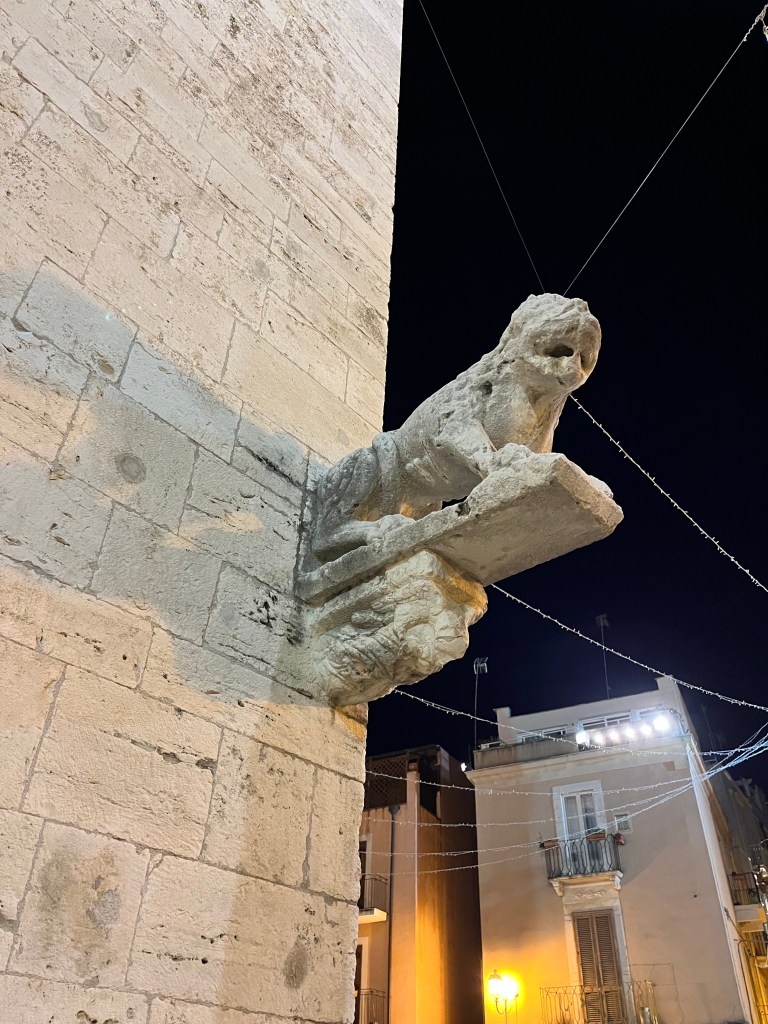
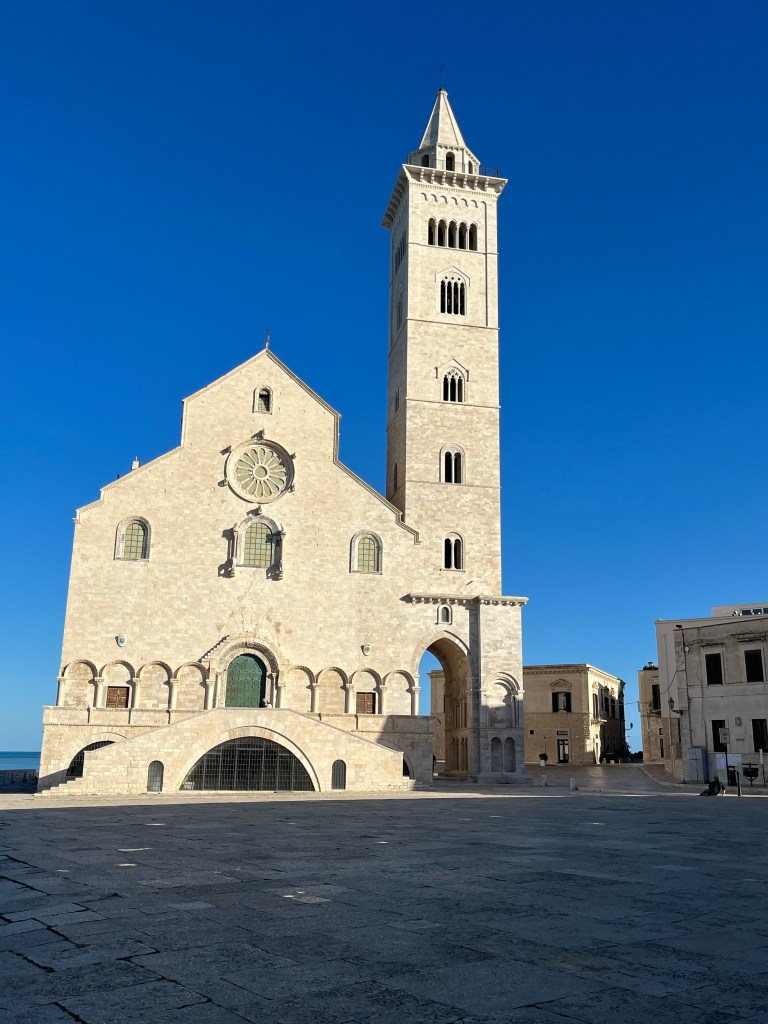
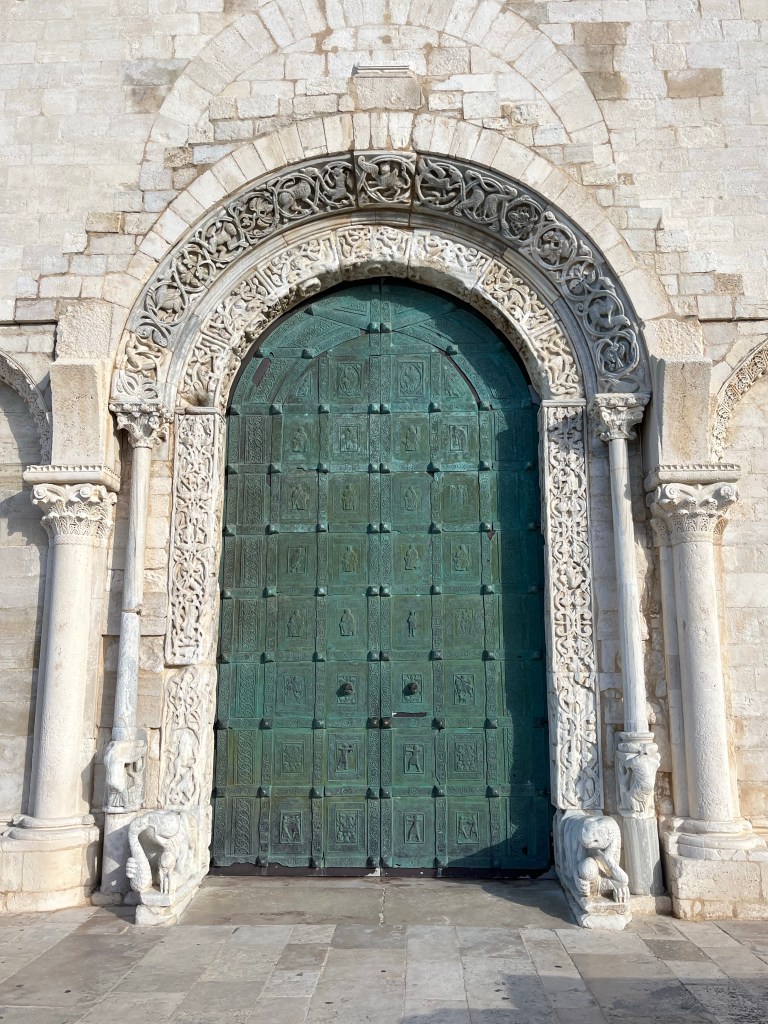
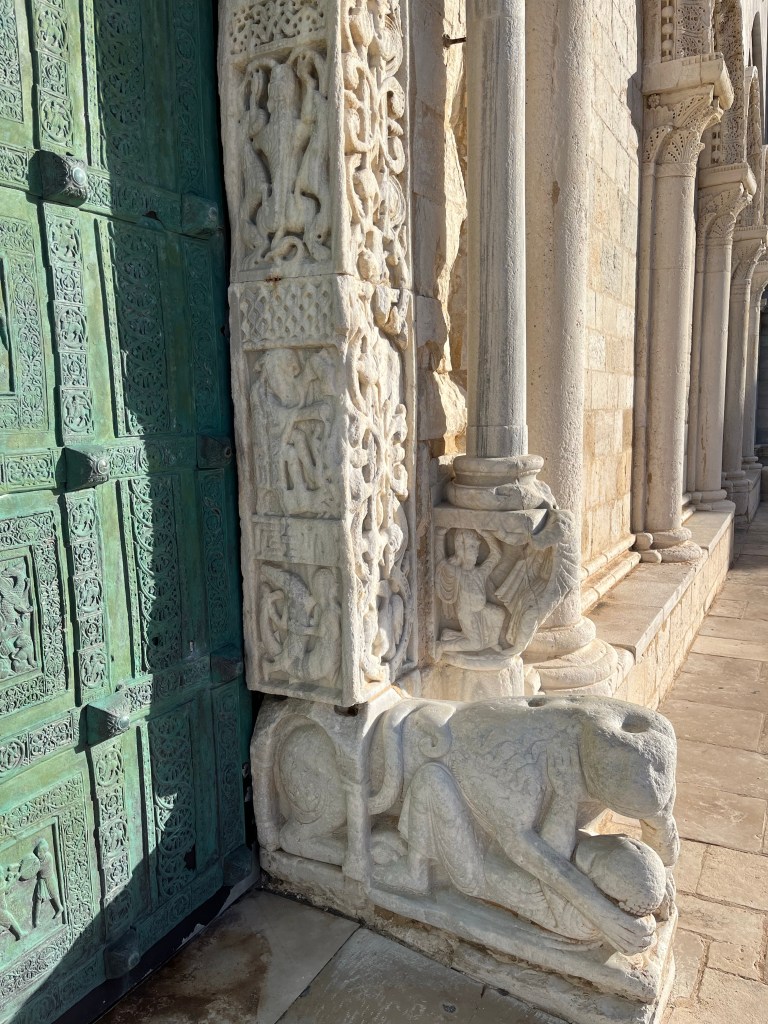
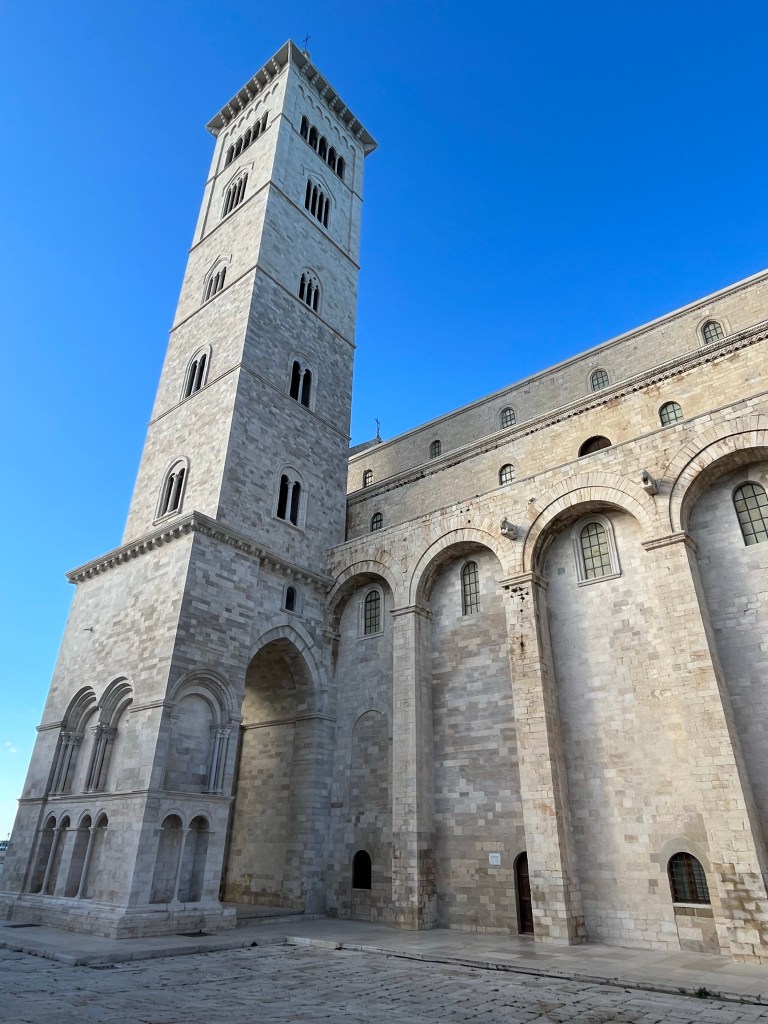
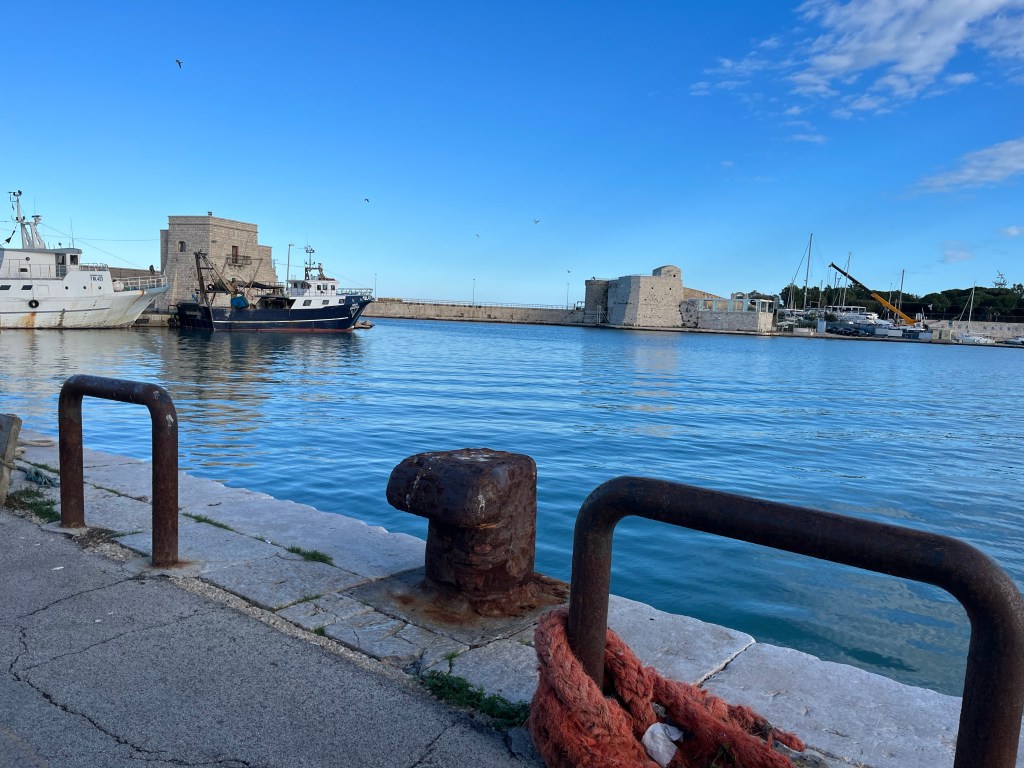
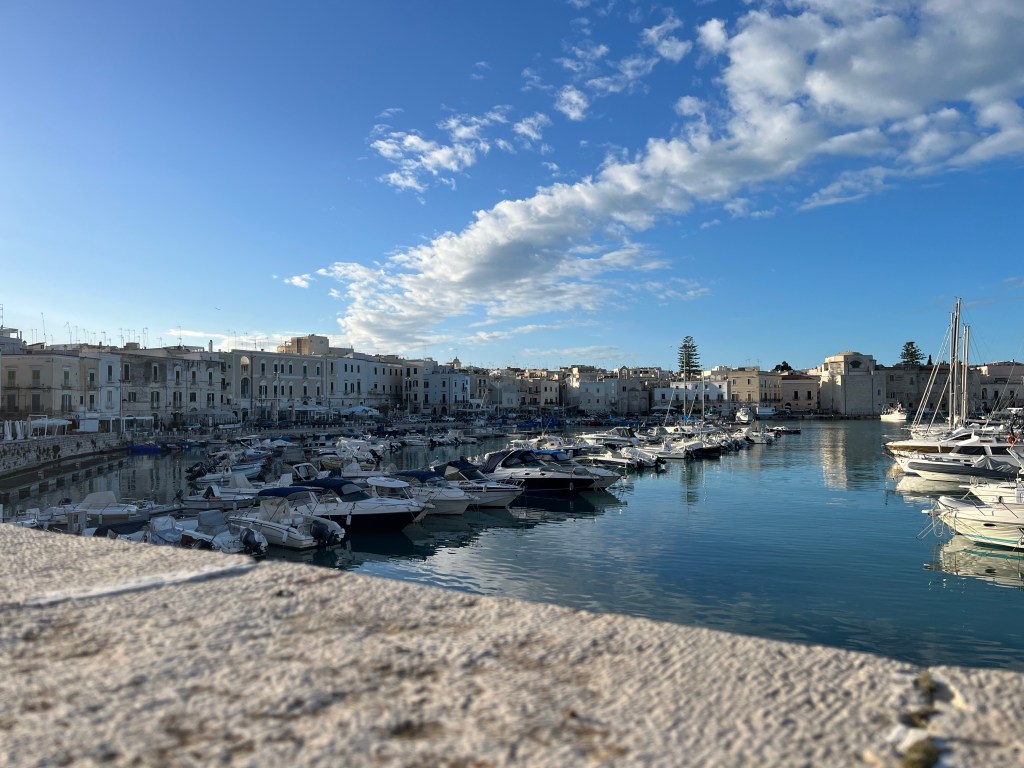
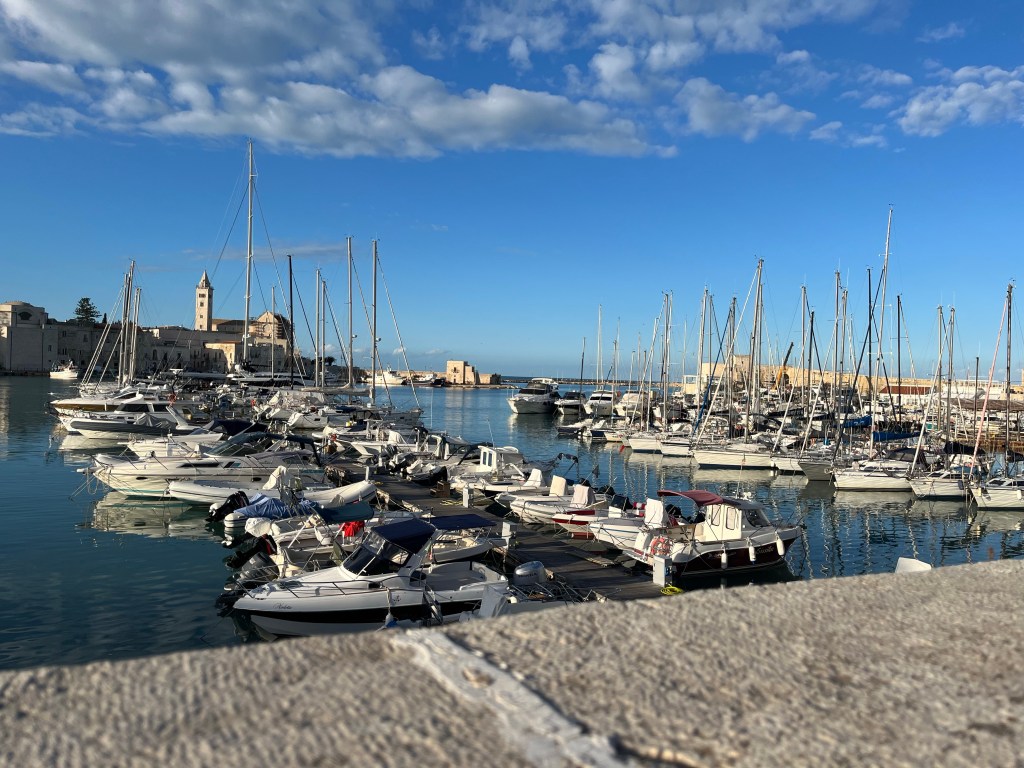
We enjoy our visit to Trani, with it’s cathedral, harbour and waterside piazzas, and grand buildings.
The trail between the two towns though – nothing really going for it other than it gets you from point A to point B.
After our visit to Trani and lunch, we head to the train station to return to Barletta, still with a plan to walk the following two sections the next day: Trani through Bisceglie to Molfetta, a 23km route along the coast, with train pre- and post the walk.
At the station our plan soon changes as we watched train after train being cancelled or delayed that early evening, and announcements about an unscheduled strike the following day (foiled again).
We spend the day in Barletta instead, wandering the old streets, a visit to the castle, the museum and a delicious, relaxed long lunch.
Followed by some Canasta – progress DC 4, Richo 2.
18kms, mostly agricultural paths, until the outskirts of the town; a few spots with mud.
4.25 hours.
4-11deg; sunny, no wind.
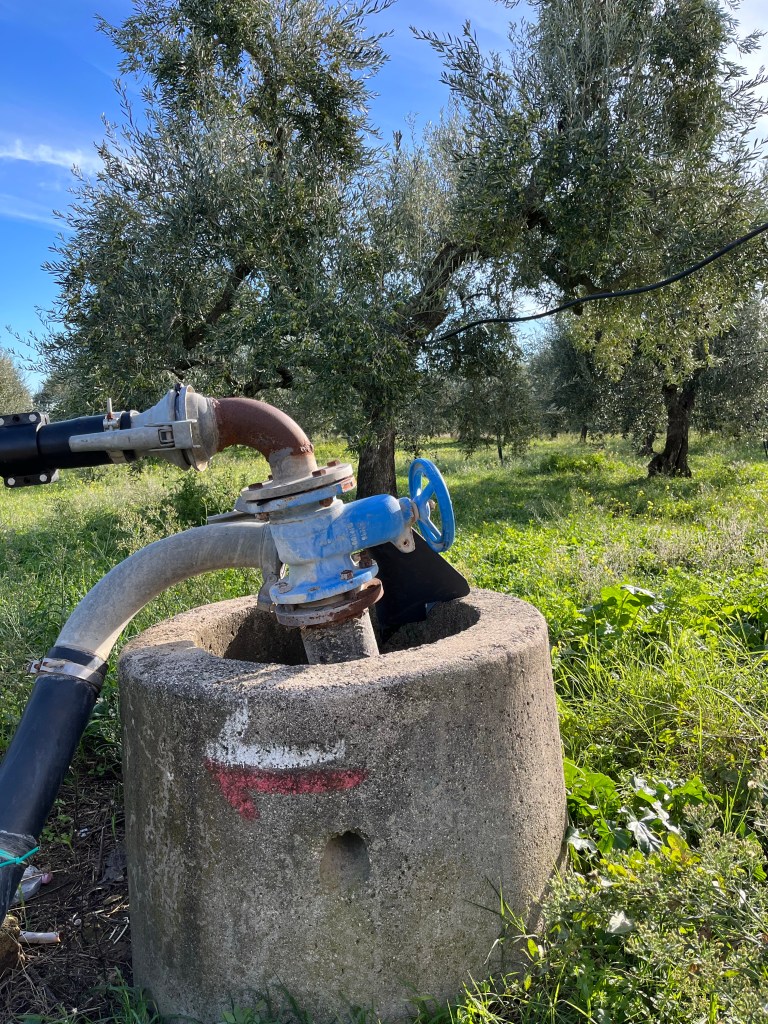
Once leaving the town the path leads you straight into the olive fields, and they are a hive of activity. This day is in stark contrast to the previous days – olives and vines had been seen occasionally, but now they accompany us until the outskirts of Cerignola.
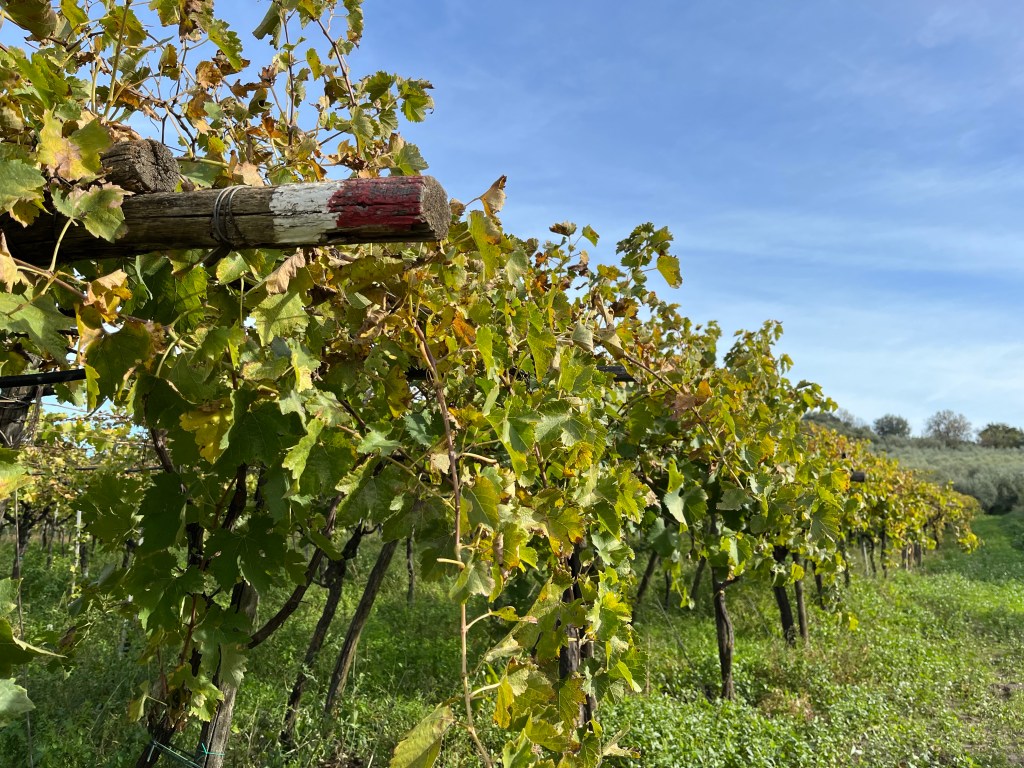
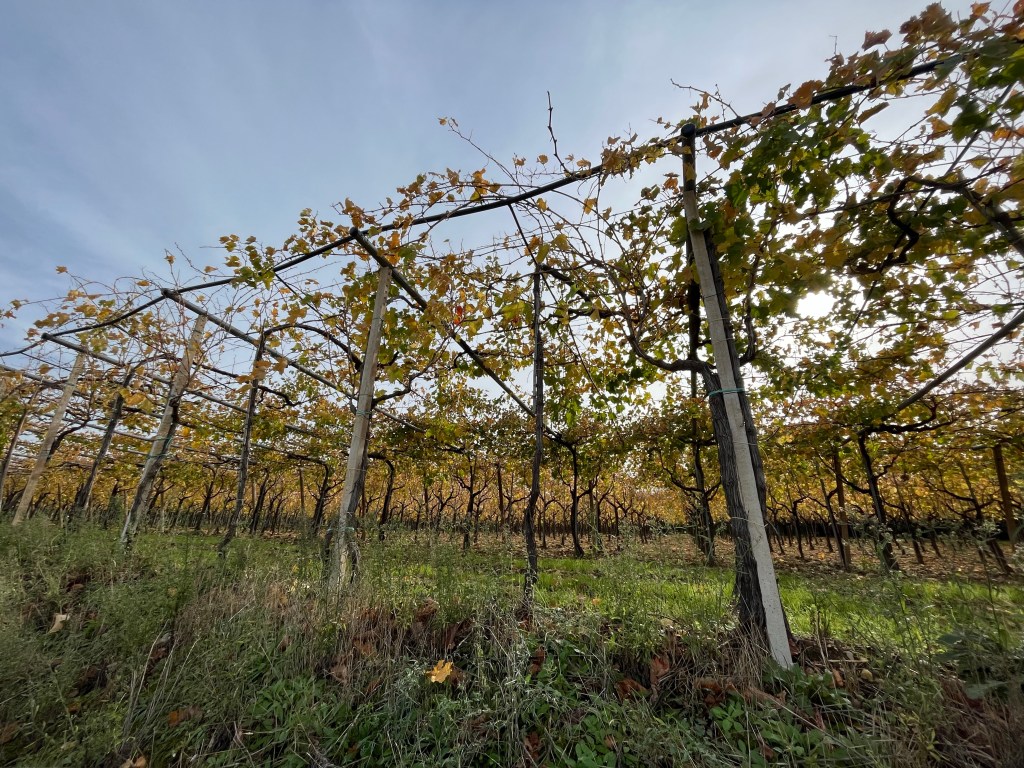
The vines are a range of autumn colours as they continue to drop their leaves.
The olive groves are busy with harvesting, the sound of the machines shaking the olives from their branches, and the tractors taking the olives to the trucks. Every now and then someone wants to know where we are from, and what we are doing? One man tells us that we are not going the right way – the road is the direct route and will save us 3-4 kms from the route in the app.
Even though it is a little shorter today, we arrive feeling really tired. The route into the town feels like such a long slog, and a bit of a shock to us after multiple days of quiet small towns, limited traffic, and the peacefulness of the fields. We don’t take a rest when we should, instead trying to just get it over and done with.
We are staying just near the cathedral, one of the largest in southern Italy.
More rain due tomorrow, and we need to make some further decisions about what we are likely to manage going forward, what we want to prioritise, and still get to Santa Maria de Leuca in the time we have available, covering what we can, and still smelling those roses along the way.
My plans included stages along the coast going into Bari, and heading inland after Monopoli to walk stages of the Via Ellenica (the path from Brindisi to Matera) towards Brindisi, through Alberobello, Locorotondo, Cisternino, and Ostuni.
Stay – B&B Piazza Duomo
Eat – Pizzeria Scorpion dal 1980 – excellent pizza at a fantastic price.
2-11deg, sunny, but the chill in the breeze means we keep some layers on while walking today.
20kms, a bit wet underfoot in places but no mud on the gravel roads. We are really glad we did not take this on the day before as it is very exposed out in the fields almost all day.
Highlights – A scenic day once into the agricultural fields until Stornarella, then the amazing murals throughout the town of Stornara.
6.25 hours, including a long lunch break at a restaurant in Stornarella.
The first surprise as we head out of the town is the green hills of the Apennines now have a fair covering of snow.
We leave the road after a couple of kms and are into the fields.
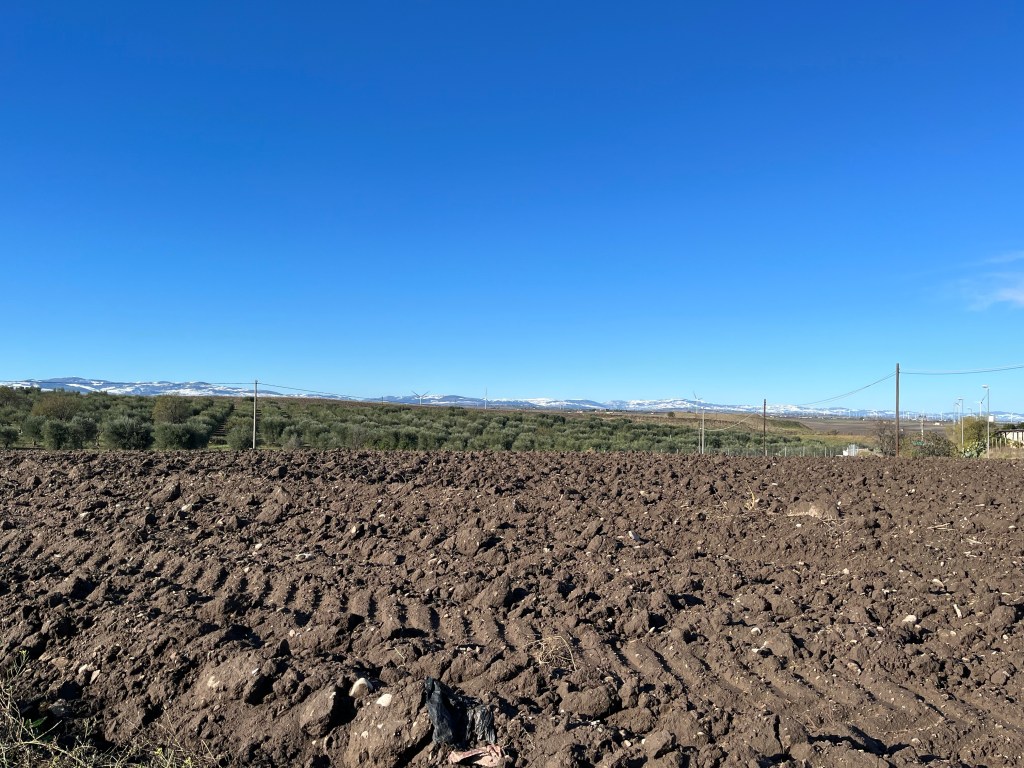
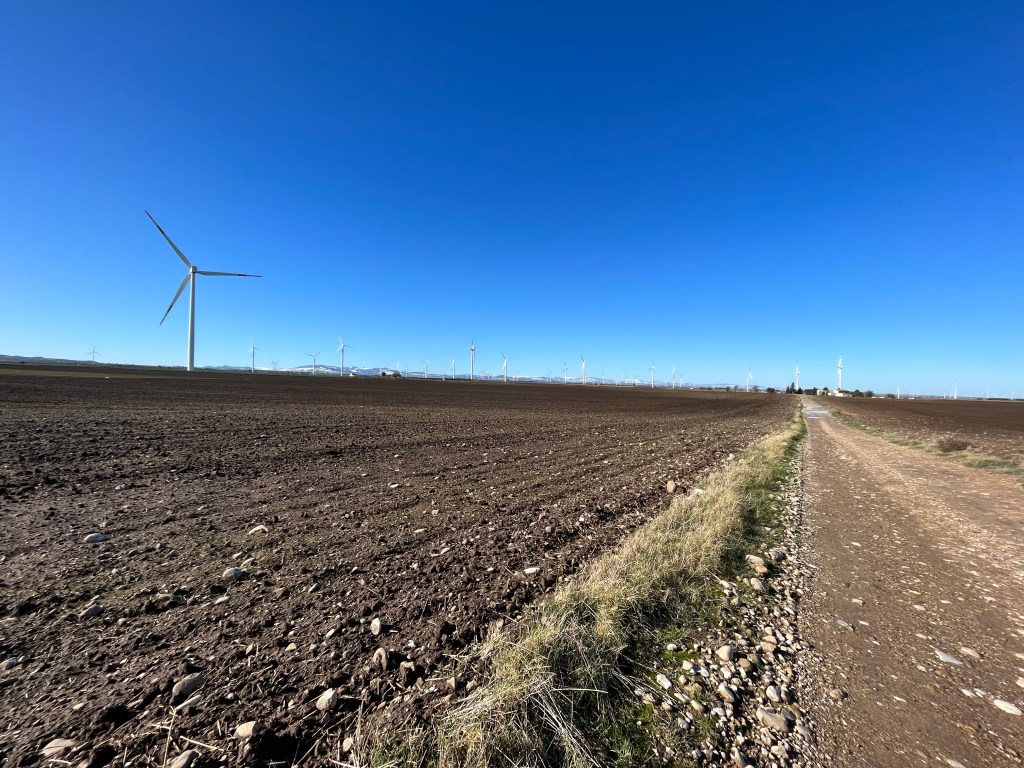
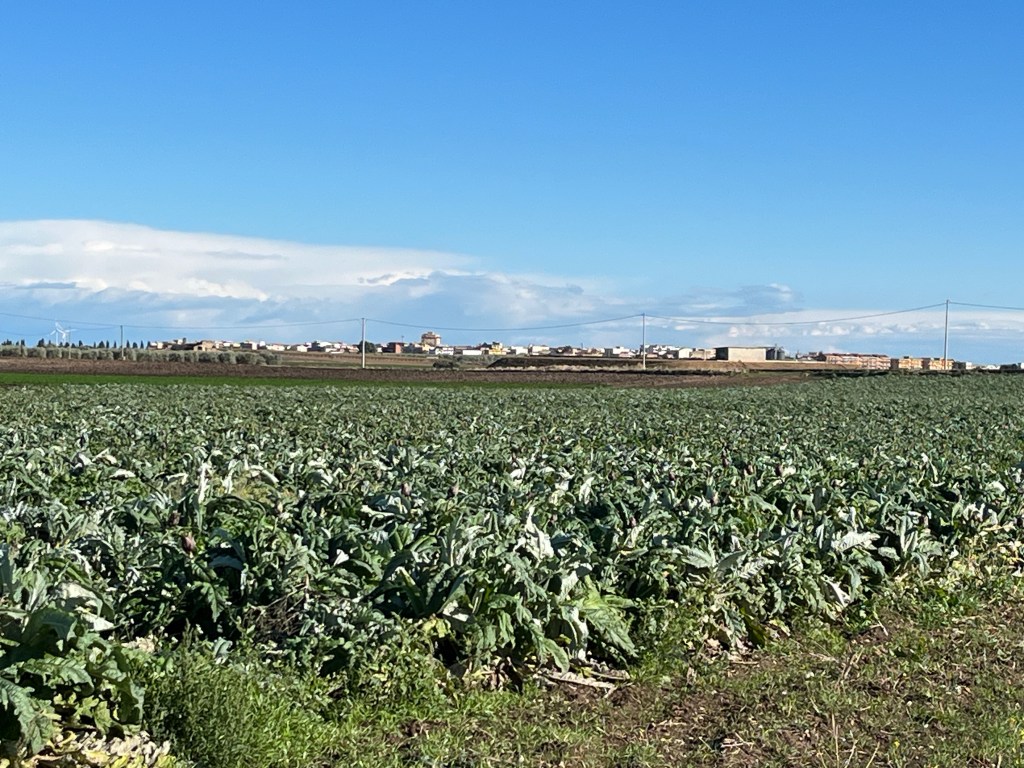
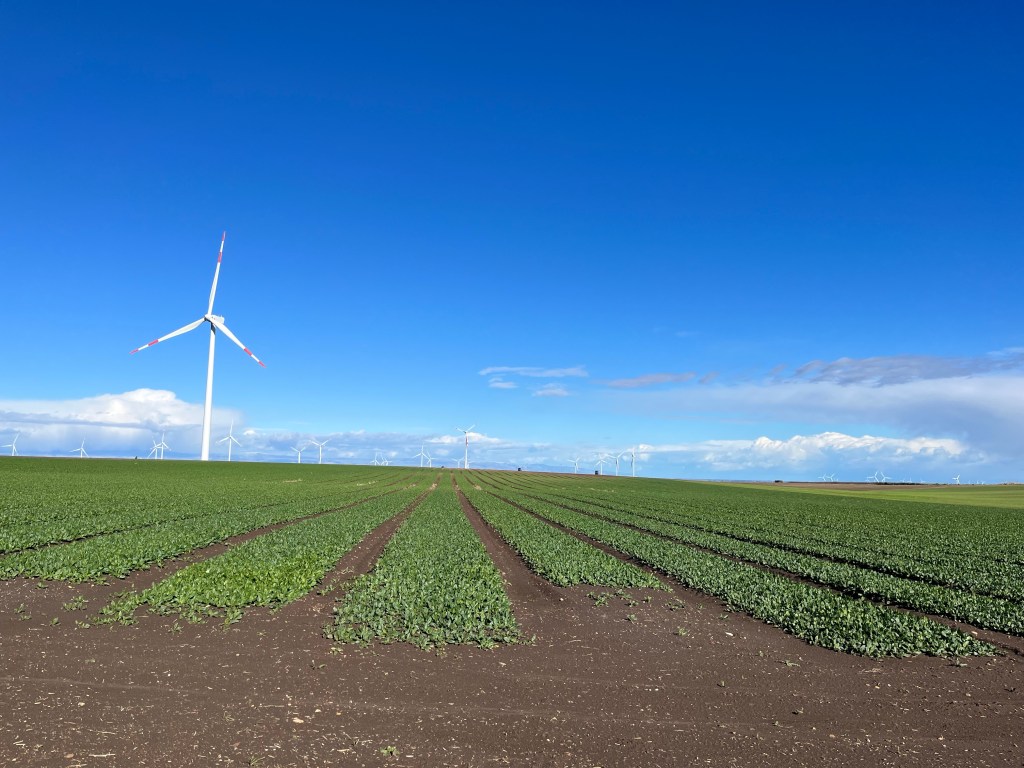
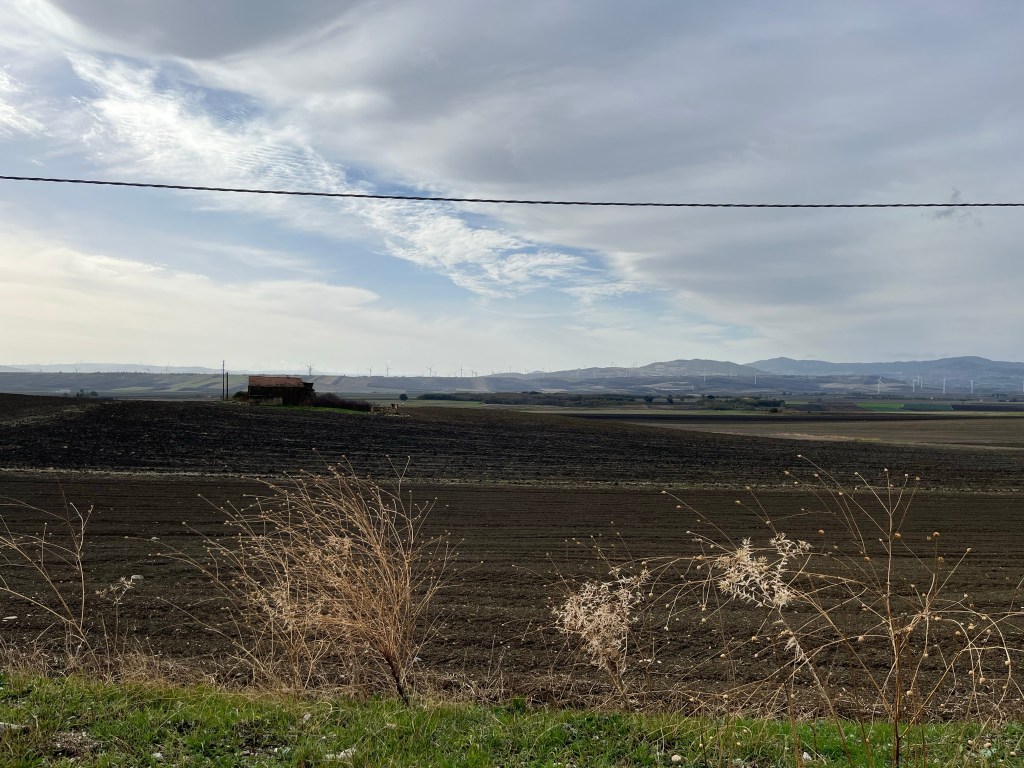
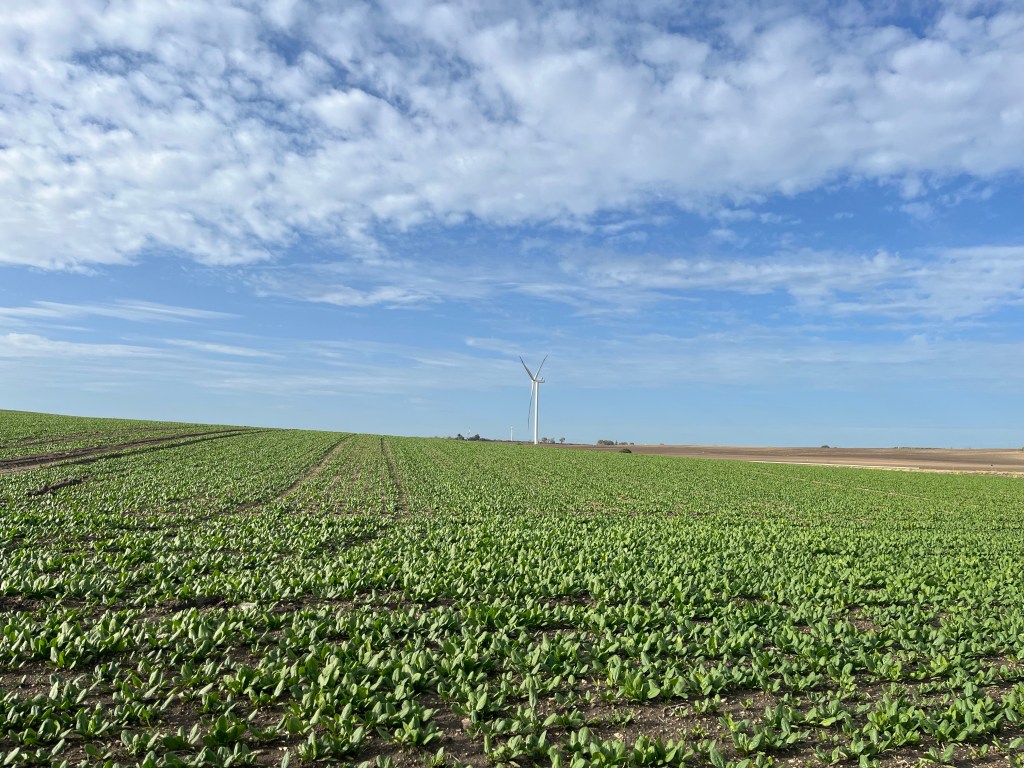
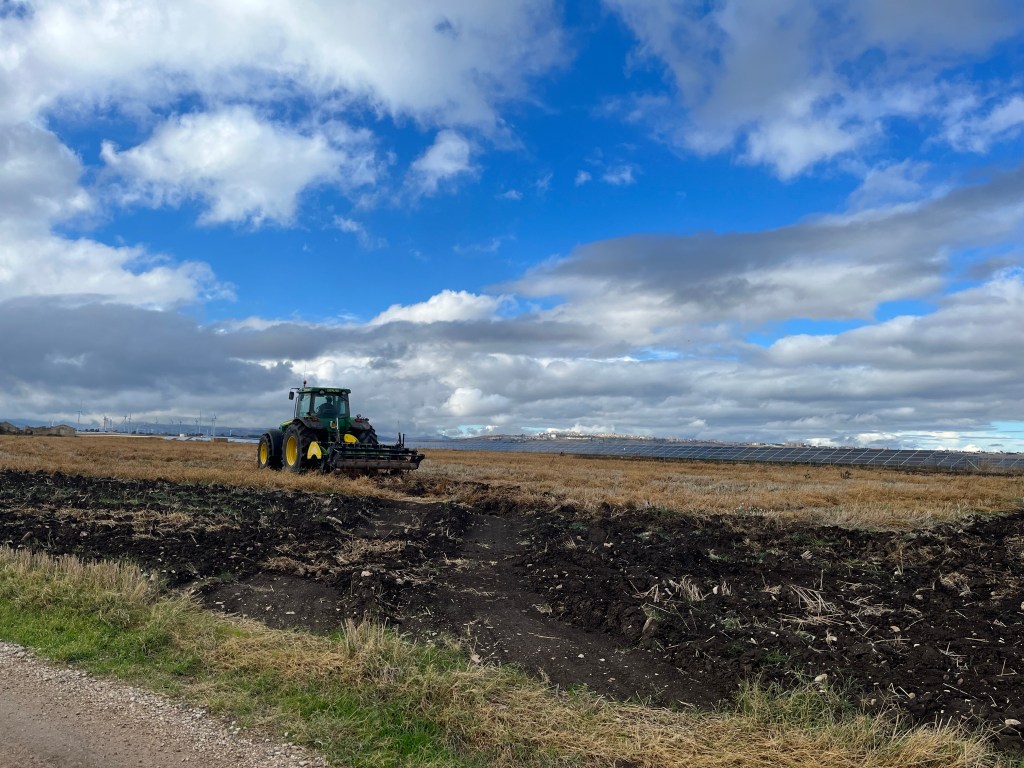
Through the fields today we see – artichokes, fennel, parsley, brassicas, broad beans, spinach, and other seedlings too small to identify. Many of the fields are ploughed and you can see that the black and brown deep soil is often chock-a-block with rocks. I liken it to a picnic bar – then all we can think about is how much we want a picnic bar.
While we see the occasional car and worker, it is again a really peaceful day in the fields with the sound of the starlings, our footsteps and the click of the sticks.
In Stornarella we hoped to find somewhere open for lunch, but all the bars seem to be closed, or closing. A woman at one bar points us in the direction of a restaurant that is open, despite the late lunch hour – we never would have seen it ourselves. We take our time with a delicious lunch at Ristorante Godot, and they send us on our way with a handful of chocolates.
After lunch the last stretch is along the bicycle/walking trail adjacent to the roadway stretching straight out between Stornarella and Stornara. Many drivers seem to treat it like a racetrack.
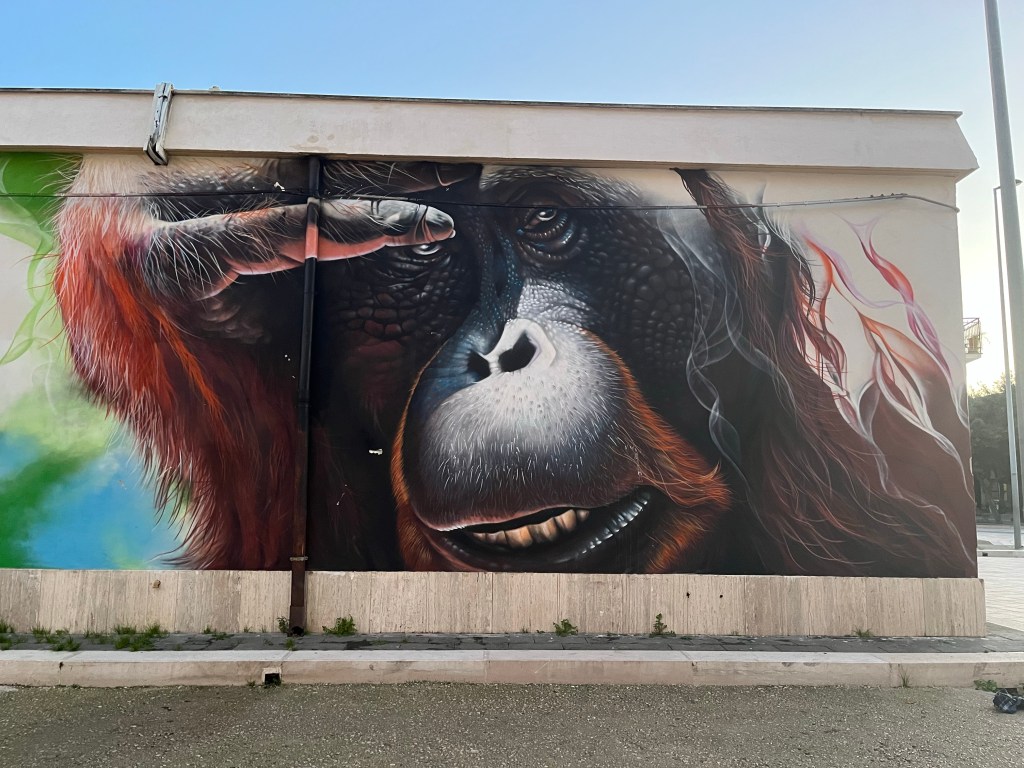
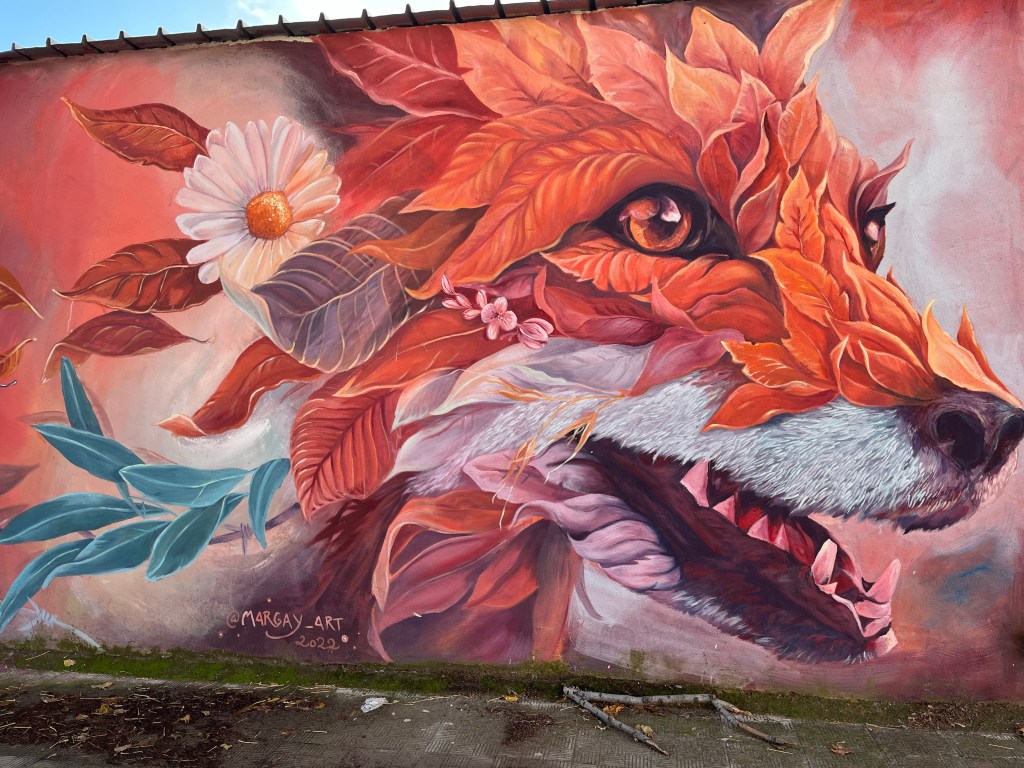
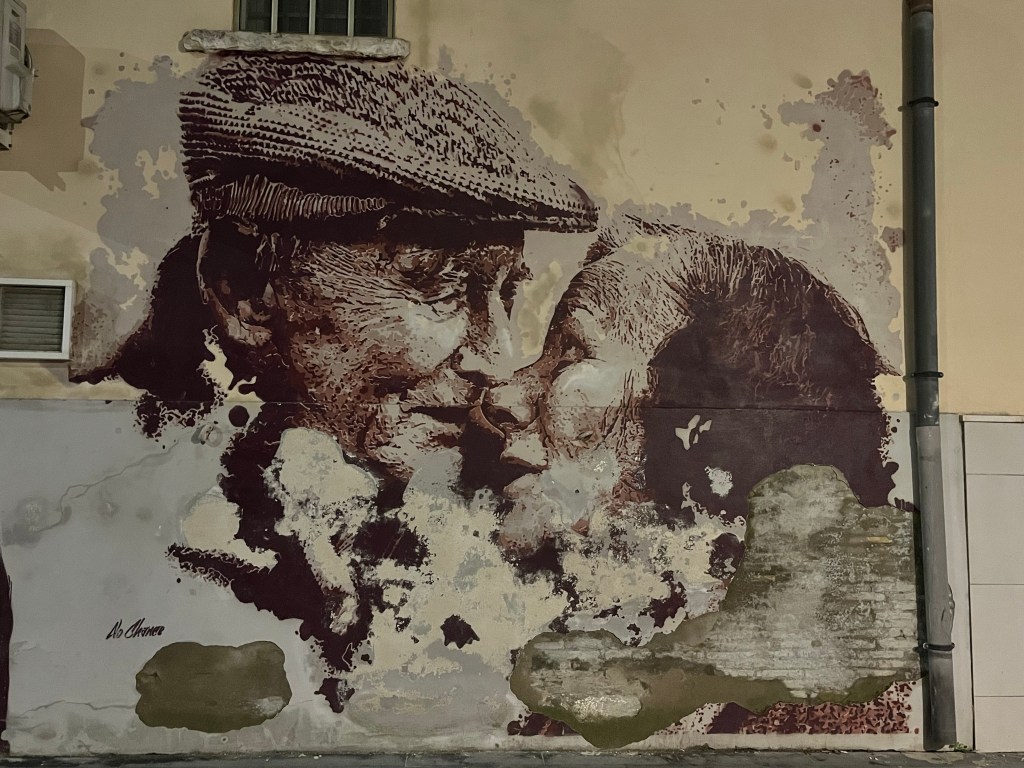
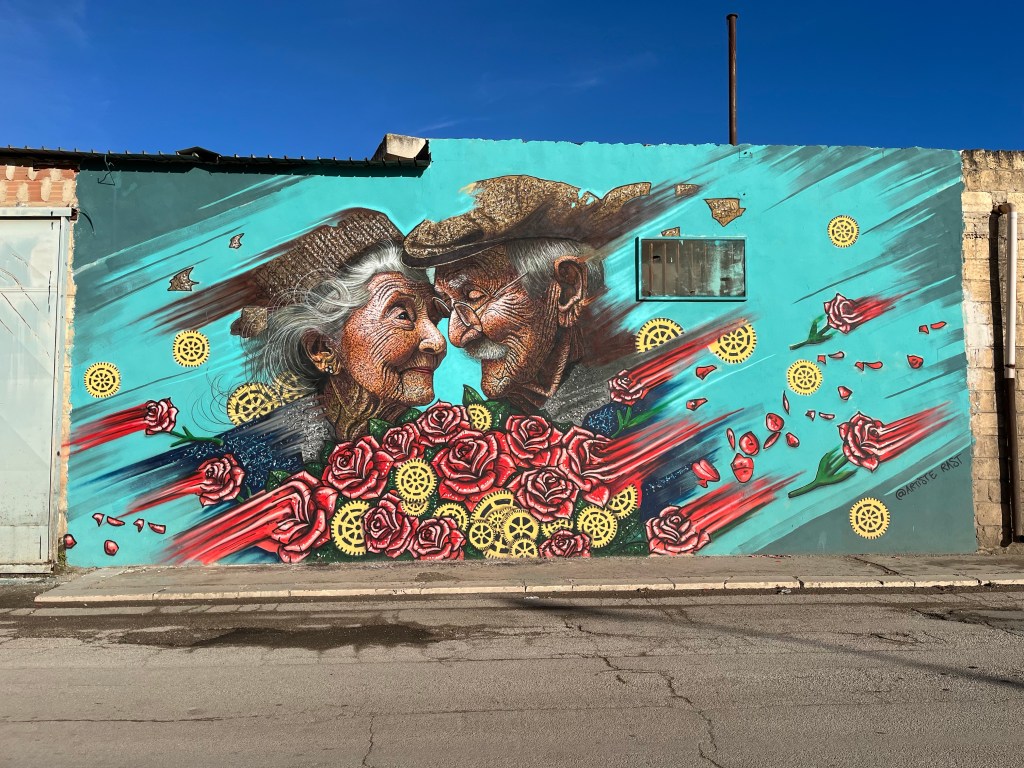
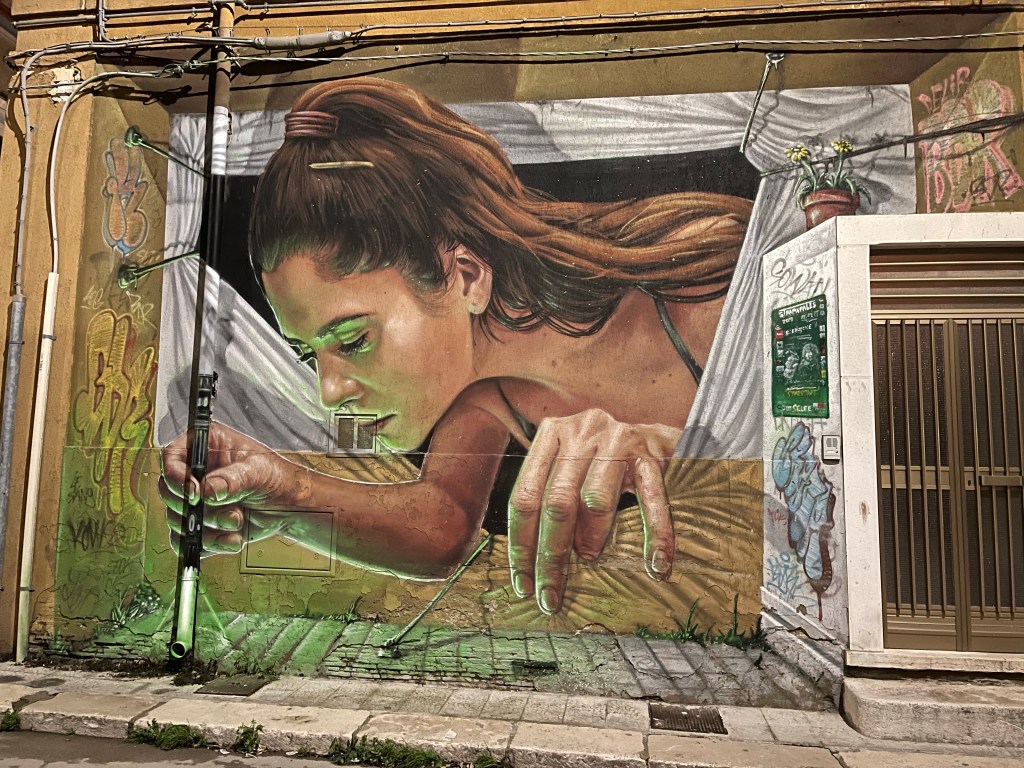
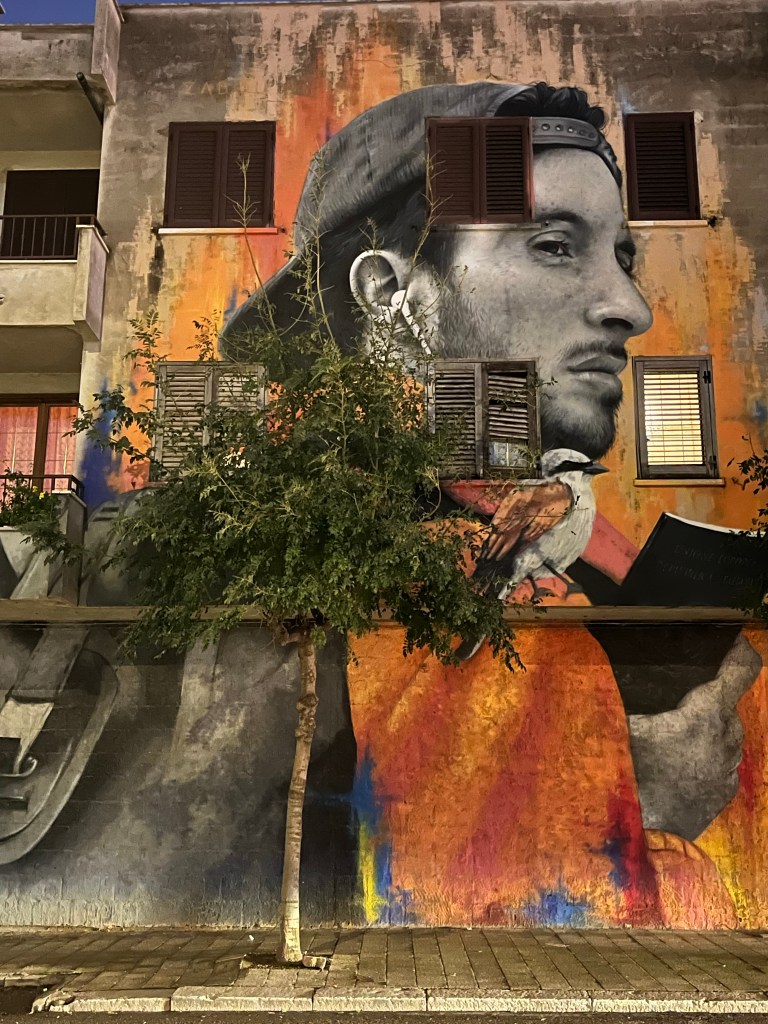
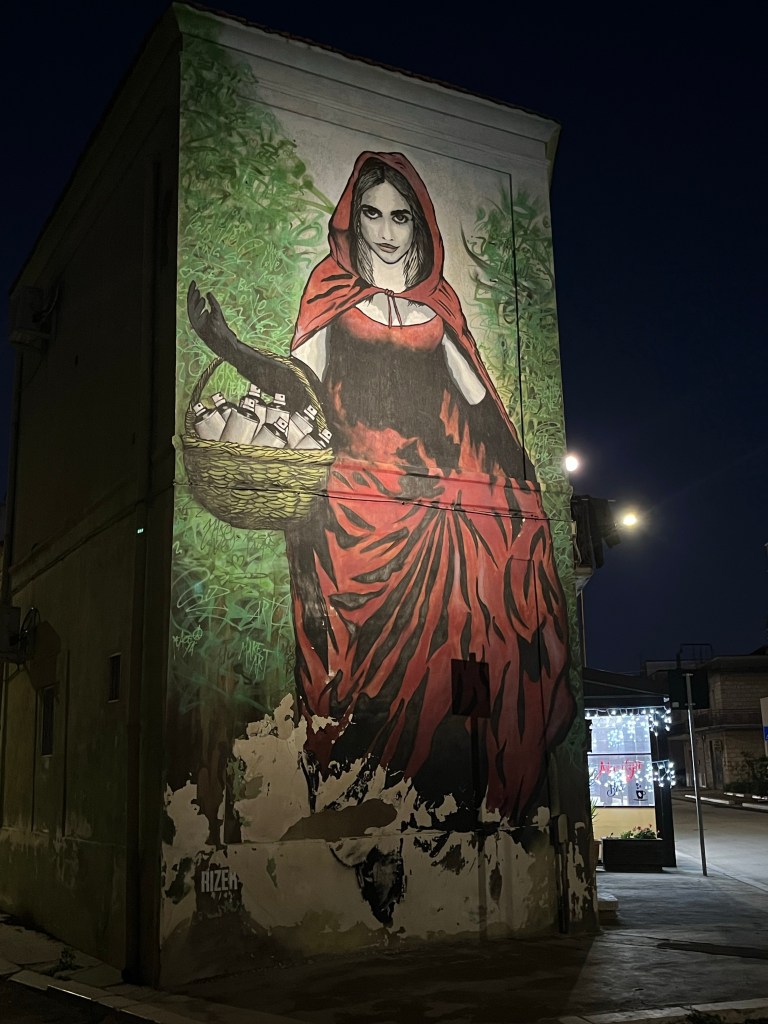
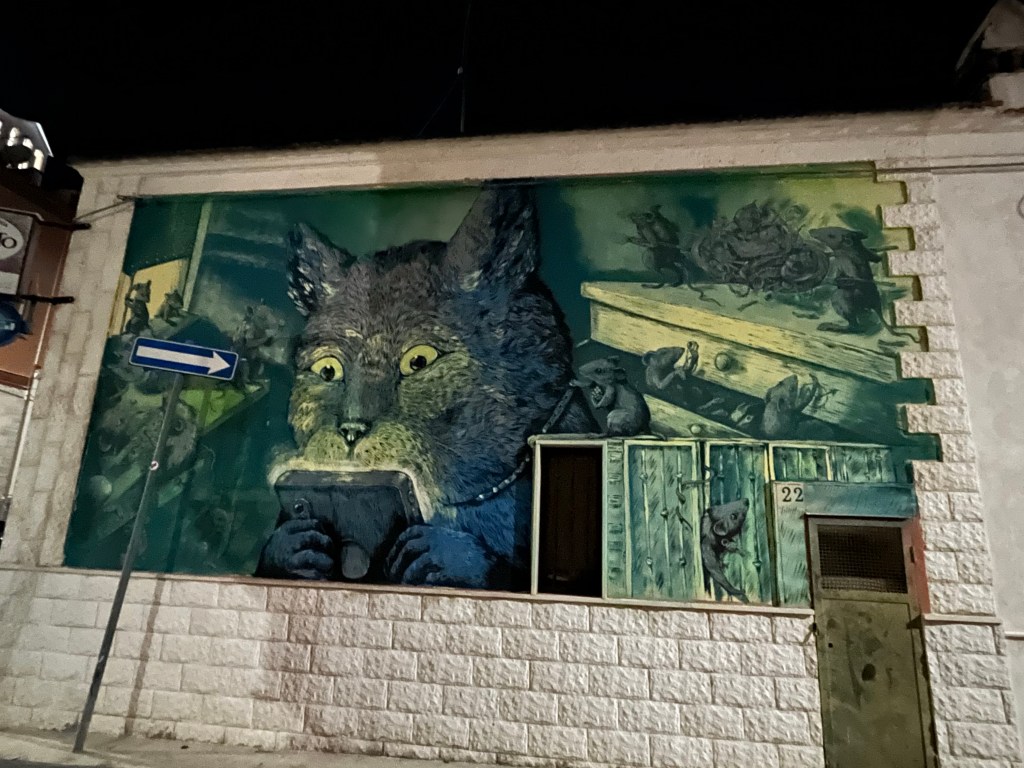
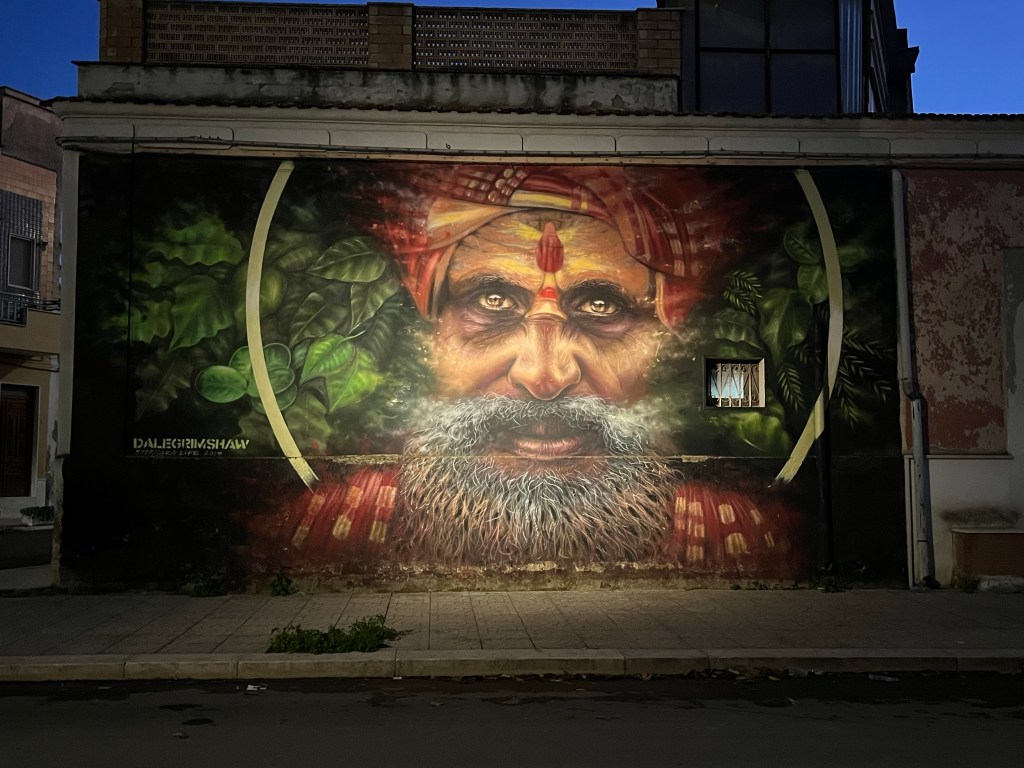
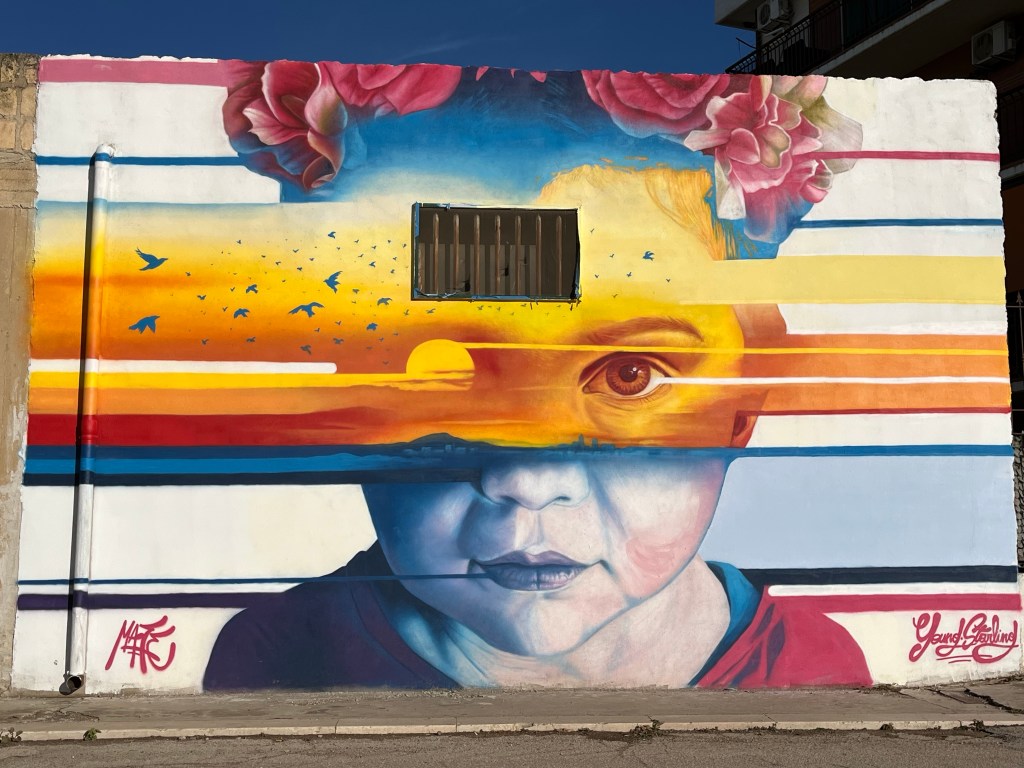
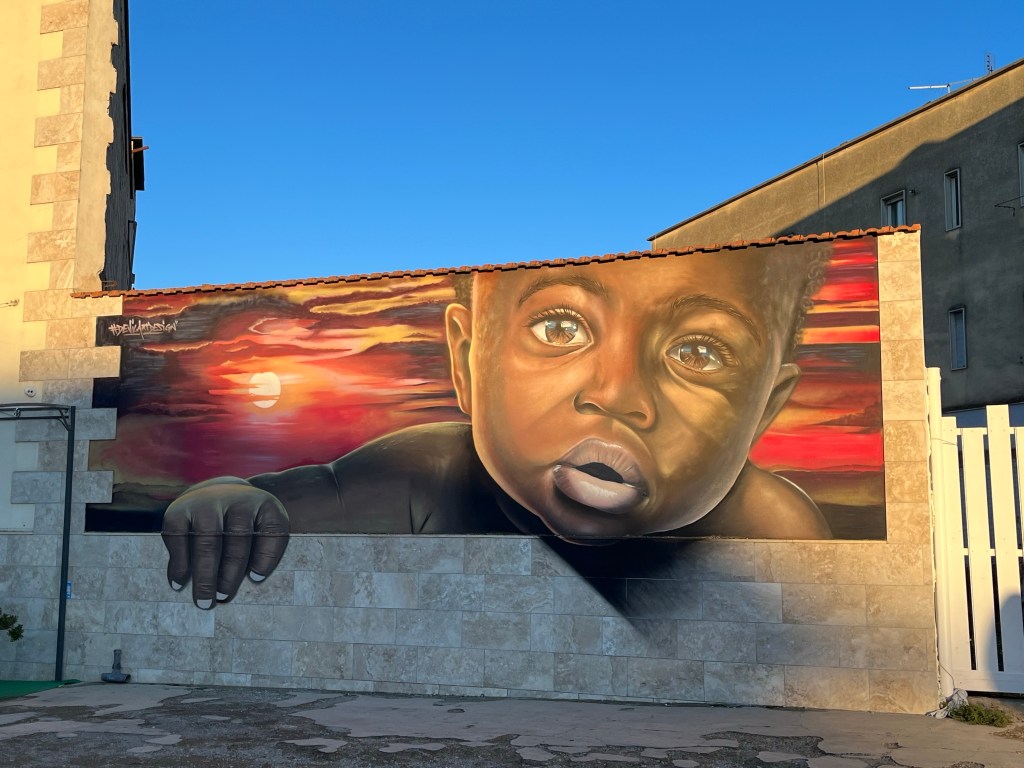
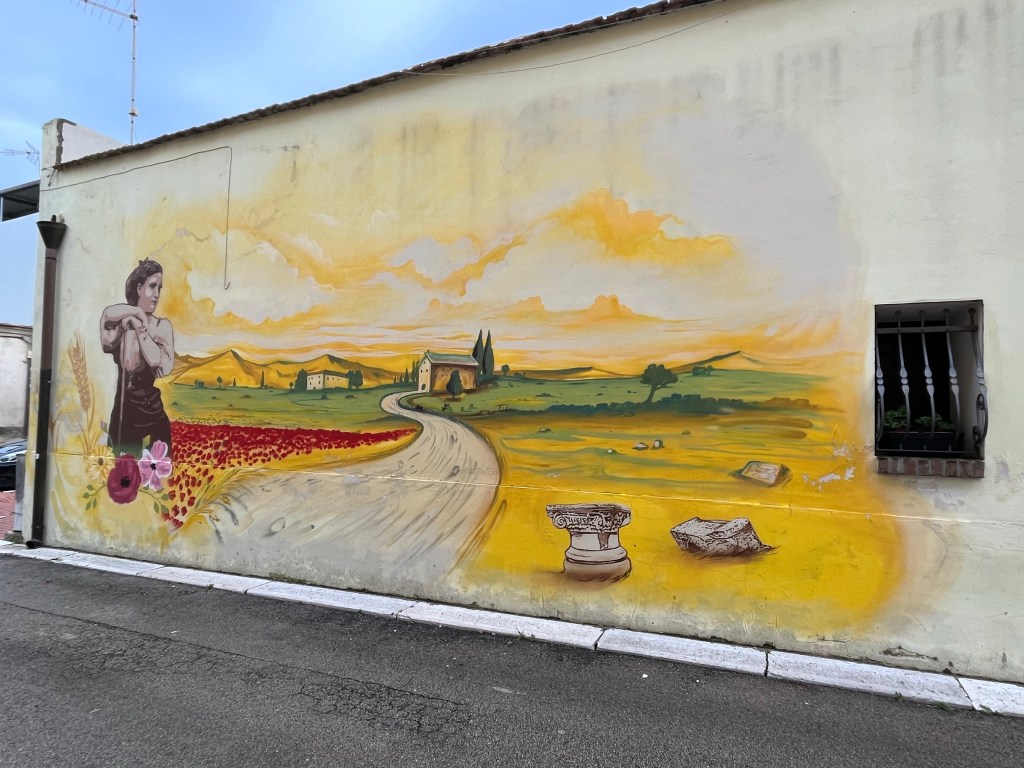
The second surprise of the day is how amazed we are by Stornara. I had read about the murals in Stornara but we are still amazed with how impressive a sight they are.
We locate a few on our way to the accommodation for the night, then head out in the evening to see what else we can find.
A sample of the murals we located, both that evening and heading out of town the following morning.
Stay – B&B Piazza Matteotti – as recommended in the guidebook, with a VF stamp.
Eat – we picked up some pizza slices from Excaliber pizzeria.
20km, a few small hills, lots of fields, and plenty of mud in the latter part of the trail. 5.5 hours, with breaks, and sticky mud.
12-16deg, mild breeze.
Highlights – the big sky, and the colours of Ordona.
After dropping by the supermarket we head out of town. Initially on bitumen along a very quiet road, the town disappears from sight quickly. Past fields and more ruins, after our first rest, the road changes from bitumen to gravel, with a few puddles.
The trees and weeds by the roadside have fine filaments of spider webs, and many other filaments flutter in the breeze across the road. We see some as the light shines on them – we see most trailing off each other.
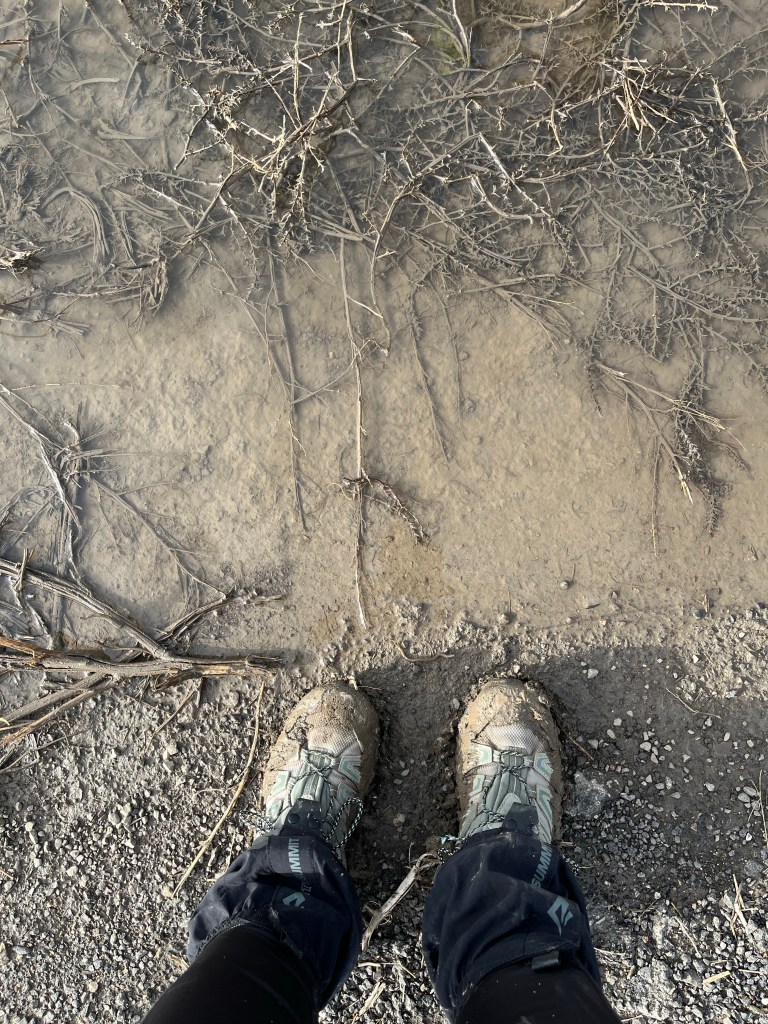
There is a long section along a road by the freeway, with the occasional car or truck, but plenty of room to move off the road. It is after we turn off that road, and onto some agricultural roads/paths that we hit the mud. It is sticky, clinging to our boots, and slows us down. When you step back onto gravel, the sticky mud picks up the loose stones – our boots are weighed down by mud and stones. We try cleaning them off in puddles, but each time there is more mud ahead, especially when we reach the newly planted fields of spinach.
During the last stretch towards the town we think we are free of it, but more awaits us.
While not as scenic as the previous day out of Troia, and there are some sections with traffic noise, it is overall very peaceful. Most of the day we are accompanied by the sound of the birds (starlings) over the fields. The familiar sound of olive harvesting is present before we arrive at the freeway; in another field the olive trees look in decline.
Stay in Ordona. Winter has arrived.
The forecast for the following day is very cold, persistent rain and strong winds, with a thunderstorm.
We settle for another day in the very cosy BnB. We have layers for cold, but cold and wet with strong cold winds is another matter.
In the end, the day-long rain doesn’t eventuate but the cold and severe wind keeps us hunkered down for most of the day, and the thunderstorm appears in the early evening.
We do venture out a few times for a wander around the small town. We even briefly thought about a visit to the archeological zone (a couple of kms outside the town) but a few minutes outside put that foolhardy idea to rest.
When I head to the supermarket for some cornflakes, it is 8deg; a couple of hours later, when we go for a walk around the town, it is 7deg – one of those days when it starts cold and just keeps getting colder.
There are a few people in their cars, but, apart from school pick-up, very few out on the streets. A couple of dog walkers, and a few people on their way to the butchers, or supermarket.
There is a man with his truck, circling the town and calling out the products he has to sell.
Through the middle of the town there is a pedestrian area, that to me feels like I am on the set of a western. While the wind blows a couple of pieces of rubbish, and someone’s doormat, down the deserted street, I almost expect to see tumbleweed.
Stay – La casa di nonna Lina – a beautiful little apartment, with a washing machine, and an official stamp. Recommended in the guidebook.
Eat – We had dinner at the very large, seafood restaurant, Sapori di Sicilia. Otherwise, snacks, fruit and panini made up from the supermarket.
It remains cold the next couple of days, but dry.
The knee issue that stopped us, and then has kept us going slowly, now appears to have resolved – hoping we can really push forward through Puglia. Let’s see what the weather has in store.
After a few tourist days visiting Benevento and Foggia, and taking the very scenic train trip between the two through the Apennines, we return to walking. We have only snacked on the VFS in southern Lazio and Campania, but hope we can cover most of Puglia on foot.
Part 1 – Troia to Giardinetto.
13 kms, 3.5 hours.
15deg, cloudy, a bit of mud, a few spits of rain.
Highlights – views across the plains and the Appenines.
We arrived in Troia by bus from Foggia by 9.30. The bus driver has some music on – mostly some easy listening, seventies and eighties, including with a bit of Prince in there. The opening notes of “Sweet child of mine” begin, but the bus driver is clearly not a fan – he skips through to the next song. “Where do we go now?” – that is surely the soundbite for Pellegrini.
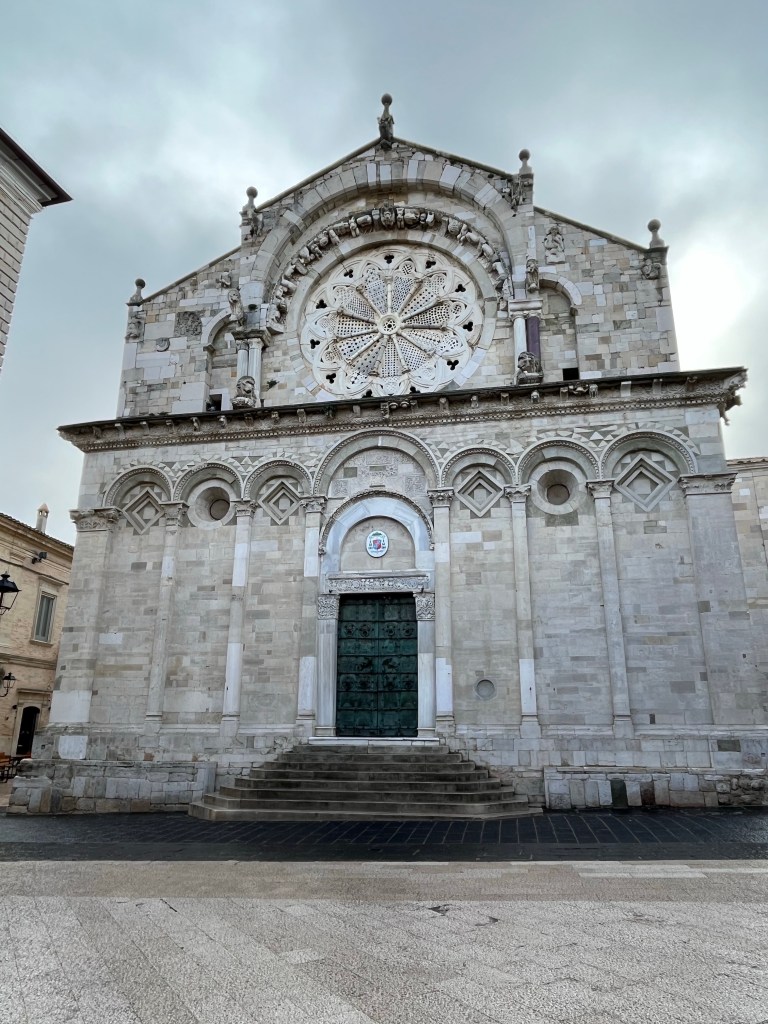
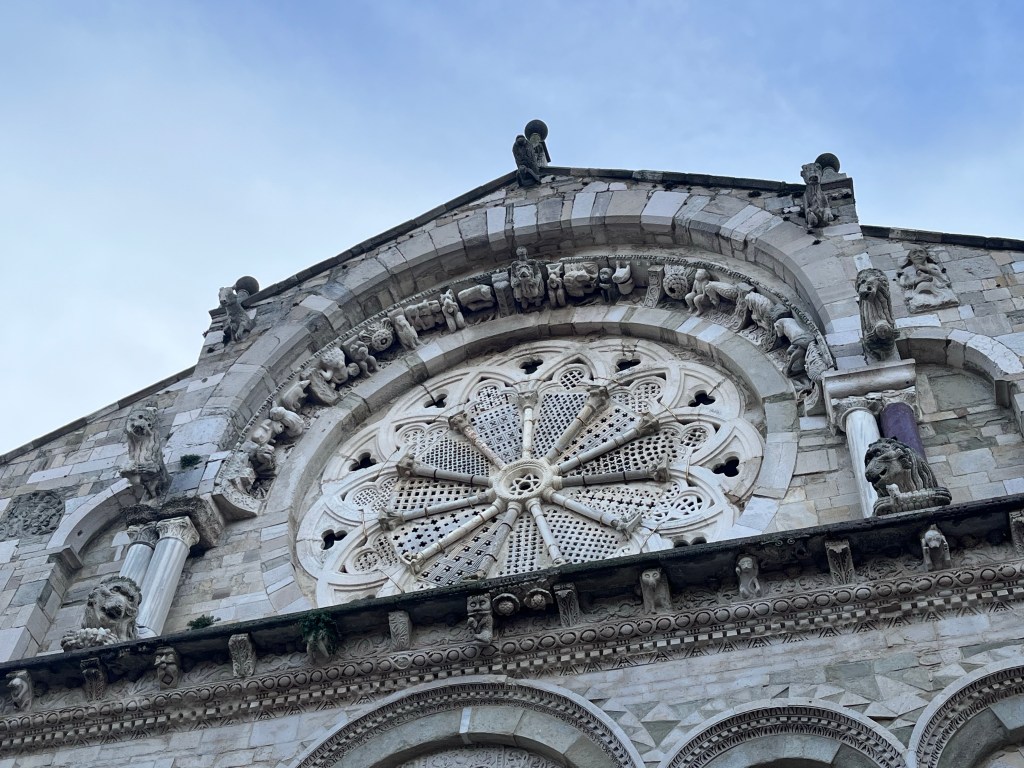
We walked straight into the piazza with the cathedral with its magnificent facade, its Rose window, and various animal carvings that range from mischievous monkeys to a stunned dog-like creature that looks like it woke up high above the ground but is afraid of heights and wondering how it got there.
I visit the information centre in search of a stamp; the cleaner is there alone but gets on the phone, and soon I have stamps in the credentials.
Out of the town and slowly down a steep slippery road. Once we are down the hill we step straight into the mud. By the time we step onto the asphalt road we have gathered a good covering of mud and stones on our boots.
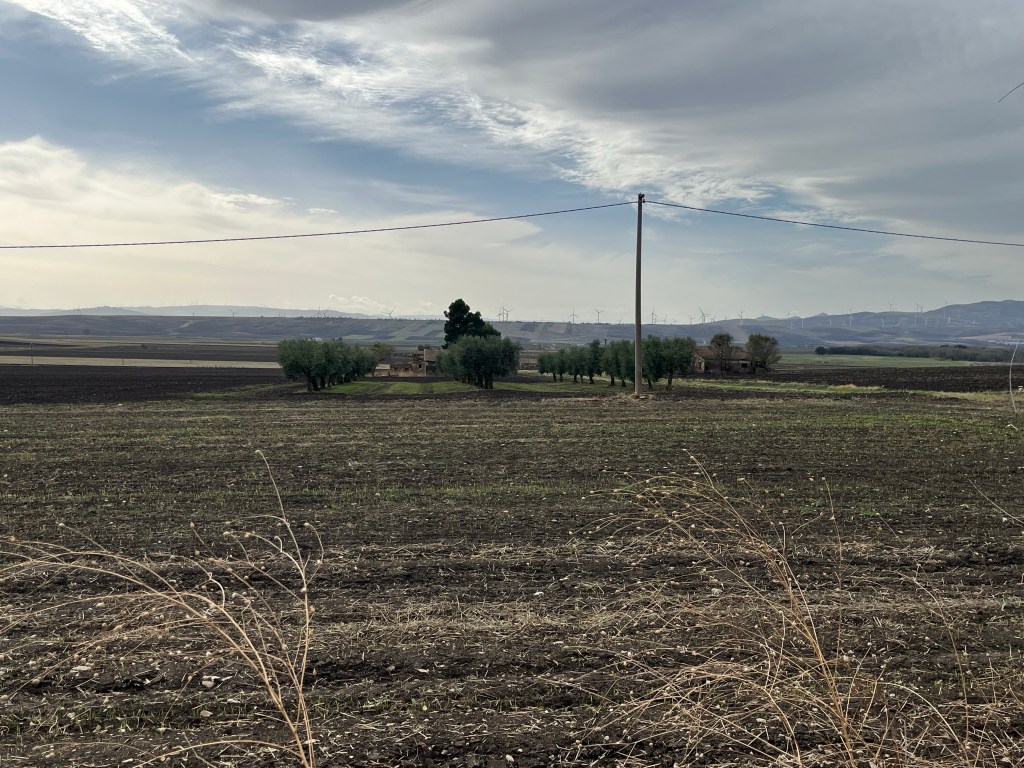
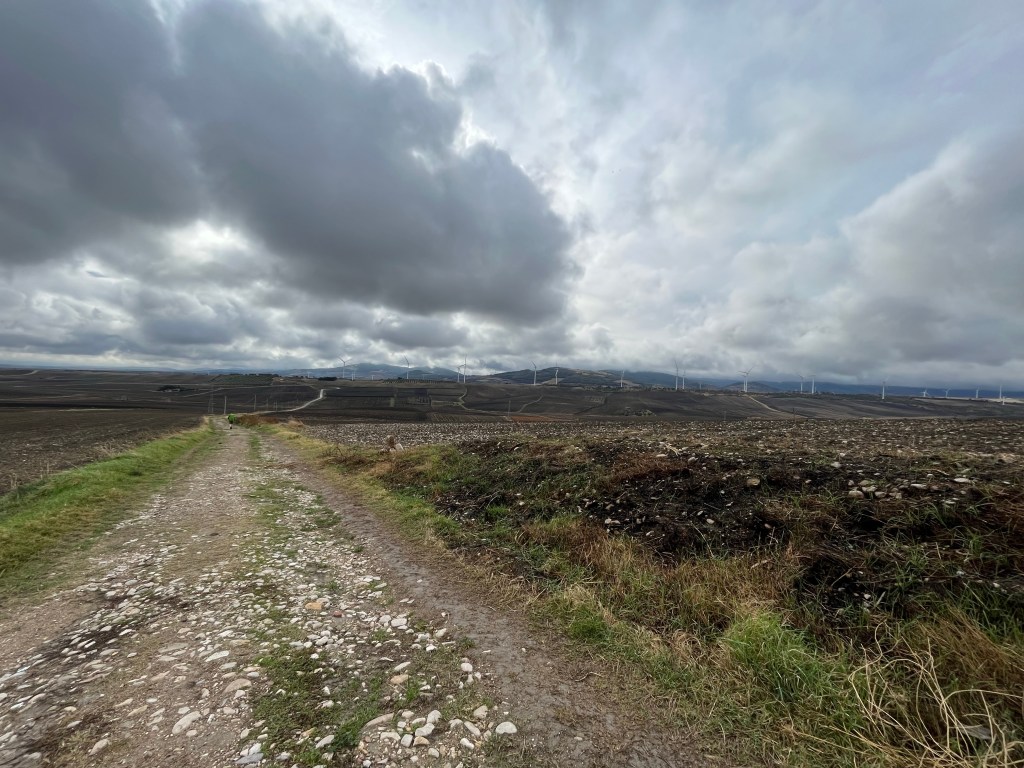
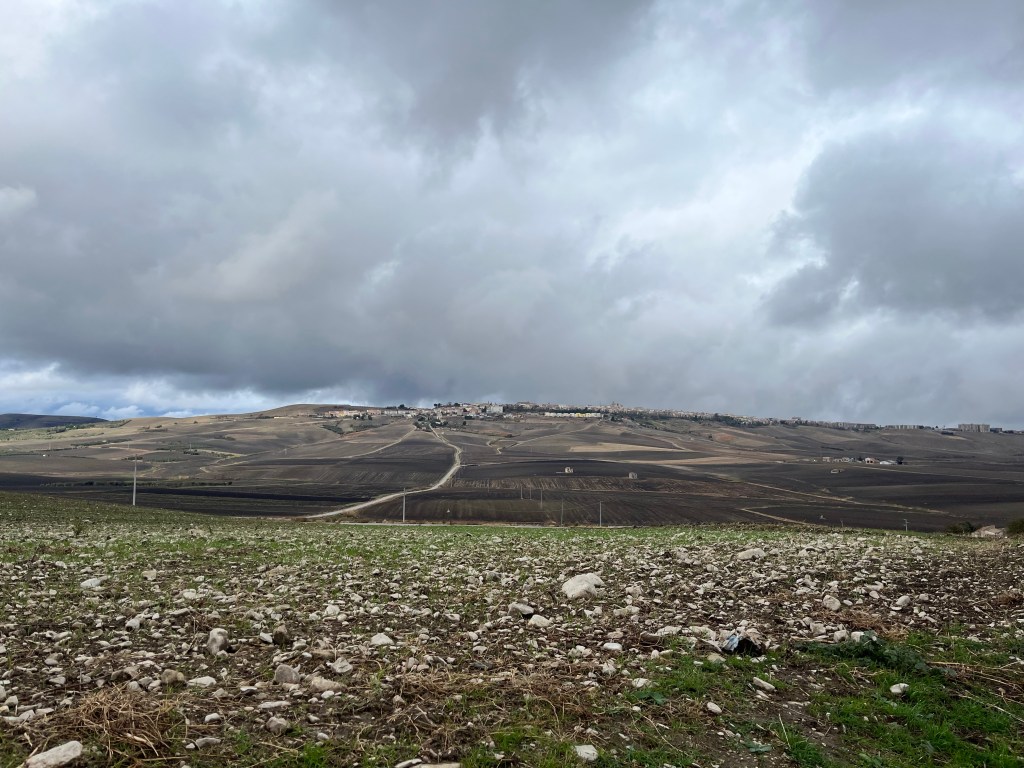
Although very different to the previous days we have managed to walk, we really appreciate the scenic nature of today’s route, with the green hills of the Apennines off to our right, the brown hills of the ploughed fields, to our left and ahead – the colours change throughout the walk as the sun pokes through at times and then disappears. And the sky adds its own drama to the day.
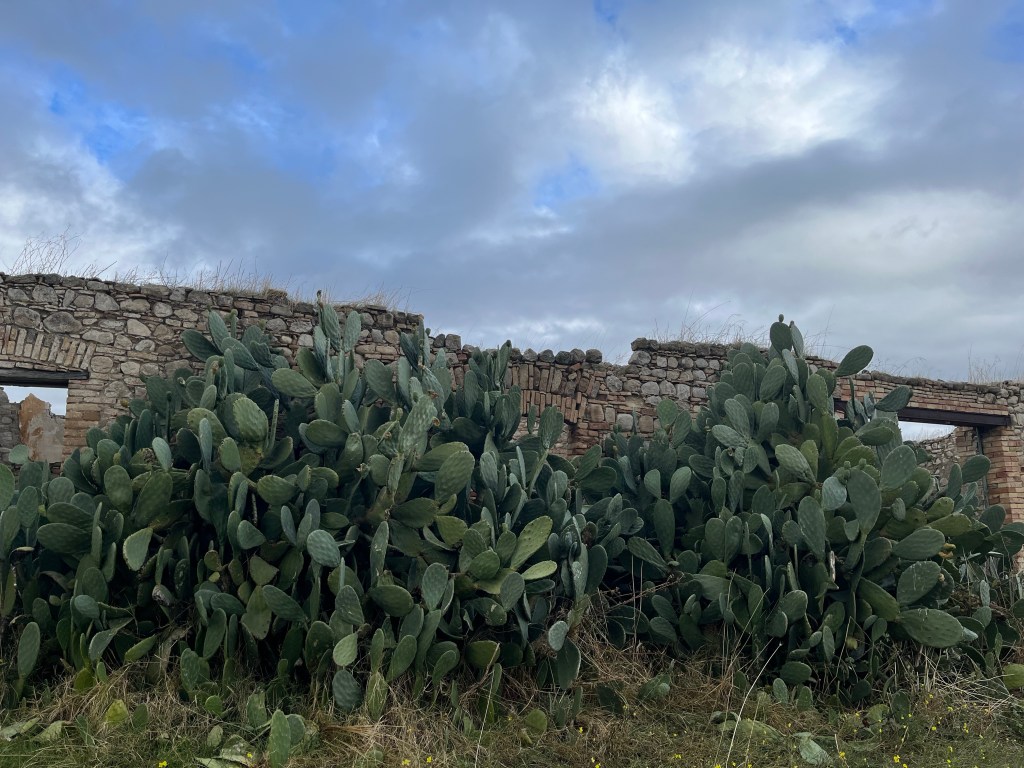
There are quite a few abandoned old farmhouses, some right by the pathway, a few fields of solar panels, and the wind turbines. We walk on some quiet roads, some agricultural.
We arrive at our destination for the night and settle in for lunch.
Stay and eat – Agriturismo Posta Guevara (in the guide).
When there isn’t any sightseeing to do, my evening activity to work on my Italian listening skills is watching some tv. I avoid the news, and many talk shows, focusing on some quiz shows (including Affari tuoi, the Italian equivalent of Deal or No Deal) and dubbed episodes of Little House on the Prairie (Mary has just gone blind) and Colombo (entertaining in any language).
A short day tomorrow, probably in some rain.
Stage 23, part 2 – Giardinetto to Castelluccio dei Sauri
13 deg; Wet, and windy.
Yesterday we could see the town up on the hill ahead of us. Today, everything is shrouded in cloud, though we can see just far enough to see the closest of the wind turbines on the move this morning.
We prep ourselves for a walk in the rain, but another look at the forecast has the rain increasing rather than abating.
I check with reception if the bus that goes from Foggia to Castelluccio dei Sauri passes by this hamlet – no, only by car. He offers to drive us.
11kms, in constant wind and rain, and probably mud versus a 15 minute car ride – I accept.
We spend the morning in the bar/restaurant playing cards, have lunch (delicious ragu is an appropriate choice for a day like today) then head to our accommodation for the day. He offers to come and pick us up, but it is a short walk across the small town and the rain has stopped for a little while.
No photos today.
It is amazing how much better a pack can feel when the weight is dropped just a bit as we actually wear some of the warmer clothing, plus the rain gear, and without filled water bottles.
Stay – B&B Panorama; warm and comfortable out of the howling wind and rain – recommended in the guidebook. And a stamp.



































































 Richo and DC